
Palace Picture House · Programme note
Mata Hari 1931
Garbo plays the most famous woman spy in history in a film that invents most of what it shows, and audiences paid handsomely to see it.
By HertzyPertzy · Updated · 6 minute read
In short
Mata Hari is a 1931 American drama from MGM, directed by George Fitzmaurice, with Greta Garbo as the exotic dancer shot as a German spy in 1917 and Ramon Novarro as the young Russian airman who falls in love with her. It is only loosely based on the real woman, whose guilt has long been doubted. It was Garbo's biggest money-maker, by one account, and its erotic dance and bedroom scenes were cut when it was reissued under the Hays Code. Works of 1931 are due to enter the US public domain on 1 January 2027, though this film's exact date is hedged below.
Watch the film
It is not played on this page: see where to watch it.
Find where to stream, rent or buy it, on JustWatch.
- Released
- 26 December 1931 in the United States, by most accounts; sources differ on the New York opening date
- Made by
- Metro-Goldwyn-Mayer. Directed by George Fitzmaurice; produced by Fitzmaurice and Irving Thalberg
- Written by
- Benjamin Glazer, Leo Birinsky, Doris Anderson and Gilbert Emery
- Cast
- Greta Garbo (Mata Hari), Ramon Novarro (Lieutenant Alexis Rosanoff), Lionel Barrymore (General Shubin), Lewis Stone (Andriani), C. Henry Gordon (Dubois)
- Crew
- Camera William Daniels; editor Frank Sullivan; costumes Adrian; uncredited music by William Axt
- Length
- 92 minutes uncut; the censored version on the 2005 DVD runs 89 minutes
- Format
- Sound, black and white, in English
- Copyright
- Due to enter the public domain in the United States on 1 January 2027, with the other works of 1931, if it counts as published in 1931; a catalogue record reported to give a January 1932 registration is why the date is hedged, and a 1932 publication would mean 2028. Restorations and recorded scores have rights of their own
The story
Paris, 1917. Dubois, the head of French intelligence, suspects that the dancer Mata Hari is passing secrets to the enemy. Lieutenant Alexis Rosanoff, a young Russian airman, arrives in the city with dispatches and falls hard for her. She is also the lover of his general, Serge Shubin, and she uses both men to get the papers copied.
Shubin finds out and Mata Hari kills him. Rosanoff crashes his aeroplane and is blinded. She goes back to him, and is arrested at his bedside. At her trial Dubois threatens to call Rosanoff as a witness, and she stops fighting. She is sentenced to death. The blind airman is told that she has gone into hospital for an operation, and the film ends as she is led out to the firing squad.
The real Mata Hari
She was born Margaretha Geertruida Zelle in Leeuwarden, in the Netherlands, in 1876. She married, went to Java, and came home with a failed marriage. In Paris she took the stage name Mata Hari, from a Malay phrase for the sun, and made her debut in March 1905. Her act was a slow disrobing, until she wore only a jewelled breastplate and ornaments. She became a celebrated dancer and courtesan.
She was arrested on 13 February 1917 and convicted that July of spying for Germany. Her counsel was refused the chance to cross-examine the prosecution's witnesses. Neither French nor British intelligence could produce definite evidence against her, and biographers have argued that she was a scapegoat for France's wartime failures. She was shot at the Château de Vincennes on 15 October 1917, aged 41, and by most accounts refused a blindfold. The French army declassified her sealed trial papers, 1,275 pages, in 2017.
The film takes the legend rather than the file. Its Russian airman, its jealous general and its murder have no place in the record. It is usually described as only loosely based on her life.
Making the film
MGM gave the picture to George Fitzmaurice, who produced it with Irving Thalberg. The script has four credited writers: Benjamin Glazer, Leo Birinsky, Doris Anderson and Gilbert Emery. William Daniels shot it, and Adrian designed the costumes, a bejewelled exoticism that pared down to plain clothes by the end. The story had been filmed before: a German silent Mata Hari appeared in 1927.
The cast was a good one. Ramon Novarro, then one of MGM's big draws, played the Russian. Lionel Barrymore played the general, in the year he won an Oscar for another film. Lewis Stone and C. Henry Gordon filled the other main parts. Critics enjoyed teasing the star's accent and the others' idea of Russian ones
It opened at the end of December 1931. Sources agree on 26 December as the release date, and differ on where the film first played. The budget was $558,000. It earned worldwide rentals of about $2.2 million, a profit of around $879,000, which one account makes it Garbo's most successful picture commercially. She was by then the most popular actress in the United States, according to a survey for 1930 and 1931.
The dance and the censors
The film comes from before the Hays Code was enforced, and shows it. Garbo opens with a quasi-Oriental dance before a statue of Shiva that ends in a discreet striptease. Variety called its dance a polite kind of hootchy-kootchy. Some of the dance is thought to have been done by a double. There are bedroom scenes, with the lovers in bed and talking, and the costumes show more than later films would dare.
British censors found a seduction scene set before an icon of the Virgin Mary too much, and in the British version the icon was replaced by a portrait of somebody's mother. When strict Code enforcement began in 1934, the reissue lost the best part of the dance, with a double used in long shots, and a bedroom scene with pillow talk. Another fade-out was moved earlier. Only a censored version is generally available, running 89 minutes on a DVD of 2005. Reports of an uncut print in Brussels have not been confirmed.
Reception
The New York Times found it handsomely staged and well directed, and praised the three leading players. Variety thought the story nothing sensational and gave the actors the credit for its effect. A modern reviewer ranks it as a good example of early 1930s film-making, melodramatic, with an unexpectedly expressionist climax, if not the equal of the year's Dracula.
Novarro was still one of Hollywood's top draws that year; MGM let his contract lapse in 1935, and he was murdered in 1968. Garbo made Susan Lenox later in 1931, and retired after Two-Faced Woman in 1941.
Why it matters
It fixed the picture of the woman spy. The seductive dancer who trades secrets for love, and pays for it, is largely a Hollywood invention that this film made familiar. The real case was a wartime trial that has troubled historians ever since.
It shows what pre-Code films were allowed. Within three years the dance and the pillow talk were cut. What survives is a version trimmed by the censors, which says something about how films of this period are seen today.
It is Garbo at the height of her power. By one account it made more money than any other film of hers, in a year when she ranked as the most popular actress in the country.
It is due to be free. Works of 1931 are due to enter the United States public domain on 1 January 2027. Whether this film goes then or a year later depends on whether it counts as published in 1931 or 1932.
On the same programme
Some of these films are rooms you can play
These notes come from Reel Trouble, a comedy platformer through film history. Every room in it is a movie set, built from scratch as a parody of a real film, and a fall is never a death: it is a retake.
-
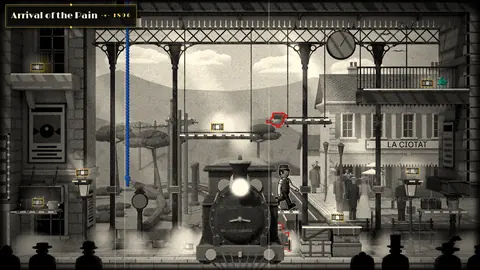 1896
Arrival of a Train at La Ciotat
Our room: Arrival of the Pain
-
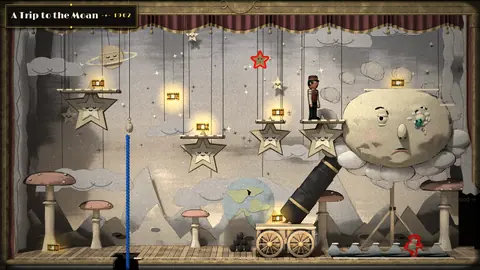 1902
A Trip to the Moon
Our room: A Trip to the Moan
-
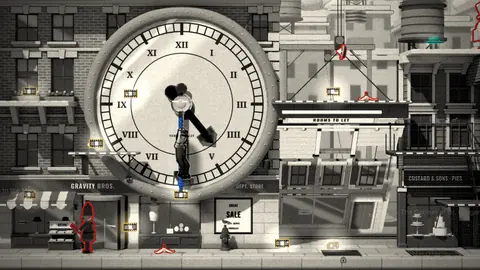 1923
Safety Last!
Our room: Safety Second
Free, in a desktop browser or as a download for Windows, Mac and Linux.
Quick answers
Is the 1931 Mata Hari a true story?
Only loosely. The real Mata Hari was a Dutch-born dancer shot by a French firing squad in 1917 for spying for Germany, but the film's Russian airman, its general and its plot are invented, and her guilt has long been doubted.
Who starred in Mata Hari (1931)?
Greta Garbo played the title role, with Ramon Novarro as Lieutenant Alexis Rosanoff, Lionel Barrymore as General Shubin, Lewis Stone as Andriani and C. Henry Gordon as the intelligence chief Dubois.
Was Mata Hari a real spy?
Nobody has proved it. She was convicted in 1917, but biographers argue she was a scapegoat, her defence counsel was refused cross-examination, and neither French nor British intelligence could produce definite evidence against her.
How did Mata Hari die in real life?
She was shot by a firing squad at the Château de Vincennes, near Paris, on 15 October 1917, aged 41. She is reported to have refused a blindfold.
Was Mata Hari (1931) censored?
Yes, later. After strict enforcement of the Hays Code began in 1934, the reissue was cut: the dance before the Shiva statue was shortened and a bedroom scene removed. Only a censored version is generally available. British censors also objected to one seduction scene before an icon.
Was Mata Hari a hit?
Yes. Its worldwide rentals were about $2.2 million against a budget of $558,000, and one account calls it Garbo's most profitable film.
Is Mata Hari (1931) in the public domain?
Works of 1931 are due to enter the US public domain on 1 January 2027. Because a registration in January 1932 is reported for this film, check whether it counts as published in 1931; if not, it would wait until 2028. Modern restorations and scores have their own rights.
Were there other Mata Hari films?
Many. A German silent film of 1927, directed by Friedrich Feher, was one of the earlier ones, and a 1985 film followed with Sylvia Kristel.
Sources and further reading
- Mata Hari (1931 film), Wikipedia: credits, plot, budget, box office, censorship and reception
- Mata Hari, Wikipedia: the real woman, her arrest, trial, execution and the 2017 release of her files
- Mata Hari, Turner Classic Movies, article: the dance, the costumes, British censorship, reception
- Review: Mata Hari (1931), Fiction Machine, 2022: the re-release cuts, Garbo's acting, the real case
- Ramon Novarro, Wikipedia: his standing at MGM in 1931 and his death
- Greta Garbo, Wikipedia: her popularity in 1930 and 1931, and her career
- Mata Hari (1927 film), Wikipedia: the earlier German film
- 2027 in public domain, Wikipedia: the works of 1931 due to enter the US public domain