
Palace Picture House · Programme note
Night Nurse 1931
Barbara Stanwyck and Joan Blondell nurse two starving children in a fast, rough Warner Bros. thriller, and Clark Gable plays the villain.
By HertzyPertzy · Updated · 6 minute read
In short
Night Nurse is an American film of 1931, directed by William A. Wellman for Warner Bros. Barbara Stanwyck plays Lora Hart, a young nurse who works out that two sick girls in her care are being starved for their trust fund, with Joan Blondell as her wisecracking friend and Clark Gable as the chauffeur behind it. It is based on a novel by Dora Macy, a pen name of Grace Perkins. A fast, frank, violent picture, it is now remembered as a pre-Code melodrama and as the first of five films Stanwyck made with Wellman.
Watch the film
It is not played on this page: see where to watch it.
Find where to stream, rent or buy it, on JustWatch.
- Original title
- Night Nurse
- Released
- 8 August 1931 in the United States, by the usual listing
- Made by
- Warner Bros. Pictures. Director William A. Wellman; screenplay Oliver H. P. Garrett, with additional dialogue by Charles Kenyon; photography Barney McGill; music Leo F. Forbstein
- Cast
- Barbara Stanwyck (Lora Hart), Joan Blondell (Maloney), Ben Lyon (Mortie), Clark Gable (Nick), Charles Winninger (Dr. Bell), Ralf Harolde (Dr. Ranger)
- Based on
- The novel Night Nurse (1930) by Dora Macy, a pen name of Grace Perkins
- Length
- About 72 minutes by the usual listing; a 35 mm print screened by the UCLA Film & Television Archive is given as 69 minutes
- Format
- Sound, 35 mm, black and white, English
- Copyright
- Due to enter the public domain in the United States on 1 January 2027, with the other films of 1931. The novel is a separate work, and a restoration or later release has rights of its own
The story
Lora Hart wants to be a nurse and has no high-school diploma, which the hospital's superintendent counts against her. A kindly surgeon, Dr. Bell, vouches for her, and she is taken on as a trainee. She meets Maloney, another nurse, who shows her the trade: the long hours, the slang and the doctors' hands. One night a bootlegger named Mortie arrives with a gunshot wound. Lora treats him and does not report it, which makes him a friend for later.
Her first private case is the night shift in a wealthy household, where two small girls are sick. Their mother is a drinker, and the doctor in charge, Dr. Ranger, is a shifty fellow who fails to cure them. Lora notices that the children are getting thinner, not better. The chauffeur, Nick, is the mother's companion and does as he pleases in the house. Lora suspects, rightly, that the two men are starving the girls so that the trust fund they stand to inherit will fall into the mother's, and so Nick's, hands.
When she tries to call a doctor in the middle of an emergency, Nick knocks her down. By then the film has stopped being a hospital drama. It becomes a race to save a child, and it ends with the law playing no part: an ambulance delivers a body dressed as a chauffeur to the morgue.
Who made it
The film was made at Warner Bros., which in the early 1930s turned out stories of gangsters, tired reporters and women with jobs at a speed that is hard to credit now. Dixon, writing in Senses of Cinema, describes the studio as a factory sending out roughly a film a week to Depression audiences. William A. Wellman, who had directed Wings, was a natural hand for it: by Dixon's account a tough, quick director who seldom needed more than a take or two.
The source is a novel of 1930 by Dora Macy, a pen name of Grace Perkins, an American actress, writer and later magazine editor. The screenplay is credited to Oliver H. P. Garrett, with additional dialogue by Charles Kenyon. The photography is by Barney McGill and the music by Leo F. Forbstein. It runs about 72 minutes by the usual listing. The 35 mm print the UCLA Film & Television Archive screened in 2015 is given as 69, a reminder that old prints and old listings do not always agree.
Two nurses and a chauffeur
Barbara Stanwyck's Lora is quick, working class and handy with her fists. Turner Classic Movies' Jeff Stafford calls her a working-class nurse who uses her brains and fists, and the UCLA archive's notes call her tough and funny. Night Nurse was the first of five films she made with Wellman.
Joan Blondell, as Maloney, trades wisecracks with her. The script shows both women in various stages of undress, and the double meanings are not subtle. Dixon adds that the film treats the sexual harassment of working women as routine.
Clark Gable plays Nick, in an early role and without the moustache he later made his own. The part, by more than one account, was first meant for James Cagney, who after The Public Enemy could not take a supporting heavy. Stafford reports that Wellman thought Nick among the most despicable villains imaginable, and that Warner executives judged Gable not star material, partly because of his ears. MGM signed him the same year, and by the end of 1931 he was a leading man.
The violence is the hard part to watch. Nick knocks Lora to the floor, and Dixon counts two such blows. Stafford reads one scene as the start of an assault that the film does not show. Wellman did not make light of it, and it is not a scene for jokes.
A pre-Code picture
The Production Code was only enforced in 1934, and Night Nurse is a textbook case of what had been possible before. It was thought risqué on release chiefly for the lingerie scenes. Beyond that, it deals with bootlegging, drugs, drink and the neglect of children, and it ends by suggesting that the police and the courts could not deal with a man like Nick. Stafford says elements of this kind helped bring tighter censorship, and one critic has said that this film and The Public Enemy were often cited in the making of the Code: a view, not a settled fact.
The reviews were mixed. Time is reported to have liked it, finding the film better than the novel, the New York Times thought it exciting at times, and Variety found it exaggerated, a little like a serial, while praising Blondell and Winninger. Stafford calls it an overlooked minor feature, more engrossing than some more famous pictures by the same people.
Where it stands in law
Films released in 1931 are due to enter the public domain in the United States on 1 January 2027, 95 years after publication. Nothing found shows whether Warner Bros. renewed its copyright, which for films of this period decided whether protection lasted, so the plain statement is that the date applies to it with the other works of 1931. The novel and any modern restoration or score are separate works with their own terms. Trade marks, and the use of an actor's likeness, are separate again.
Why it matters
It shows the studio at work. Warner Bros. in 1931 sold toughness and speed, and Night Nurse does not stop to apologise.
It started a partnership. It was the first of five films Stanwyck and Wellman made together, and Stanwyck's wisecracking, hard-working heroine became one of the period's stock figures.
It shows Gable before stardom. A man who would soon play the romantic lead for MGM is here a brutish chauffeur, and by Wellman's reported verdict a very good one.
It tells us what the Code was for. The film shows what the people who wanted stricter rules objected to: villains who kill for money and a story in which the law is absent.
On the same programme
Some of these films are rooms you can play
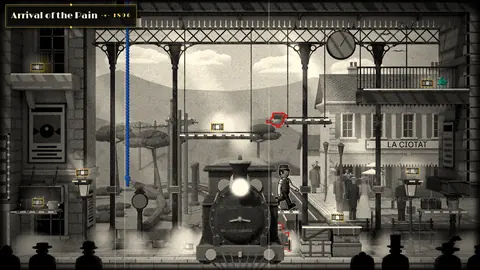
These notes come from Reel Trouble, a comedy platformer through film history. Every room in it is a movie set, built from scratch as a parody of a real film, and a fall is never a death: it is a retake.
-
 1896
Arrival of a Train at La Ciotat
Our room: Arrival of the Pain
-
 1902
A Trip to the Moon
Our room: A Trip to the Moan
-
 1923
Safety Last!
Our room: Safety Second
Free, in a desktop browser or as a download for Windows, Mac and Linux.
Quick answers
What is Night Nurse (1931) about?
A young woman, Lora Hart, trains as a nurse and is sent to look after two sick girls in a rich, drink-sodden household. She comes to suspect that the family's doctor and chauffeur are starving the girls to get at their trust fund, and sets out to stop them.
Who is in Night Nurse (1931)?
Barbara Stanwyck plays Lora Hart and Joan Blondell her friend Maloney. Ben Lyon is the bootlegger Mortie, Clark Gable the chauffeur Nick, Charles Winninger the surgeon Dr. Bell and Ralf Harolde the shady Dr. Ranger.
Is Night Nurse a pre-Code film?
Yes. It was made before the Production Code was enforced in 1934. Its nurses are shown undressing, its villains are willing to kill children for money, and its ending suggests that police and courts cannot be relied on.
Was Clark Gable the villain in Night Nurse?
Yes, he plays Nick, the chauffeur behind the plot, in an early role. He hits the heroine in the film, and one account has James Cagney considered for the part first. Gable was signed by MGM in the same year.
Is Night Nurse based on a book?
Yes, on a novel of 1930 called Night Nurse, credited to Dora Macy. Dora Macy is a pen name of Grace Perkins, who also wrote for the screen.
Who directed Night Nurse?
William A. Wellman, the director of Wings (1927) and The Public Enemy (1931). It was the first of five films he made with Barbara Stanwyck.
Is Night Nurse (1931) in the public domain?
Films released in 1931 are due to enter the public domain in the United States on 1 January 2027. Modern releases and the novel have separate rights.
Sources and further reading
- Night Nurse (1931 film), Wikipedia: credits, plot, casting, reception, the Library of Congress print and the Production Code remark
- Night Nurse, Jeff Stafford, Turner Classic Movies, 2004: Stanwyck, Blondell, Gable and Wellman
- Night Nurse, Wheeler Winston Dixon, Senses of Cinema, 2016: Wellman, Warner Bros., class and medicine
- The Public Enemy / Night Nurse, UCLA Film & Television Archive, screening notes, 2015: the 35 mm print
- Grace Perkins, Wikipedia: the author behind the name Dora Macy
- 2027 in public domain, Wikipedia: films of 1931 entering the public domain in the United States
- List of films in the public domain in the United States, Wikipedia: why renewal decides many films of 1931