
Palace Picture House · Programme note
The Toll of the Sea 1922
Usually called the first Technicolor film on general release, it put colour in the print, gave Anna May Wong her first lead at 17, and lost its own ending.
By HertzyPertzy · Updated · 7 minute read
In short
The Toll of the Sea is an American silent drama of 1922, directed by Chester M. Franklin for the Technicolor Motion Picture Corporation and released by Metro, with a script by Frances Marion that moves Madame Butterfly to China. It is usually described as the first Technicolor film on general release: its two colours were in the print itself, so any cinema's projector could show it. It gave Anna May Wong, then 17, her first lead, in a part that shows both what she could do and how Hollywood saw her. Its last minutes are lost, and the UCLA restoration of 1985 ends on a shot made with an original two-colour camera.
Watch the film
It is not played on this page: see where to watch it.
Watch the 1985 restoration free, at the National Film Preservation Foundation.
- Premiere
- 26 November 1922, Rialto Theatre, New York. General release 22 January 1923
- Made by
- Technicolor Motion Picture Corporation, released by Metro Pictures. Directed by Chester M. Franklin; written by Frances Marion; photographed by J. A. Ball; edited by Hal C. Kern; produced by Herbert T. Kalmus, with Joseph M. Schenck supervising by Kalmus's account
- Cast
- Anna May Wong (Lotus Flower), Kenneth Harlan (Allen Carver), Beatrice Bentley (Barbara "Elsie" Carver), Baby Moran (Little Allen), Etta Lee and Ming Young (gossips)
- Story
- Frances Marion's scenario, "practically the step-daughter of Madame Butterfly" by her own account, with the setting moved from Japan to China
- Filmed
- Santa Monica and Hollywood, California, almost entirely outdoors in sunlight
- Length
- Five reels, 4,600 feet (some sources say six reels). The transfer of the 1985 restoration runs 54 minutes at 19 frames a second, without the original ending
- Format
- 35 mm, silent, 1.33:1, two-colour Technicolor (Process 2), with a compilation score by Ernst Luz published in 1923
- Copyright
- Listed as public domain in the United States, its home country; registered 5 December 1922 (LP18473). The camera negative is on deposit at UCLA, and the rights in digital copies of the restoration are unclear
The story
Lotus Flower (Anna May Wong), a young Chinese woman, pulls an American, Allen Carver (Kenneth Harlan), out of the sea. They marry "Chinese fashion", and he promises to take her home with him. He leaves without her, and she has his son.
Years later he comes back with an American wife, Elsie (Beatrice Bentley). Lotus Flower gives up the boy so that he can grow up in America. In the last minutes, which no longer exist, she kills herself.
It is Madame Butterfly moved from Japan to China. Frances Marion, among the best-paid writers in Hollywood, had to write a story that showed off the colour process, and claimed no great originality: "I must admit that it was practically the step-daughter of Madame Butterfly." Ernst Luz's compilation score, which survives at the Library of Congress, warned musicians off Puccini unless they had permission.
Colour in the print
Technicolor's first feature, The Gulf Between (1917), was additive: its two colour records were recombined during projection, on a special projector that needed a technician's near-constant attention. That doomed it.
The second process put the colour in the film. In the camera a beam-splitting prism divided the light, and the green and red records fell on alternate frames of a double-length black-and-white negative, run at double speed. For each release print, two thin strips of film were made from those records, dyed red-orange and blue-green, and cemented back to back. Because the colour was physically there, no special equipment was needed: the print would run on "standard projectors".
The double speed demanded far more light, so nearly everything was shot outdoors, in Santa Monica and Hollywood, on a Chinese garden set. There was no blue scale, a loss not made good until the three-colour system.
The prints were dear: about 27 cents a foot, by the account of Technicolor's Herbert Kalmus, or $1,245 each, says Jan-Christopher Horak of UCLA, more than eight times the cost of black and white. Kalmus recalled a gross of more than $250,000, of which his company received about $160,000. Horak calls the film a commercial success that still lost money.
Anna May Wong
Wong was born Wong Liu Tsong in Los Angeles on 3 January 1905. She was 17 when The Toll of the Sea opened in New York, and 18 by its general release. It was her first lead. Motion Picture News noted that the heroine was played "by a real Chinese girl", worth noting because lead Asian roles usually went to white actors. The New York Times was won over:
She has a difficult role, a role that is botched nine times out of ten, but hers is the tenth performance.
The New York Times, November 1922
The part itself was a familiar one. The historian Shirley Jennifer Lim reads the film as a reworking of an imperial, Orientalist story. The title cards have Wong, a native Californian, speak ungrammatical pidgin English, and her clothes place her outside the modern world. Luz's score is dominated by what was then called a "Japanese-Chinese" style, with pieces titled "By the Japanese Sea" and "Japanese Legende" for a story set in China.
The colour draws the same line. Hunter Dukes points to Lotus Flower's vivid green silk against the Americans' muted tones. Sarah Street and Joshua Yumibe argue that Technicolor made the East look extraordinary and America unremarkable, and find contradictions in the ending that expose how unstable the film's Orientalism is.
Then there is the ending, in which the American keeps his American wife and takes the child, and the Chinese mother dies. Lim notes that Wong's characters often died so that a film could avoid an interracial romance. Substantial roles for Chinese Americans were scarce, and she was often passed over for white actors in yellowface. It is generally said that anti-miscegenation laws kept her from an on-screen kiss with a man of another race, and that this helped keep her from leading-lady parts. She left Hollywood for Europe in 1928. "I was so tired of the parts I had to play," she told Film Weekly in 1933. In 1935 MGM cast Luise Rainer in yellowface as O-Lan in The Good Earth, the lead Wong had hoped to play. Rainer won the Oscar.
The missing ending
For many years the film was thought lost. What survived was better than a print: the camera negative, which Technicolor deposited at the UCLA Film and Television Archive. Most silent films survive only through copies of projection prints. Richard Dayton and Pete Comandini of YCM Laboratories and Robert Gitt of UCLA restored it late in 1985.
The negative has no ending. Accounts of the loss differ: the final minutes, according to the National Film Preservation Foundation; the final sequence, according to the Berlin festival; the final two reels, in some listings. Titles re-created from Marion's synopsis now say what happens, and the restorers shot a sunset on a California beach with an original two-colour Technicolor camera. The last image is in the true process, made sixty-three years after the rest.
What happened to colour next
The prints kept making trouble. Exhibitors complained that the sandwich buckled and went out of focus: "the cupping could occur in either direction, more or less at random," Kalmus recalled, and prints went back to Boston to be flattened. Douglas Fairbanks's The Black Pirate (1926) was, he said, "a triumph from the start, but for the Technicolor company it was a terrible headache".
In 1928 a third process replaced cemented prints with dye imbibition. Sound brought the boom: in 1929 Warner Bros. signed for twenty all-colour features, then audiences tired of colour musicals and the studios cancelled. What ended the two-colour era was a camera that exposed three strips at once, finished in 1932. Disney's Flowers and Trees (1932) came first, and Becky Sharp (1935) was the first feature photographed entirely in it. Blue had arrived.
Why it matters
It made colour something any cinema could show. It was not the first colour feature. Lim calls it the first feature-length general release in two-colour Technicolor; the National Film Preservation Foundation, the earliest surviving feature in the process.
It began a career Hollywood kept in the margins. Wong went on to The Thief of Bagdad (1924) and Shanghai Express (1932), and made My China Film (1936) herself. In 2022 she became the first Asian American on American coinage.
It is a rare witness to early colour. Two-colour Technicolor prints fade to orange with time. This one was rebuilt from the camera negative, in the Foundation's words "one of the great technical achievements of film preservation".
On the same programme
Some of these films are rooms you can play
These notes come from Reel Trouble, a comedy platformer through film history. Every room in it is a movie set, built from scratch as a parody of a real film, and a fall is never a death: it is a retake.
-
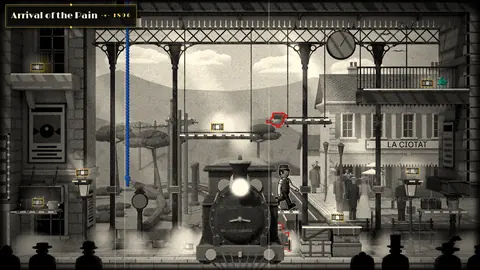 1896
Arrival of a Train at La Ciotat
Our room: Arrival of the Pain
-
 1902
A Trip to the Moon
Our room: A Trip to the Moan
-
 1923
Safety Last!
Our room: Safety Second
Free, in a desktop browser or as a download for Windows, Mac and Linux.
Quick answers
Was The Toll of the Sea the first colour film?
No. Colour features came earlier, among them the British Kinemacolor film The World, the Flesh and the Devil (1914) and Technicolor's own The Gulf Between (1917), both lost. The Toll of the Sea is usually described as the first Technicolor film on general release, and the National Film Preservation Foundation calls it the earliest surviving feature in two-colour Technicolor.
What is The Toll of the Sea about?
A young Chinese woman, Lotus Flower, saves an American from the sea, marries him "Chinese fashion" and has his son after he leaves without her. He returns with an American wife, she gives up the boy so that he can grow up in America, and she kills herself.
How old was Anna May Wong in The Toll of the Sea?
She was 17. Born on 3 January 1905, she was 17 at the New York opening on 26 November 1922 and turned 18 weeks before the general release of 22 January 1923.
Why could The Toll of the Sea play on any projector?
Because its colour was in the print. Two thin strips of film, dyed and cemented back to back, ran through a projector like ordinary film, whereas Technicolor's first process had needed a special projector and constant adjustment.
Is The Toll of the Sea based on Madame Butterfly?
In all but name. The plot follows Madame Butterfly with the setting moved from Japan to China, and Frances Marion admitted that her story was "practically the step-daughter of Madame Butterfly".
How does The Toll of the Sea end?
Lotus Flower gives up her son and kills herself, but those last minutes no longer survive. The restoration tells them in titles re-created from Frances Marion's synopsis and closes on a shot of the sea filmed in 1985 with an original two-colour camera.
Who restored The Toll of the Sea?
The UCLA Film and Television Archive, in 1985, from the camera negative that Technicolor had deposited there. The work was done by Richard Dayton and Pete Comandini of YCM Laboratories and Robert Gitt of UCLA.
Is The Toll of the Sea in the public domain?
The 1922 film is listed as public domain in the United States, its home country. Digital copies of the 1985 restoration can be another matter: the Public Domain Review marks the rights in the copy it shows as unclear, and the National Film Preservation Foundation shows the restoration free on its own site.
Sources and further reading
- The Toll of the Sea (1922), Scott Simmon and Martin Marks, National Film Preservation Foundation, film and music notes
- Technicolor Adventures in Cinemaland, Herbert T. Kalmus, Journal of the Society of Motion Picture Engineers, December 1938, reprinted by the American WideScreen Museum
- Technicolor No. II, Barbara Flueckiger, Timeline of Historical Film Colors
- Technicolor: 1915-1935, George Eastman Museum
- The Dawn of Technicolor, 1915-1935, Jan-Christopher Horak, UCLA Film and Television Archive, 2015
- Archival Treasures: Anna May Wong in Hollywood and China, Shirley Jennifer Lim, UCLA Film and Television Archive, 2020
- The Toll of the Sea, Berlin International Film Festival, Retrospective programme, 2015
- Chromatic Aberrations: The Toll of the Sea (1922), Hunter Dukes, The Public Domain Review, 2024
- The Toll of the Sea (1922), Silent Era, Progressive Silent Film List: length, dates and copyright registration
- The Toll of the Sea, Wikipedia, with its articles on Technicolor, on early colour feature films and on Anna May Wong, for the plot and the points given here as reported