
Palace Picture House · Programme note
Napoléon 1927
Abel Gance planned six films on Napoleon, made one, cut it to pieces for the world, and then watched others spend decades putting it back.
By HertzyPertzy · Updated · 6 minute read
In short
Napoléon (on screen Napoléon vu par Abel Gance) is a French silent epic of 1927, written, directed and produced by Abel Gance, with Albert Dieudonné as Bonaparte. It was meant to be the first of six films; it ends as the young general's army marches into Italy. Gance flung the camera about, cut at furious speed, and closed with a triptych of three screens. The film was premiered at the Paris Opéra, then cut down for the world, and has been reassembled in many versions since, none of them final.
Watch the film
It is not played on this page: see where to watch it.
Find where to stream, rent or buy it, on JustWatch.
- Original title
- Napoléon vu par Abel Gance ("Napoleon as seen by Abel Gance")
- Released
- Gala premiere at the Paris Opéra on 7 April 1927; a much longer version, shown to professionals and the press, followed about a month later
- Made by
- Abel Gance, who wrote, directed and produced. A German company, Westi, later bought a share of the planned series
- Cast
- Albert Dieudonné (Napoleon), Gina Manès (Joséphine), Antonin Artaud (Marat), Edmond Van Daële (Robespierre), Alexandre Koubitzky (Danton), Annabella (Violine), Gance himself as Saint-Just
- Filmed
- From 1925, in France and on Corsica; the snowball fight was shot at Briançon in February 1925
- Length
- Sources differ for each version: the Opéra cut ran about three and a half to four hours; the Apollo cut about nine hours forty minutes; restorations run from under four hours to about seven
- Format
- Silent, 35 mm, 1.33:1; black and white with tints. The finale is projected as a triptych, three frames side by side, about 4:1
- Copyright
- In the public domain in the United States, as a 1927 work. In France and the EU it stays protected for decades, since Gance died in 1981. Restorations and scores have rights of their own
Six films, one made
Abel Gance was already famous in France when, in the early 1920s, he set out to film the life of Napoleon Bonaparte. His plan, drawn up in 1923, was for six films. Sources differ on the size of each: the British Film Institute's account gives about 75 minutes of screen time, another says about ninety. A German company, Westi, later bought a share of the series, and six films were contracted for completion by March 1926.
Gance made one. By most accounts the money ran out, and the full project came to look impossible. The film that exists, Napoléon vu par Abel Gance, begins with Napoleon at school at Brienne in 1783. It takes in the Revolution, the siege of Toulon, his marriage to Joséphine in 1796 and the opening of the Italian campaign, and stops there with the army on the march. Saint Helena was never filmed.
The cast
Albert Dieudonné plays Bonaparte, from a bullied schoolboy to the general of the Army of Italy. Gina Manès is Joséphine. The Revolution is crowded with famous faces: Antonin Artaud as Marat, Edmond Van Daële as Robespierre, Alexandre Koubitzky as Danton. Gance cast himself as Saint-Just. Annabella, later a star, plays Violine, a girl of the story's own invention.
The shoot ran from 1925 and was hard. Gance was reported to have been badly burned in a magnesium explosion and to have suffered a detached retina, and one account has the lead actor nearly drowning. The surviving history is more reliable on the film than on its anecdotes, so treat the colourful ones with care.
The inventions
Gance wanted the audience inside the story, and so the camera moves. Cameras were strapped to operators' chests so that they could run with the action; the cameraman Jules Kruger is named as wearing one for the snowball fight. Others were put on tricycles, rails, sleds, swings and pendulums. In February 1925, after a telegram announced that snow had fallen, the unit went to Briançon for the school snowball fight, where cameras on sleds swooped through the battle.
The storm is the best known sequence. Napoleon's small boat, tossed about at sea, is cut against the Convention in uproar, and a camera on a swing carried the viewer from one storm to the other. Gance cut faster and faster as it built, with close-ups, superimpositions, split screens and, as the BFI describes it, a gyroscopic tripod head for the storm. Some shots are said to carry many exposures layered in the camera itself, not in a laboratory.
The finale goes further. For Napoleon's arrival in Italy, Gance used three cameras and three projectors. The triptych has a combined ratio of about 4:1, three ordinary frames side by side. The side panels sometimes widen the central picture into a panorama and sometimes show something quite different, and the finale tints the three screens to make the French tricolour. Gance called the process Polyvision, and it was used for the end of the film alone. By one account the same idea turned up again some 25 years later as Cinerama.
The premiere, and the many versions
The gala premiere was at the Paris Opéra on 7 April 1927, with the triptychs. Sources differ about its length: the CNC gives three hours twenty-seven minutes, other accounts say nearer four hours. The film was hailed in France as a triumph. About a month later a far longer cut, around nine hours forty minutes, was shown at the Apollo cinema to professionals and the press, without the triptychs. Gance later trimmed it to a little over seven hours and put the triptychs back, and it was this cut that was sold to Metro-Goldwyn-Mayer.
It did not travel well. Britain saw a version of 1928 cut to a fraction, with the triptych shown on a narrow sheet lowered in front of the screen. The American release of 1929 ran under two hours, with no three-screen ending, just as audiences were turning to sound films. Gance himself made a shorter sound version in 1934. By one count the film exists in 22 different versions, which is one way of saying that none of them is the film.
Putting it back together
The restorer who made the film famous again was Kevin Brownlow. By his own account he first met it as a boy, in a short home-cinema abridgement. He began reconstructing it in 1969, working with and sometimes without the Cinémathèque française and the BFI. His version of nearly five hours was shown at the Telluride festival in August 1979, in the cold, without music, with Gance, then 89, watching from his hotel window. Carl Davis wrote a score for a London presentation of 1980, and Francis Ford Coppola brought an edited version, with a score by his father Carmine Coppola, to Radio City Music Hall in January 1981. Gance died later that year.
Brownlow went on. His version of 2000 ran about five and a half hours, with better sources, remade titles and the original colour tinting, and the BFI issued it on disc in 2016. Meanwhile the Cinémathèque française had commissioned Georges Mourier in 2007 to rebuild the Grande Version from nearly a thousand boxes of film in several archives. The CNC says what was expected to take six months took sixteen years. The result, about seven hours, was played in two parts at the Seine Musicale near Paris on 4 and 5 July 2024, with a new score arranged from existing music and conducted by Frank Strobel. There was no surviving original score to use.
The scores
The film has no single score. Arthur Honegger wrote the music for the French release of 1927, and a German composer wrote another for Germany. Carl Davis and Carmine Coppola each wrote a new one around 1980, so a viewer in Britain and a viewer in America saw what was in effect two different performances. The 2024 restoration has yet another. They are separate works, and each has rights of its own.
Why it matters
It put the camera in motion. Hand-held shots, point-of-view shots and strapped-on cameras were rare in 1927. Gance's work is credited with influencing the French New Wave after its revival in the 1950s.
It thought of the wide screen. The three-panel finale anticipated widescreen formats by decades, though nobody could afford to show it.
It shows how films are lost. A work cut into many versions, with its negatives dispersed, is rebuilt over a lifetime. Seven April 2027 is its centenary, and a hundred years on there is still no definitive Napoléon.
On the same programme
Some of these films are rooms you can play
These notes come from Reel Trouble, a comedy platformer through film history. Every room in it is a movie set, built from scratch as a parody of a real film, and a fall is never a death: it is a retake.
-
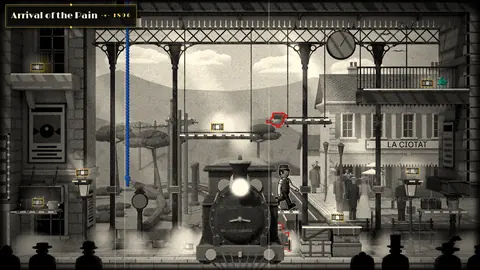 1896
Arrival of a Train at La Ciotat
Our room: Arrival of the Pain
-
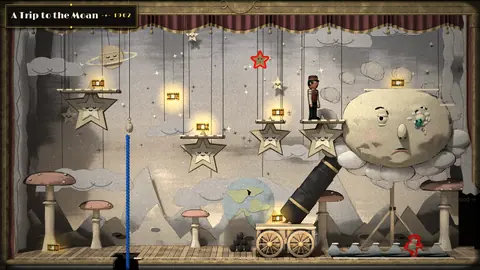 1902
A Trip to the Moon
Our room: A Trip to the Moan
-
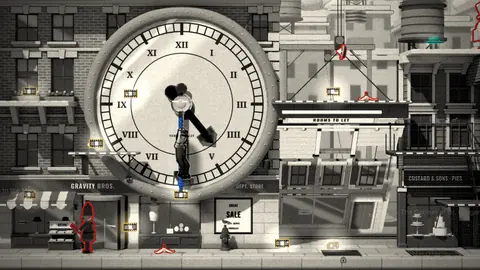 1923
Safety Last!
Our room: Safety Second
Free, in a desktop browser or as a download for Windows, Mac and Linux.
Quick answers
How long is Napoléon (1927)?
It depends on the version. The Opéra premiere cut ran about three and a half to four hours by most accounts, the Apollo cut about nine hours forty minutes, and the Cinémathèque française restoration of 2024 about seven hours.
Why is Abel Gance's Napoléon so famous?
For its technique. Gance used hand-held and strapped-on cameras, very fast cutting, multiple exposures and, in the finale, three screens side by side. Later filmmakers, including the French New Wave, looked back to it.
What is Polyvision?
Gance's name for projecting three synchronised films side by side. In the finale of Napoléon the three screens sometimes show one wide panorama and sometimes three different images.
Why does Napoléon stop at the Italian campaign?
Gance planned six films covering the whole of Napoleon's life, but money ran out after the first. The surviving film runs from his schooldays at Brienne to the army's advance into Italy.
Who restored Napoléon?
Many people. Kevin Brownlow began reconstructing it in 1969 and showed a version at Telluride in 1979. The Cinémathèque française, led by Georges Mourier, premiered a seven-hour restoration in July 2024.
Who wrote the music for Napoléon?
Arthur Honegger wrote the score for the French release of 1927. Later versions have their own scores: Carl Davis for Brownlow's reconstruction in Britain, Carmine Coppola for the 1981 American run, and others since.
Is Napoléon (1927) in the public domain?
As a 1927 work it entered the public domain in the United States in 2023, according to the general rule Duke's Center for the Study of the Public Domain describes. In France and the EU it remains protected, as Gance died in 1981. Restorations and new scores can have rights of their own.
Who played Napoleon in Gance's film?
Albert Dieudonné played Napoleon. Gina Manès played Joséphine, Antonin Artaud played Marat, and Gance cast himself as Saint-Just.
Sources and further reading
- Napoléon (1927 film), Wikipedia: cast, versions, scores, the points given here as reported
- A monumental reckoning: how Abel Gance's Napoleon was restored to full glory, Sight and Sound, British Film Institute
- Restauration du « Napoléon » d'Abel Gance, l'histoire d'une longue renaissance, Centre national du cinéma (CNC)
- Le Napoléon d'Abel Gance retrouve sa forme originelle, Centre national du cinéma (CNC), 2021
- Napoleon (1927), Turner Classic Movies
- Gance's Napoleon revolutionizes filmmaking techniques, EBSCO Research Starters
- Public Domain Day 2023, Duke Center for the Study of the Public Domain