
Palace Picture House · Programme note
Battleship Potemkin 1925
Eisenstein's silent film of a mutiny made its sailors a legend, its steps the most copied sequence in cinema, and its censors a good deal of work.
By HertzyPertzy · Updated · 6 minute read
In short
Bronenosets Potyomkin (Battleship Potemkin) is a Soviet silent film of 1925, directed by Sergei Eisenstein for the twentieth anniversary of the 1905 revolution. It tells of a mutiny over rotten meat on a Russian warship and of the crowd at Odessa that cheers the rebels. The mutiny was real; the famous massacre on the Odessa Steps, by most accounts, was not as shown. The film made montage, the art of building meaning by cutting, a subject of argument for a century, and was banned in several countries.
Watch the film
The whole film: 71 minutes, from the 2005 reconstruction, with Russian intertitles and no music.
Played from Wikimedia Commons, which hosts this copy as a public-domain work. Nothing is fetched from there until you press play. If it will not play here, it will on their page.
Also an older, rougher copy with English subtitles, on Wikimedia Commons (opens in a new tab)
- Original title
- Bronenosets Potyomkin (Russian)
- Released
- First shown at the Bolshoi Theatre, Moscow, on 21 December 1925; public release in Moscow on 18 January 1926
- Made by
- Goskino, USSR. Director and writer Sergei Eisenstein; co-writer Nina Agadzhanova; cinematographer Eduard Tisse
- Cast
- Aleksandr Antonov (Vakulinchuk), Vladimir Barsky (Commander Golikov), Grigori Aleksandrov (the officer Gilyarovsky). Most of the others were not actors, and were chosen for their faces
- Filmed
- From 31 March 1925, in Odessa, with a ship standing in for the Potemkin, which was no longer afloat
- Length
- Five episodes, about 75 minutes in modern copies; the running time varies with version and projection speed
- Format
- Silent, 35 mm, black and white; one flag hand-coloured red on the print
- Copyright
- Wikimedia Commons treats it as public domain in the United States, as published before 1929. Its status in Russia and elsewhere, and the rights in restorations and recorded scores, are separate matters not settled here
The story
The film runs in five episodes, each with its own title. In "Men and Maggots", sailors on the battleship Potemkin refuse borscht made from meat crawling with maggots, although the ship's surgeon has passed it as fit. In "Drama on the Deck", the officers order a firing squad, the men turn on them, and a sailor called Vakulinchuk is killed in the fight.
In "A Dead Man Calls for Justice", his body is laid out on the quay at Odessa and the townspeople file past, then rally to the ship with food and speeches. In "The Odessa Steps", soldiers march down the great staircase and fire on the crowd. In "Meeting the Squadron", the warship faces the loyal fleet, and the guns stay silent as the other crews cheer the mutineers.
The real mutiny, and the steps that were not
The mutiny happened. On 27 June 1905 the crew rose, and Vakulinchuk, one of its leaders, was mortally wounded by the executive officer. The ship reached Odessa that night. The city was already in turmoil, and after Vakulinchuk's funeral on 29 June the ship fired two shells into the city. Riots followed and much of the port burned. On 30 June the Potemkin met the loyal squadron, where one battleship's crew joined the mutineers. A week later the ship put into Constanța, in Romania, and the crew gave her up. By then the mutiny had failed, which the film does not mention.
The massacre on the steps is where the legend begins. Troops did fire on crowds in Odessa that June: The Times and the British consul reported it, and deaths are said to have been in the hundreds. But the scene as filmed, soldiers marching down a staircase by daylight and shooting a fleeing crowd, is by most accounts Eisenstein's invention, drawn from riots elsewhere in the city. He left out the fire. The film shows the event the way the revolution wanted it remembered, and many people do now remember it that way.
Making it
The Soviet authorities commissioned a film for the twentieth anniversary of the 1905 revolution. The first script, by Nina Agadzhanova, covered many episodes of that year, and Eisenstein cut it down to the one ship. The mutiny took only a short section of the original. Shooting began on 31 March 1925 in Odessa, with Eduard Tisse as cinematographer. The Potemkin herself was no longer afloat, so another ship stood in for her. Most sources say the old battleship Dvenadsat Apostolov; the footage, one source notes, looks more like the Rostislav. Interiors were shot on the cruiser Komintern.
Eisenstein cast mostly people with no stage experience, chosen for their faces and bearing, not for fame. His assistant Grigori Aleksandrov plays one of the officers.
Montage
The film is the standard example of Soviet montage: meaning built by the collision of shots, not by what is in any one of them. The steps are the textbook case. A mother falls and her baby carriage rolls down the stairs. A woman in pince-nez is shot, and the lens is broken. Faceless soldiers march in rows, filmed from below, while the crowd runs in the other direction. Three marble lions from the Vorontsov Palace, one sleeping, one waking, one rising, are cut together so that the stone seems to get up, a joke and a protest in one.
The red flag raised on the mast is another trick of the film's own: the stock of the day showed red as black, so the flag was coloured by hand on the print, by one count on 108 frames.
Release, bans and the restoration
The first showing was at the Bolshoi Theatre, Moscow, on 21 December 1925, and the public release followed on 18 January 1926. Abroad it became famous, helped in Germany by a score by Edmund Meisel, which by one account he wrote in twelve days because the censors approved the film late. It was shown there in 1926.
The authorities were less pleased. Britain's censors refused it a certificate in 1926 on the ground that films should not take sides in political controversy; it was shown privately to film societies and workers' groups from 1929, and formally passed in 1954, the year after Stalin died. In Germany it went through eight censorship proceedings from 1926, was banned for "endangering public safety", was released cut, and was passed as a sound film in 1930. France, Japan and parts of the United States are also reported to have banned it, for dates that sources do not agree on. In the Nazi years, by one account, SS men were told not to see it, while Goebbels admired its craft.
At home the film was re-edited too. The Trotsky quotation that opened it was removed when he fell from power. The reconstruction of 2005, led by the historian Enno Patalas under the Deutsche Kinemathek, put together material from Moscow, Berlin and London and used a new recording of Meisel's score. The Kino release of 2007 describes dozens of restored shots and all 146 title cards as Eisenstein had them.
Why it matters
It made editing an argument. Critics still use the steps to teach how cutting can make meaning, and they still disagree about the lions.
It was voted the greatest film once. A poll at the 1958 Brussels World's Fair named it the best film of all time. In the Sight and Sound critics' poll it stood 11th in 2012 and 54th in 2022, so reputations move.
It is quoted constantly. The pram on the stairs turns up in Brian De Palma's The Untouchables (1987) and in other films, from drama to parody.
It shows what a film can do to memory. People who have never seen it know the massacre on the steps, and many take it for history. That the staircase itself is real, with its 192 steps, only helps the confusion.
On the same programme
Some of these films are rooms you can play
These notes come from Reel Trouble, a comedy platformer through film history. Every room in it is a movie set, built from scratch as a parody of a real film, and a fall is never a death: it is a retake.
-
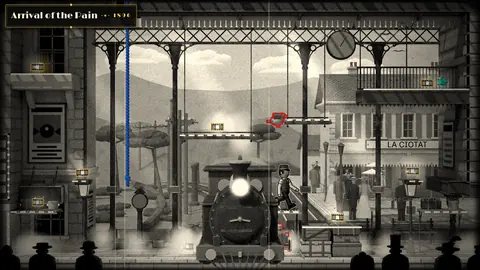 1896
Arrival of a Train at La Ciotat
Our room: Arrival of the Pain
1896
Arrival of a Train at La Ciotat
Our room: Arrival of the Pain
-
 1902
A Trip to the Moon
Our room: A Trip to the Moan
1902
A Trip to the Moon
Our room: A Trip to the Moan
-
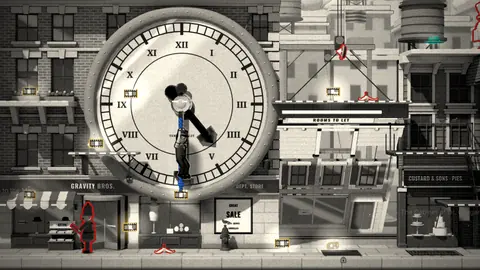 1923
Safety Last!
Our room: Safety Second
1923
Safety Last!
Our room: Safety Second
Free, in a desktop browser or as a download for Windows, Mac and Linux.
Quick answers
Did the Odessa Steps massacre really happen?
Not as the film shows it. Troops did fire on crowds in Odessa in June 1905, and The Times and the British consul reported it, but the massacre on the steps, by most accounts, was Eisenstein's invention, built from riots elsewhere in the city.
Was the Potemkin mutiny a real event?
Yes. Sailors on the battleship Potemkin mutinied on 27 June 1905 after being served borscht made from maggoty meat. The ship reached Odessa, met the fleet and ended up in Constanța, Romania, on 7 July.
Why was Battleship Potemkin banned?
Its revolutionary message and scenes of violence. Britain refused it a certificate in 1926 and passed it only in 1954; in Germany it went through eight censorship proceedings from 1926; other countries banned it for a time.
What is the Odessa Steps sequence famous for?
For its montage: a baby carriage rolling down the steps, a woman shot through her pince-nez, and a rank of soldiers whose faces are never shown. It has been quoted by many films, among them The Untouchables (1987).
How did Eisenstein make the red flag red?
By hand. Film stock of the day rendered red as black, so a flag on the mast was coloured red on the print. By one count it was done on 108 frames.
What is the 2005 reconstruction of Battleship Potemkin?
A version prepared by film historian Enno Patalas for the Deutsche Kinemathek, assembled from material in Moscow, Berlin and London, and shown with Edmund Meisel's original score. It restored cuts made by censors and edited-out text, including a Trotsky quotation.
Is Battleship Potemkin in the public domain?
Wikimedia Commons treats it as public domain in the United States, as it was published before 1929. Its status elsewhere varies by country, and modern restorations and scores can carry their own rights.
Where does Battleship Potemkin rank among the greatest films?
At the 1958 Brussels World's Fair it was named the greatest film of all time by an international poll. In the Sight and Sound critics' polls it stood 11th in 2012 and 54th in 2022.
Sources and further reading
- Battleship Potemkin, Wikipedia, for the production, the dates, the bans and the polls, taken with the other sources
- Potemkin mutiny, Wikipedia, on the events of June and July 1905
- Battleship Potemkin, Kulturstiftung des Bundes, on the reconstruction of 2005
- Potemkin restored, The Bioscope, on the restoration and the Kino release
- Panzerkreuzer Potemkin, Deutsches Historisches Museum, on the German censorship from 1926
- 10 great censored films, British Film Institute
- Battleship Potemkin, EBSCO Research Starters
- Battleship Potemkin (1925), Sergei Eisenstein, Senses of Cinema, 2017
- Eisenstein in Vienna, The Criterion Collection
- 100 Jahre Panzerkreuzer Potemkin, Jüdische Allgemeine, 2025