
Palace Picture House · Programme note
Sunrise 1927
Fox gave a German director a free hand and a city to build, and got a prestige film that won a prize no one has been given since.
By HertzyPertzy · Updated · 6 minute read
In short
Sunrise: A Song of Two Humans is a 1927 American drama directed by F. W. Murnau for the Fox company, with George O'Brien and Janet Gaynor as a farming couple and Margaret Livingston as the woman from the city who tempts the husband to murder. It was Murnau's first Hollywood film, written by Carl Mayer from a story by Hermann Sudermann, and it carried a synchronised music and effects track. It did not make its money back, but it won three prizes at the first Academy Awards, including one that was given only that year, and it now stands among the most admired films of the silent era.
Watch the film
It is not played on this page: see where to watch it.
Find where to stream, rent or buy it, on JustWatch.
- Full title
- Sunrise: A Song of Two Humans
- Premiere
- 23 September 1927, Times Square Theatre, New York. Sources give general release dates in November 1927, and differ on the day
- Made by
- Fox Film Corporation. Director F. W. Murnau; scenario Carl Mayer; sets Rochus Gliese; camera Charles Rosher and Karl Struss; producer William Fox
- Cast
- George O'Brien (the Man), Janet Gaynor (the Wife), Margaret Livingston (the Woman from the City), Bodil Rosing (the Maid), J. Farrell MacDonald (the Photographer)
- Based on
- "Die Reise nach Tilsit" ("The Excursion to Tilsit"), a story by Hermann Sudermann, 1917
- Length and format
- About 93 or 94 minutes. 35 mm, black and white. A sound version with a Fox Movietone sound-on-film track, and a silent version for cinemas without sound equipment
- Honours
- Three prizes at the first Academy Awards, 16 May 1929. Added to the US National Film Registry in 1989. Fifth in the 2012 Sight and Sound critics' poll
- Copyright
- In the public domain in the United States since 1 January 2023, as Duke's Center for the Study of the Public Domain lists it. This page links to no copy: the discs and files in circulation are commercial transfers. Its status elsewhere depends on each country's term
The story
A farming couple live by a lake with their baby. A woman from the city, on holiday, has taken the husband (George O'Brien) as her lover. She wants him to sell up, come to the city and drown his wife (Janet Gaynor) on the way, making it look like an accident. He agrees to a boat trip. In the middle of the lake he cannot do it, and she runs from him.
What follows is a day in the city: a trolley ride, a church where a wedding is under way, a photographer's studio, a fairground. The couple are shy of each other, then not. The film is told in pictures with a few title cards, and its names are generic: the Man, the Wife, the Woman from the City. The sub-title, A Song of Two Humans, says that the story is meant to be any couple's. A storm on the lake on the way home puts the reconciliation to a test.
The scenario was by Carl Mayer, who also wrote The Last Laugh. It is based on "Die Reise nach Tilsit" ("The Excursion to Tilsit"), a story by Hermann Sudermann, published in 1917. Mayer is said to have written it in free verse.
Why Fox hired Murnau
William Fox's company saw Murnau's The Last Laugh (1924), a film nearly without titles, in late 1924. In March 1925 newspapers reported that its director was coming to Hollywood, and he left Germany in July 1926. Fox sold him as "the German Genius". He is said to have been given an unusual freedom, including the choice of many of his own collaborators, Mayer among them.
Fox was at the same time investing in its own sound-on-film system, Movietone, and this was a film that would use it. The result was Murnau's first American film, made four years after Nosferatu.
The city built to look bigger
The sets were designed by Rochus Gliese, who is said to have drawn them in Germany. The centrepiece was a city built indoors on the lot, where background houses were smaller than the foreground ones and children and little people played the distant passers-by, which makes the street look far deeper than it is. Floors and ceilings were slanted too. Sources describe the set as costing about $200,000, by one account nearly the whole budget of an ordinary programme picture of the day.
The camera was shared by Charles Rosher and Karl Struss. Rosher had worked with Murnau in Berlin as an unofficial adviser on Faust. In the studio marsh, where the floor was too uneven for a dolly, the camera ran on rails fixed to the ceiling, and Struss is said to have filmed upside down. The cinematographer Nestor Almendros, writing in American Cinematographer, singled out the trolley ride, in which the light moves as the car turns and the background is real, not projected. Rosher is reported to have worked mostly with 35 mm and 55 mm lenses, so much of the depth came from the sets themselves.
Premiere and box office
The film opened at the Times Square Theatre in New York on 23 September 1927, two weeks before The Jazz Singer. It carried a recorded music score and sound effects on the Fox Movietone system, while silent prints went to cinemas without equipment. The synchronised score is credited to Hugo Riesenfeld, with Erno Rapee also named in some listings.
Critics were divided. Robert Sherwood of Life called it the most important picture in the history of the movies, by one account, and Mordaunt Hall of the New York Times called it a masterpiece. A Time reviewer found the story meagre and the film soporific. The public was less moved. Most sources agree that it lost money: the film historian Scott Eyman gives rentals of $818,000 in the United States and Canada, and it is said never to have earned back its cost. Many independent cinema owners were unconvinced.
A prize given once
At the first Academy Awards, on 16 May 1929 in the Blossom Room of the Hollywood Roosevelt Hotel, Sunrise won three prizes. Charles Rosher and Karl Struss won for cinematography. Janet Gaynor won as best actress, for three films at once: Sunrise, 7th Heaven and Street Angel, as acting awards then covered a year's work. And the film won a prize for unique and artistic production, an award for prestige pictures set apart from commercial ones. It was given that year only.
The more usual top prize, for outstanding picture, went to Wings. The Academy later treated that one as its highest honour and dropped the other category, so the film is not counted as a Best Picture winner, though people sometimes describe it as having shared the top prize.
Why it matters
It is a German film made in America. Murnau brought the roving camera, the built city and the story told in pictures into a Hollywood studio. Fox directors including John Ford and Frank Borzage are said to have learned from it, and Ford's Four Sons and Borzage's 7th Heaven reused parts of Gliese's sets.
It was nearly lost. The original American negative burned in a Fox vault fire in New Jersey on 9 July 1937. Later copies were made from surviving prints, and in 2003 the Academy Film Archive, the British Film Institute and the successors to Fox preserved it.
Its reputation rose and stayed. It was placed on the US National Film Registry in 1989. In the 2012 Sight and Sound critics' poll it came fifth, with 93 votes, behind Vertigo, Citizen Kane, Tokyo Story and The Rules of the Game, and it has stayed near the top of that poll since. Murnau never saw it become a classic: he left Fox, and died in a car crash near Santa Barbara on 11 March 1931, aged 42, the day after the accident and about a week before his last film, Tabu, opened. The film's hundredth birthday falls on 23 September 2027.
On the same programme
Some of these films are rooms you can play
These notes come from Reel Trouble, a comedy platformer through film history. Every room in it is a movie set, built from scratch as a parody of a real film, and a fall is never a death: it is a retake.
-
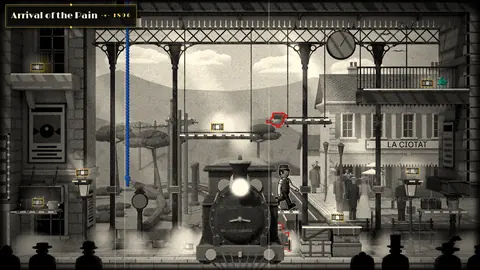 1896
Arrival of a Train at La Ciotat
Our room: Arrival of the Pain
-
 1902
A Trip to the Moon
Our room: A Trip to the Moan
-
 1923
Safety Last!
Our room: Safety Second
Free, in a desktop browser or as a download for Windows, Mac and Linux.
Quick answers
What is Sunrise (1927) about?
A farmer is lured by a woman from the city into planning to drown his wife on a boat trip. He cannot do it, she runs from him, and the two spend a day in the city before a storm on the lake puts everything at risk. It is billed as a song of two humans, and it is told almost without words.
Who directed Sunrise?
F. W. Murnau, a German director who had made Nosferatu (1922) and The Last Laugh (1924). Sunrise was his first film in Hollywood, made for William Fox's company.
Is Sunrise based on a book?
On a story. Carl Mayer's scenario draws on "Die Reise nach Tilsit" ("The Excursion to Tilsit") by Hermann Sudermann, published in 1917.
Did Sunrise win Best Picture?
Not exactly. At the first Academy Awards in 1929 it won a separate prize for unique and artistic production, given only that year. Wings won the award for outstanding picture, which the Academy later treated as its top honour.
Did Sunrise have sound?
It had recorded music and sound effects but no spoken dialogue. Murnau chose the Fox Movietone sound-on-film system. Silent prints were also made for cinemas that could not play it.
Did Sunrise make money?
No, by most accounts. One often-cited figure puts its American and Canadian rentals at about $818,000, and the film is said to have failed to earn back its cost.
How did Murnau die?
He was injured on 10 March 1931 when a hired car overturned on the Pacific Coast Highway in California, and he died the next day in a Santa Barbara hospital, aged 42.
Is Sunrise in the public domain?
In the United States, yes: it is among the 1927 works that entered the public domain on 1 January 2023. Modern restorations and recorded scores can have rights of their own, and the position in other countries is a separate question.
Sources and further reading
- Sunrise: A Song of Two Humans, Wikipedia: cast, awards, the box-office figure, the film's rankings and its copyright
- Sunrise: A Song of Two Humans, San Francisco Silent Film Festival: Fox, Murnau's freedom, the set, the reception
- Sunrise: A Song of Two Humans (1927), Silent Era: credits, premiere theatre, scores, the lost negative and the preservation
- Sunrise, Nestor Almendros, American Cinematographer (theasc.com): the sets, the trolley ride, the cameras
- The 1st Academy Awards, Academy of Motion Picture Arts and Sciences (oscars.org)
- 1st Academy Awards, Wikipedia: the one-off category, the nominations, the ceremony
- The 100 Greatest Films of All Time 2012, British Film Institute, Sight and Sound
- Public Domain Day 2023, Jennifer Jenkins, Duke Center for the Study of the Public Domain
- F. W. Murnau, Wikipedia: the move to Fox, the later films, his death