
Palace Picture House · Programme note
Sherlock Jr. 1924
A cinema projectionist falls asleep, steps into the film he is showing, and is thrown about by its cuts: Keaton's 45 minutes of trick photography and stunts.
By HertzyPertzy · Updated · 6 minute read
In short
Sherlock Jr. is an American silent comedy of 1924, directed by and starring Buster Keaton, about a cinema projectionist who dreams himself into the film he is showing. It runs only about 45 minutes and did modest business at the time, but it is now one of the most admired comedies of the silent era. Its tricks, among them a hero thrown from scene to scene by the cuts and a driverless motorbike chase, still puzzle and delight audiences. It was chosen for the US National Film Registry in 1991 and has been in the US public domain since 2020.
Watch the film
The whole film: 44 minutes, silent, with no music. A copy from a video upload; the uploader does not say which print it is.
Played from Wikimedia Commons, which hosts this copy as a public-domain work. Nothing is fetched from there until you press play. If it will not play here, it will on their page.
- Released
- 21 April 1924 by most accounts; other listings give May 1924
- Made by
- Buster Keaton Productions for Metro Pictures. Producers Joseph M. Schenck and Buster Keaton
- Director
- Buster Keaton, credited alone
- Written by
- Clyde Bruckman, Jean Havez and Joseph A. Mitchell
- Cast
- Buster Keaton (the Projectionist), Kathryn McGuire (the Girl), Joe Keaton (her Father), Ward Crane (the villain)
- Filmed
- From January 1924 in and around Los Angeles, over about four months
- Length
- About 45 minutes, in five reels; silent, black and white, English intertitles
- Copyright
- In the US public domain since 1 January 2020 (Duke's Center for the Study of the Public Domain lists it). Restorations and recorded scores have rights of their own
The story
A young man works as a projectionist in a small-town cinema. He is also a would-be detective, and he is in love with the daughter of the house. A rival, the local sheik, calls on her too. When the girl's father misses a pocket watch, the rival has already pawned it, and he plants the pawn ticket on the projectionist. The father throws the young man out.
Back in the booth, the projectionist starts the film for the evening's show and falls asleep over the machine. His dream self gets up, leaves his body in the chair, walks down the aisle and climbs into the picture. The film on the screen, Hearts and Pearls, has a plot that looks very like his own troubles. Inside it he is Sherlock Jr., the great detective, and the villains are his rivals in other clothes.
The dream has a tense billiards game in which the villain has fixed the thirteen ball, a poisoned drink, a kidnapped heroine and, to finish, a chase across town on a motorbike with nobody at the handlebars. Then the projectionist wakes. In the waking world the girl has found out for herself who really took the watch.
Walking into the screen
The famous scene comes early in the dream. The sleeper steps up to the screen, and the picture on it cuts: a garden, a street, a cliff edge, a lion, a desert, a snowdrift. Each time the scene changes the hero is put down in the new place, trying to sit on a bench that is no longer there. The film is, in effect, a comedy about what editing does to a person.
It had to be done in the camera. According to accounts of the shoot, Keaton and his cameraman Elgin Lessley used surveying instruments to keep Keaton and the shifting backgrounds exactly lined up from one cut to the next. Other tricks are older stage ones. In the best known, the hero seems to leap through his own disguised assistant and a few frames later is gone, and the method has never been fully explained. The British Film Institute notes that Keaton used vaudeville stage mechanics alongside the film effects of his day.
Stunts and a broken neck
Keaton did the dangerous work himself, and the motorbike chase is the best example. By most accounts he doubled for the driver who is thrown off at the start, and rode the machine through traffic from the handlebars, while a few close calls were helped by tricks of the camera. A split screen is said to have let the bike cross a gap in a bridge between two trucks, and the near miss with a train was reportedly filmed backwards.
The injury came from a different scene. Keaton, standing on a moving boxcar, grabbed the spout of a railway water tower. The water came down far harder than planned, threw him on to the track and, by one account, brought his head against a rail. He got up, finished the scene, and had headaches for some weeks.
It was years before anyone knew what had happened. A doctor who X-rayed him found a healed break in his neck. Most tellings put this about a decade after the film, in the mid-1930s, and sources differ on the exact gap. It is a story that rests largely on Keaton's own telling, so take the details with some salt.
The Arbuckle question
Roscoe "Fatty" Arbuckle had been Keaton's first director and friend. After the scandal of 1921 his career was in trouble, and Keaton helped him where he could. The two are said to have arranged for Arbuckle to share the direction of Sherlock Jr. under the name William Goodrich, a pseudonym he had already used.
That is where the agreement ends. By Keaton's account, Arbuckle became hard to work with on set, and Keaton took over and finished the film alone. Arbuckle's second wife, Doris Deane, later claimed he had directed the whole picture. Biographical accounts say that it is unclear how much of his work remained in the final cut. The film's credits name only Keaton as director.
A modest release
Filming began in January 1924, and the picture was ready within about four months. Keaton previewed it more than once and cut it each time, ending with about 45 minutes. The studio's head, Joseph Schenck, wanted about a thousand feet more. Keaton refused. The film went out in the spring of 1924, on 21 April by most accounts, though some listings say May.
It took about $448,000, slightly less than its predecessor. Keaton himself is said to have thought it good but not one of his great pictures. Reviews were mixed: one New York paper praised its tricks, while trade papers were cooler. The critics who built Keaton's reputation in the decades after wrote very differently, and the film now appears regularly in lists of the best comedies and the best films of its decade.
Why it matters
It is a film about the cinema itself. Its story turns on a film within a film. Long before critics talked about self-aware cinema, Keaton had a man step into a screen and find that the cuts were beyond his control.
The tricks were made in the camera. With no digital help, the effects depend on exact measurement and a performer who could hit his marks within an inch. That is why they still look uncanny.
It reached later films. Woody Allen's The Purple Rose of Cairo (1985), in which a character walks out of a film into real life, is generally said to owe much to it, the idea reversed.
It is free to use in the United States. The film joined the public domain there on 1 January 2020, with the other works of 1924. Restorations and recorded scores are separate work, and have rights of their own.
On the same programme
Some of these films are rooms you can play
These notes come from Reel Trouble, a comedy platformer through film history. Every room in it is a movie set, built from scratch as a parody of a real film, and a fall is never a death: it is a retake.
-
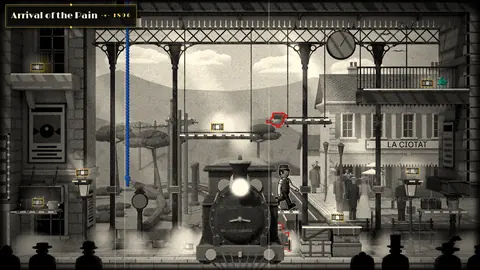 1896
Arrival of a Train at La Ciotat
Our room: Arrival of the Pain
-
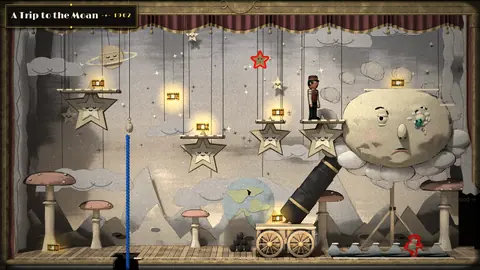 1902
A Trip to the Moon
Our room: A Trip to the Moan
-
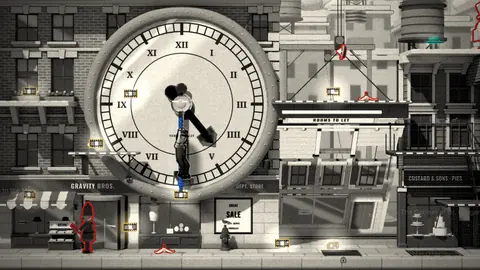 1923
Safety Last!
Our room: Safety Second
Free, in a desktop browser or as a download for Windows, Mac and Linux.
Quick answers
What is Sherlock Jr. about?
A cinema projectionist who longs to be a detective is framed for a theft by his rival. Asleep in the booth, he dreams himself into the film on the screen, as a great detective who solves the case.
How did Buster Keaton walk into the movie screen?
By careful camerawork. Keaton and his cameraman Elgin Lessley are said to have used surveying instruments to keep Keaton and the changing backgrounds lined up, so that each cut leaves him exactly where he stood.
Did Buster Keaton really break his neck making Sherlock Jr.?
By his own later account, yes. A rush of water from a tower spout knocked him onto the track and he hit his head on a rail. He carried on, and a doctor's X-ray years later showed a healed fracture of the neck.
Did Fatty Arbuckle direct Sherlock Jr.?
He was brought in as co-director under the name William Goodrich but is not credited. By most accounts Keaton finished the film alone, and it is unclear how much of Arbuckle's work stayed in the film.
How long is Sherlock Jr.?
About 45 minutes, which makes it a short feature. Keaton is said to have cut it down after preview screenings, and refused the studio's request to add about 1,000 feet.
Was Sherlock Jr. a hit?
Not especially. It took about $448,000, a little less than his previous film Three Ages, and Keaton is said to have thought it one of his lesser pictures. Its standing grew with later critics.
Is Sherlock Jr. in the public domain?
In the United States, yes: Duke's Center for the Study of the Public Domain lists it among the 1924 works that became free on 1 January 2020. A modern restoration or a recorded score may have rights of its own.
Sources and further reading
- Sherlock Jr., Wikipedia: release dates, credits, cast, plot, production, reception, registry and copyright status
- Sherlock Jr. (1924), Turner Classic Movies, on the stunts, the dream sequence, the previews and the box office
- Sherlock Jr., San Francisco Silent Film Festival, on the water-tower stunt and the neck injury
- Sherlock Jr. (1924), British Film Institute, film page
- The movie scene that broke Buster Keaton's neck, Far Out Magazine, relaying the historian David MacLeod
- Roscoe Arbuckle, Wikipedia, on Arbuckle's work for Keaton and the pseudonym William Goodrich
- Remembering Buster Keaton and The Navigator (1924), Library of Congress, Now See Hear! blog, 2023
- Public Domain Day 2020, Center for the Study of the Public Domain, Duke University