
Palace Picture House · Programme note
The Thief of Bagdad 1924
Douglas Fairbanks wrote, produced and starred in a million-dollar fantasy, and a wire-hung carpet, a flying horse and a vast set made it a hit with critics.
By HertzyPertzy · Updated · 5 minute read
In short
The Thief of Bagdad is an American silent fantasy of 1924, directed by Raoul Walsh and starring Douglas Fairbanks as Ahmed, a thief who wins a princess with the help of magic. Fairbanks wrote the story, produced it and was its driving force; William Cameron Menzies designed the huge Arabian sets. It was among the most expensive films of its day, and its flying carpet and flying horse are still famous. It is also full of Hollywood's Orientalist clichés. The film is in the public domain in the United States.
Watch the film
It is not played on this page: see where to watch it.
Find where to stream, rent or buy it, on JustWatch.
- Original title
- The Thief of Bagdad
- Released
- Premiere at the Liberty Theatre, New York, on 18 March 1924
- Made by
- Douglas Fairbanks Pictures, released by United Artists. Director Raoul Walsh; story and producer Douglas Fairbanks; screenplay Achmed Abdullah and Lotta Woods; art direction William Cameron Menzies; camera Arthur Edeson
- Cast
- Douglas Fairbanks (Ahmed), Julanne Johnston (the Princess), Sojin Kamiyama (the Mongol Prince), Anna May Wong (the Mongol Slave), Snitz Edwards (the Evil Associate), Brandon Hurst (the Caliph)
- Source
- Tales from the Arabian Nights, reworked by Fairbanks into a new story
- Length
- About 140 minutes in modern releases; speeds and cuts vary
- Format
- Silent, 35 mm, black and white, English intertitles; a score by Mortimer Wilson
- Copyright
- Public domain in the United States. Modern restorations, scores and discs can have rights of their own
The story
Ahmed is a thief in Baghdad. He falls in love with the Caliph's daughter, and he knows that a thief will never marry a princess.
So he poses as a prince, among rivals who include a Mongol prince, Cham Shang, the villain. The Mongol's slave, placed among the princess's attendants, spies for him.
Ahmed wins magic gifts: a crystal ball, a golden apple, an invisibility cloak, a magic powder and a carpet that flies. When the Mongol threatens the city, he comes back to save it and the princess.
Fairbanks and the idea
By 1923 Douglas Fairbanks was the biggest star of the swashbuckler. After Robin Hood (1922) he planned a pirate film, but he is said to have wanted colour for it and found the colour processes of the day too limited. A gift of a book of Arabian Nights tales turned his attention east. The story is his own, drawing on several of the tales, and the screenplay credit goes to Achmed Abdullah and Lotta Woods.
There was also pride. By one account, Fairbanks wanted to outdo the German costume epics he admired and doubted would pay. Raoul Walsh directed, Arthur Edeson photographed it, and the production company was Fairbanks's own, with United Artists as distributor. It opened at the Liberty Theatre in New York on 18 March 1924. Reviewers, then and since, tend to credit Fairbanks over Walsh.
The sets and the tricks
The designer was William Cameron Menzies, who is often credited with pioneering production design in Hollywood. The sets are said to have covered six acres in Los Angeles, and the film leans on wide shots of towers, walls and stairs that Fairbanks scales, with few close-ups. The shoot is said to have lasted a little over thirty-five days.
The tricks are mostly wires. By most accounts the flying carpet was a flat steel platform dressed in a Persian rug with a long fringe to hide it, hung from six sets of wires on a tall crane and hauled by a pulley and hand winch. Undercranking, shooting at a slower rate, made it look faster. The finale, with the carpet leaving the palace and rising over the city, is said to have used eighteen cameras. Walsh claimed the idea of the carpet in his memoir.
The winged horse was a real horse running on a treadmill before a screen, with wings worked on wires and Fairbanks double-exposed into the shot. Piano wire is also said to have worked a giant spider's legs and held up the rope Fairbanks climbs. Stills of an underwater sequence survive. Accounts differ on the details of these tricks.
The cast, the cost and the reception
Julanne Johnston plays the Princess, Brandon Hurst the Caliph, and Snitz Edwards the thief's evil associate. Anna May Wong, later one of the first Chinese American stars, plays the Mongol Slave, in a costume described as scant. Fairbanks is said to have signed her after her lead in The Toll of the Sea. The role has been called a stepping stone in her career, though the part itself is a treacherous one. Sojin Kamiyama, a Japanese actor born in 1884, plays the Mongol Prince. He worked in American silents through the 1920s, then went home to Japan, and his last credited role was in Seven Samurai (1954).
The cost is quoted as just over a million dollars: a reputed $1,135,654. Walsh said it was the first Hollywood picture to pass the million mark. It is described as one of the most expensive films of the 1920s. Its takings are given as about $3 million in rentals in the United States and Canada. The critic Alistair Cooke argued that it earned less than some Fairbanks pictures that cost half as much.
The reviews were glowing. The New York Times called it "an entrancing picture, wholesome and beautiful", and the writer Robert E. Sherwood judged it a great step forward for the movies. The poet Vachel Lindsay is said to have seen it ten times. The American Film Institute later put it ninth among its ten best fantasy films, and the Library of Congress selected it for the National Film Registry in 1996.
The Orientalism
The film's Arabia is an invention, and its East is a stage set. Critics describe it as built from popular Orientalist romances: a thieving, scheming, lazy, scented Orient, with a sinister Mongol as the foe. The villain and his spy-slave are Asian characters written as treacherous, which is how the roles Sojin and Wong played are read today. One critic finds it full of Orientalist clichés, which he puts down to ignorance and laziness rather than malice. Another finds the first reel a pure joy and the rest a parade of Orientalist dressing-up. Scholars have also read this film and its 1940 remake as carrying Western imperial attitudes.
Why it matters
It is a high point of the silent spectacle. Its sets, wires and double exposures built a fantasy world, and the flying carpet is the picture people remember.
It showed what a production designer could do. Menzies is credited with pioneering production design in Hollywood.
It set the template for the Arabian fantasy. A British Technicolor remake appeared in 1940, with Sabu in the thief's role, and later films in Europe and India borrowed the same figures.
It shows the cost of a fantasy East. The same film that delighted a 1924 crowd taught that crowd a set of stock faces, and it is worth watching with both facts in mind. Many cheap copies circulate; restorations with the original tinting have also been issued.
On the same programme
Some of these films are rooms you can play
These notes come from Reel Trouble, a comedy platformer through film history. Every room in it is a movie set, built from scratch as a parody of a real film, and a fall is never a death: it is a retake.
-
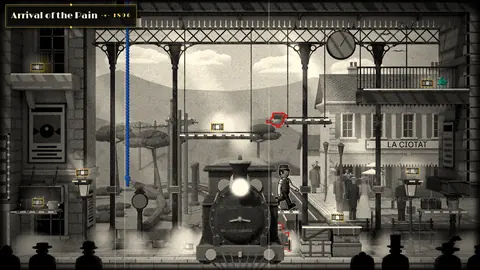 1896
Arrival of a Train at La Ciotat
Our room: Arrival of the Pain
-
 1902
A Trip to the Moon
Our room: A Trip to the Moan
-
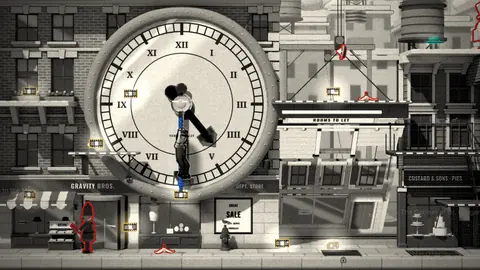 1923
Safety Last!
Our room: Safety Second
Free, in a desktop browser or as a download for Windows, Mac and Linux.
Quick answers
Who directed The Thief of Bagdad (1924)?
Raoul Walsh directed it. But Douglas Fairbanks wrote the story, produced it and starred, and critics at the time usually gave him the credit rather than Walsh.
How was the flying carpet in The Thief of Bagdad done?
By most accounts the carpet was a steel platform dressed in a rug with long fringe to hide it, carried on wires from a tall crane. Fairbanks rode it, and undercranking made it look faster.
How much did The Thief of Bagdad cost?
Its reputed cost is about $1.1 million, which made it one of the most expensive films of the 1920s. Director Raoul Walsh said it was the first Hollywood picture to cost more than a million dollars.
Who played the Mongol slave in The Thief of Bagdad?
Anna May Wong, then early in her career, played the Mongol slave, a spy placed in the princess's household. Sojin Kamiyama played the villain, the Mongol Prince.
Is The Thief of Bagdad (1924) based on the Arabian Nights?
Loosely. Fairbanks was given a book of Arabian Nights tales and drew on several of them, but the plot of the thief, the princess and the magic gifts is a new story.
Is The Thief of Bagdad in the National Film Registry?
Yes. It was selected for the United States National Film Registry in 1996.
Is the 1924 Thief of Bagdad in the public domain?
In the United States, yes: it is described as public domain there. Restorations, recorded scores and disc releases can carry rights of their own.
Is there a remake of The Thief of Bagdad?
Yes. A British Technicolor version appeared in 1940, with Sabu as the thief. Later Indian and Italian films also borrowed the story.
Sources and further reading
- The Thief of Bagdad (1924 film), Wikipedia: credits, cast, reputed cost, remakes, registry year
- A Magic Carpet Ride with Douglas Fairbanks, George Eastman Museum, on the production, the premiere and the Arabian Nights book
- The Magic of the Magic Carpet, San Francisco Silent Film Festival, on the effects
- The Thief of Bagdad (1924), Turner Classic Movies, on Fairbanks, Menzies, the cost and the reception
- The Thief of Bagdad (1924) review, High on Films, on the set and the film's clichés
- Thief of Bagdad (1924), The Public Domain Review, on the film and its copyright status
- Sojin Kamiyama, Wikipedia, on the actor's career