
Palace Picture House · Programme note
The Hunchback of Notre Dame 1923
Universal rebuilt Notre Dame on nineteen acres of its backlot, and Lon Chaney spent hours a day in the make-up chair to play Quasimodo.
By HertzyPertzy · Updated · 6 minute read
In short
The Hunchback of Notre Dame is an American silent film of 1923, directed by Wallace Worsley for Universal, with Lon Chaney as Quasimodo and Patsy Ruth Miller as Esmeralda. It adapts Victor Hugo's novel of 1831, with a happier ending for the heroine and a new villain. It was Universal's biggest silent success, by one account its "Super-Jewel" of the year,. The original 35 mm material is gone: today's copies descend from 16 mm prints.
Watch the film
The whole film: 109 minutes, silent, tinted, with its intertitles and no music. A YouTube upload of unstated source.
Played from Wikimedia Commons, which hosts this copy as a public-domain work. Nothing is fetched from there until you press play. If it will not play here, it will on their page.
- Released
- New York, September 1923: sources differ between a Carnegie Hall benefit screening on 30 August, the Astor Theatre run from 2 September, and an Astor premiere on 6 September; general release 6 September
- Made by
- Universal Pictures, at Universal City, California. Carl Laemmle, president; Irving G. Thalberg, young production executive
- Director
- Wallace Worsley, on loan from Paramount
- Written by
- Edward T. Lowe Jr. and Perley Poore Sheehan, from Victor Hugo's novel Notre-Dame de Paris (1831)
- Cast
- Lon Chaney (Quasimodo), Patsy Ruth Miller (Esmeralda), Norman Kerry (Phoebus), Nigel De Brulier (Dom Claude), Brandon Hurst (Jehan), Ernest Torrence (Clopin), Tully Marshall (Louis XI)
- Filmed
- From December 1922 to the summer of 1923 on sets covering nineteen acres at Universal City
- Length
- Twelve reels in the roadshow version, cut to about ten for general release; about 102 minutes in common copies, depending on the print and its speed
- Copyright
- Public domain in the United States: works published in 1923 entered it on 1 January 2019, and one account says this film's copyright was in any case not renewed. Restorations and recorded scores have rights of their own
The story, and what the film changed
Paris, 1482. Quasimodo, the deaf and misshapen bell-ringer of Notre Dame, is made to carry off the gypsy dancer Esmeralda. She is saved by the dashing Captain Phoebus, and Quasimodo, flogged in the square, is given water by her when no one else will. Phoebus is wounded, Esmeralda is blamed, the mob rises, and the bell-ringer defends the cathedral.
Victor Hugo published the novel, Notre-Dame de Paris, on 16 March 1831. The film was, by one count, the seventh adaptation. It rearranges the book. In the novel the villain is the archdeacon Claude Frollo, who lusts after Esmeralda; Phoebus is a shallow rogue who survives and marries; Esmeralda is hanged, and years later a skeleton found in a charnel house is taken to be Quasimodo's, embracing hers. In the film Dom Claude is a decent priest and the villain is his brother Jehan. Esmeralda survives, and in the account most summaries give, Quasimodo dies, leaving her with Phoebus.
Chaney and the hump
Lon Chaney, already known as the man of a thousand faces, had wanted the part for years. By one account he acquired the film rights in 1921 and so acted as an uncredited producer; the credited one is Carl Laemmle. Chaney's pay is given, by one account, as $2,500 a week.
The make-up was an ordeal. Accounts say it took three to three and a half hours to apply, using cotton, collodion, adhesive tape, nose putty and a plaster hump. On the weight sources differ: twenty pounds of plaster in some, a costume "cast" of about 50 pounds in another, in which Chaney is said to have complained of the pain of working doubled over. He reportedly could wear it for no more than six hours at a time, and removing it was worse, since the glue pulled out his eyebrow hair. A stuntman, Joe Bonomo, is named as his double for the rope slide down the cathedral front.
Thalberg and the backlot cathedral
Irving Thalberg was, by one account, a 23-year-old executive when he persuaded Laemmle that Universal should make it, and he is said to have insisted on Chaney. Another account says he sold it to his boss as a love story. Laemmle's studio was best known for cheap programme pictures. This was to be a spectacle. Worsley, borrowed from Paramount, directed; filming ran from December 1922 into the summer of 1923.
The sets covered nineteen acres at Universal City: eleven for the courtyard and cathedral, eight for the streets and the Court of Miracles. American Cinematographer gives the cathedral as 150 feet wide and 225 feet high, built over six months, with the sets together costing about $500,000. Another account says that only the lower half was built, with the towers and upper parts a hanging miniature. Cobblestones, it says, came from a river twenty miles away.
The crowds were as large. Reports of the extras run from some hundreds in the court scenes to 2,500 at the most, in costumes numbering around 3,000. Worsley is said to have directed them by loudspeaker, one account calling it the first public address system on a film set. Night scenes took two months and a great many lamps, and several cameramen worked under the credited Robert Newhard.
The premiere and the cast
Sources do not agree on the opening night. One has a benefit screening at Carnegie Hall on 30 August 1923, for the American Legion, and the Astor Theatre run from 2 September; another gives the Astor on 6 September, a week after a benefit for veterans. General release followed on 6 September. The roadshow version was twelve reels, soon cut to about ten.
Business was large. A figure of $3.5 million in rentals is given against a cost of about $1.25 million, which made it, by one account, Universal's most successful silent and its "Super-Jewel" of the year. Reviews praised Chaney; Variety found the film misery from first to last.
Esmeralda was Patsy Ruth Miller, born in St Louis in 1904. The actress Alla Nazimova is said to have spotted her at a party, she had been named a WAMPAS Baby Star in 1922, and she was about nineteen when she faced Chaney. She left films in 1931 and later wrote prize-winning short stories. Norman Kerry played Phoebus, Ernest Torrence the beggar-king Clopin and Tully Marshall Louis XI.
What survives
No original 35 mm print or negative is known to survive. The film lived on in 16 mm prints that Universal sold for showing at home, and a 1959 negative made by Blackhawk Films from a worn print supplied most copies for decades. In the 1990s David Shepard found a better 16 mm print, taken from a 35 mm duplicate negative. All existing prints are short of the original by at least fifteen minutes, by one account, and the shorter ten-reel version is the one that remains. In 2014 a print made from the first negative with the original titles was found in a private collection, and it is said to be the basis of Universal's restoration. Universal also reissued the film with sound in the 1930s.
Why it matters
It made a prestige picture out of a programme studio. Universal, better known for cheap programme pictures, spent about $1.25 million on a single film and made it back nearly three times over in rentals.
It built the star's reputation. Chaney's Quasimodo is the picture people remember, and two years later he made The Phantom of the Opera at the same studio.
It made the backlot an object of pride. A cathedral built in a field in California became part of the film's advertising, in an age when scale sold tickets.
It has been told again and again. Charles Laughton played the part in 1939, Anthony Quinn in 1956, and Disney's animated version came in 1996. Since 1 January 2019 the 1923 film has been free of United States copyright, like the rest of that year's output.
On the same programme
Some of these films are rooms you can play
These notes come from Reel Trouble, a comedy platformer through film history. Every room in it is a movie set, built from scratch as a parody of a real film, and a fall is never a death: it is a retake.
-
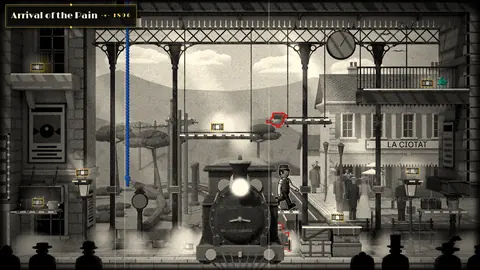 1896
Arrival of a Train at La Ciotat
Our room: Arrival of the Pain
-
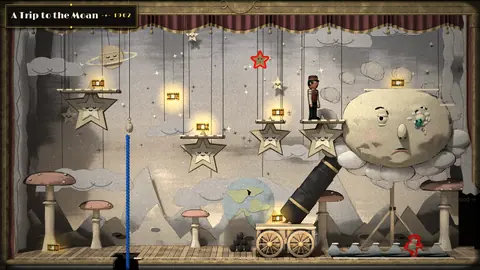 1902
A Trip to the Moon
Our room: A Trip to the Moan
-
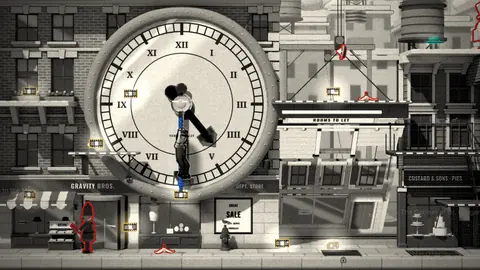 1923
Safety Last!
Our room: Safety Second
Free, in a desktop browser or as a download for Windows, Mac and Linux.
Quick answers
Who played Quasimodo in the 1923 film?
Lon Chaney. He had pressed for a screen version for some years, and by one account he held the film rights himself. He was paid, by one account, $2,500 a week.
How does the 1923 Hunchback differ from Victor Hugo's novel?
The film gives the story a new villain, Jehan, the archdeacon's wicked brother, and lets Esmeralda live. In the novel the archdeacon Claude Frollo is the villain, Esmeralda is hanged and Quasimodo dies beside her remains.
How big was the Notre Dame set?
Universal's sets covered nineteen acres. By one account the cathedral stood 150 feet wide and 225 feet high; the upper parts and towers were, by another, a hanging miniature. The sets are put at about $500,000.
How heavy was Lon Chaney's hump?
Sources differ. Some describe a twenty-pound plaster hump; another account has a costume "cast" of about 50 pounds. His make-up took about three to three and a half hours to apply.
Who was Irving Thalberg and what did he do for the film?
Thalberg was a 23-year-old executive at Universal. By one account he persuaded the studio head Carl Laemmle to make the film and insisted on Chaney, pitching it as a love story.
Does the 1923 Hunchback of Notre Dame survive complete?
No. No 35 mm original is known to survive, and the surviving copies descend from 16 mm home-cinema prints. Every existing print is missing at least fifteen minutes of the original release, by one account.
Is the 1923 Hunchback of Notre Dame in the public domain?
In the United States, yes: works published in 1923 entered the public domain on 1 January 2019. Restorations and new scores can carry rights of their own.
Who played Esmeralda in 1923?
Patsy Ruth Miller, born in 1904 and so about nineteen at the time. She had been named a WAMPAS Baby Star in 1922 and retired from films in 1931.
Sources and further reading
- The Hunchback of Notre Dame (1923 film), Wikipedia: credits, budget, box office, filming dates, the film's plot, preservation and later versions, as reported
- The Hunchback of Notre Dame, San Francisco Silent Film Festival: the set, the extras, Thalberg, the screenings and the surviving prints
- Hunchback of Notre Dame, American Cinematographer, theasc.com: the set, the crowds, the lighting, the make-up and the first screenings
- The Hunchback of Notre Dame (1923), Turner Classic Movies, article: Chaney's make-up, Thalberg, the set
- The Hunchback of Notre Dame (1923), Silent Era, Progressive Silent Film List: premiere, length and surviving prints
- Notre-Dame de Paris, Wikipedia: the novel's plot and ending
- Patsy Ruth Miller, Wikipedia: her birth, discovery and career
- Public Domain Day 2019, Duke Center for the Study of the Public Domain: works of 1923 and the 95-year term