
Palace Picture House · Programme note
Skippy 1931
A nine-year-old was nominated for Best Actor, his uncle won Best Director, and the boy's comic-strip hero later lent his name to a lawsuit about peanut butter.
By HertzyPertzy · Updated · 6 minute read
In short
Skippy is an American comedy of 1931 from Paramount, directed by Norman Taurog and based on Percy Crosby's comic strip. Jackie Cooper plays Skippy Skinner, a doctor's son who befriends a poor boy from the town's shantytown and tries to save a dog from the dog-catcher. The film was nominated for four Academy Awards and won one, Best Director, for Taurog, who was Cooper's uncle by marriage. It made Cooper a star, and it is a fair record of how the early talkies sold childhood: with tears, and a good many of them real.
Watch the film
It is not played on this page: see where to watch it.
Find where to stream, rent or buy it, on JustWatch.
- Original title
- Skippy
- Released
- 5 April 1931, by Paramount Pictures
- Made by
- Paramount Pictures. Director Norman Taurog; screenplay credited to Joseph L. Mankiewicz, Don Marquis, Norman Z. McLeod and Sam Mintz; camera Karl Struss; music John Leipold
- Cast
- Jackie Cooper (Skippy Skinner), Robert Coogan (Sooky Wayne), Mitzi Green (Eloise), Jackie Searl (Sidney), Willard Robertson (Dr Skinner), Enid Bennett (Mrs Skinner)
- Based on
- Percy Crosby's comic strip Skippy, which began in Life magazine in 1923, and the novel drawn from it
- Length
- About 85 minutes
- Format
- Sound, black and white, American English
- Copyright
- Due to enter the public domain in the United States on 1 January 2027, with the other works of 1931, as the 95-year term runs out; check the film's own renewal record before relying on that. The comic strip, its characters and the Skippy trade marks have separate histories
The story
Skippy Skinner lives in Morrisville, Indiana, the son of a respectable doctor who runs his house with a firm hand. Skippy is a boy of the kind that comic strips and Saturday afternoons loved: freckled, scruffy, forever in the middle of some scheme. At the edge of town lies Shantytown, where the poor live and where, by his father's rules, he has no business going.
He goes anyway, and makes friends with Sooky Wayne, a boy from there. (Sooky is a boy, not a dog, a point that confuses people who know only the sequel's title.) Sooky's dog is taken by the dog-catcher, and the two boys spend the rest of the film trying to raise the money to get it back. As summaries tell the story, they do not succeed, and the loss is what finally moves Skippy's father. The doctor, who has had a poor opinion of Shantytown and its people, begins to look at them differently. It is a children's comedy with a sermon in the second half, and the sermon is gentle.
From a magazine page to the screen
Skippy began as a drawing. Percy Crosby's strip started in the magazine Life in 1923, and was taken up by King Features Syndicate, whose first daily ran in 1926 and first Sunday page in 1929. Crosby kept the copyright in his creation, which was unusual for a strip artist of the time, and licensed the boy for toys, books and a good deal else. A novel followed, then the film.
The picture was Paramount's. Jackie Cooper, born in 1922, was under contract to Hal Roach and was loaned to the studio for it. By the account in Cooper's own life story, Paramount paid Roach $25,000 for him while Roach paid the boy $50 a week. Victor Schertzinger was first named as director, and was replaced by Norman Taurog for reasons that sources do not give. The screenplay is credited to four writers, among them Joseph L. Mankiewicz and Don Marquis.
The film opened in April 1931, ran about 85 minutes, and was a hit. Contemporary reviewers, the New York Times and Variety among them, singled out the boy's performance.
Making a boy cry
The film's reputation owes a great deal to its tearful scenes, and Cooper later said how they were got. In his 1982 autobiography, Please Don't Shoot My Dog, he tells of an uncle-director who needed a child to cry on cue and was willing to frighten him into it. In one scene Taurog is said to have berated him and threatened to replace him with a stand-in; Cooper, angry rather than sad, could not cry until another boy was made ready. In another, the dog was threatened with the pound, the animal was led away, and a shot was heard from off the set. The boy sobbed. The dog, he found later, was unharmed.
It is a hard story to read without a wince. It also has a happier close: Cooper says that on a third try his mother explained the scene and what the character felt, and he cried real tears in a single take. These are Cooper's recollections, set down fifty years afterwards, and the accounts of the first two scenes differ in their details. What they agree on is that the first two were methods, and the third was understanding.
The Oscars, and the uncle
At the fourth Academy Awards, held at the Biltmore Hotel in Los Angeles on 10 November 1931, Skippy was nominated four times: for Outstanding Production, for Best Director, for Best Actor and for Best Adaptation. It won once. Norman Taurog took Best Director, at the age of 32, and is described as the youngest winner of that award for some eighty years, until the Oscar for La La Land.
Cooper, at nine, is described as the youngest person ever nominated for Best Actor. He lost to Lionel Barrymore, who won for A Free Soul; the other nominees were Richard Dix, Fredric March and Adolphe Menjou. Taurog was his uncle by marriage, having married Cooper's aunt Julie about three years earlier, and sources commonly call Cooper his nephew. The studios of the 1930s were, among other things, family businesses.
The film's success brought a sequel that same year, Sooky, with Cooper and Taurog again.
Skippy and the peanut butter
The name has a second life, and a longer one. Crosby registered the Skippy trade mark in 1925. In 1932 a Californian packer, Joseph Rosefield, began selling peanut butter under the name, in packaging that borrowed the strip's paintbrush lettering and fence. Crosby opposed Rosefield's attempt to register it in 1933, and won that round, but Rosefield went on selling.
The strip ended in December 1945 after a quarrel over a new contract. Crosby, whose later years were hard and who was committed to a hospital in 1948, died there on 8 December 1964. Rosefield registered the peanut butter's name unopposed in 1947, and Crosby's daughter fought the brand in the courts, on and off, for decades. She lost, and the Supreme Court declined to hear her last petition in 2004. That quarrel is about trade marks. It has nothing to do with who may show the 1931 film.
Why it matters
It put a child at the centre of a prestige picture. A boy in a leading part was a gamble, and Paramount saw it pay: a Best Picture nomination, a Best Actor nomination at nine, and a career that soon had him acting opposite Wallace Beery in The Champ the same year.
It shows how early talkies handled children on set. The tears were the selling point, and by one participant's account they were got by methods that would not be allowed now. Film history has a habit of recording the finished scene and not the morning it took.
It remembers a comic strip that history nearly lost. Crosby's Skippy was once as widely known as any strip of its day, and the film, with the peanut butter that took the name, is much of what the public still knows of it.
It comes out of copyright with the class of 1931. The film is among the works of 1931 due to enter the public domain in the United States on 1 January 2027, if its own record agrees, and then anyone may show it.
On the same programme
Some of these films are rooms you can play
These notes come from Reel Trouble, a comedy platformer through film history. Every room in it is a movie set, built from scratch as a parody of a real film, and a fall is never a death: it is a retake.
-
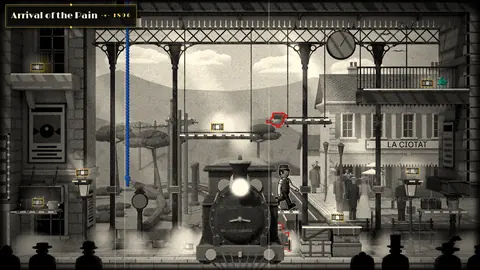 1896
Arrival of a Train at La Ciotat
Our room: Arrival of the Pain
-
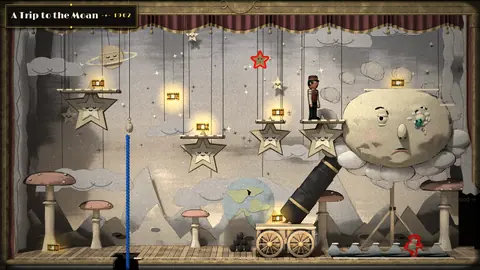 1902
A Trip to the Moon
Our room: A Trip to the Moan
-
 1923
Safety Last!
Our room: Safety Second
Free, in a desktop browser or as a download for Windows, Mac and Linux.
Quick answers
What is the 1931 film Skippy about?
Skippy Skinner, a doctor's son in a small Indiana town, makes friends with Sooky, a boy from the poor shantytown. When the dog-catcher takes a dog, the boys try to raise the money to save it, and Skippy's stern father is made to look again at the people of the shantytown.
Who played Skippy?
Jackie Cooper, then eight or nine years old, loaned to Paramount by the Hal Roach studio. His friend Sooky is played by Robert Coogan.
Did Skippy win an Oscar?
Yes, one. It was nominated for four awards at the ceremony of 10 November 1931 (picture, director, actor and adaptation) and won Best Director for Norman Taurog.
Was Norman Taurog really Jackie Cooper's uncle?
By marriage, yes. Taurog had married Cooper's aunt Julie about three years before the film, and sources commonly call Cooper his nephew.
Was Jackie Cooper the youngest Best Actor nominee?
At nine years old he is described as the youngest person ever nominated for Best Actor. He lost that year to Lionel Barrymore, who won for A Free Soul.
Is Skippy the same Skippy as the peanut butter?
No, though they share a name and a long quarrel. Percy Crosby's comic-strip Skippy came first, and Crosby opposed the peanut butter's name when it was registered in 1933. The brand kept the name after the strip ended.
Is Skippy in the public domain?
Works first published in 1931 are due to enter the public domain in the United States on 1 January 2027, after 95 years. Whether this film's own copyright was renewed is a question for its renewal record, and the comic strip and the trade marks are separate matters.
Sources and further reading
- Skippy (1931 film), Wikipedia: credits, cast, plot, awards, release date
- Skippy (1931), Turner Classic Movies, article on the production, the replaced director and Cooper's crying scenes
- Jackie Cooper, Wikipedia: the loan from Hal Roach, the nomination, his 1982 autobiography
- Norman Taurog, Wikipedia: his career and his Oscar at 32
- 4th Academy Awards, Wikipedia: the ceremony of 10 November 1931, the nominees and winners
- Percy Crosby, Wikipedia: the strip, its syndication, the artist's life and death
- Skippy v. Skippy: The Great Peanut Butter Trademark Wars, Foley Hoag LLP, Making Your Mark blog, 2014