
Palace Picture House · Programme note
The Kid Brother 1927
Harold Lloyd plays the runt of a family of sheriffs in a comedy often ranked among his best, ending on an abandoned ship.
By HertzyPertzy · Updated · 5 minute read
In short
The Kid Brother is a 1927 American silent comedy in which Harold Lloyd plays Harold Hickory, the slight youngest son of a family of tough men, who does the housework while his father and brothers run the valley. A travelling medicine show brings him a sweetheart, a villain and a chance to prove himself. Lloyd produced it through his own company, and Paramount released it. Critics and fans widely count it among his best films, and as a work of 1927 it has been in the US public domain since 1 January 2023.
Watch the film
The whole film: 81 minutes, silent, with no music.
Played from Wikimedia Commons, which hosts this copy as a public-domain work. Nothing is fetched from there until you press play. If it will not play here, it will on their page.
- Released
- 22 January 1927, United States, by the date usually given (one catalogue says 17 January)
- Directed by
- Ted Wilde (credited, with J. A. Howe); Lewis Milestone is said to have worked on it uncredited
- Produced by
- Harold Lloyd, for the Harold Lloyd Corporation; distributed by Paramount Pictures
- Starring
- Harold Lloyd (Harold Hickory), Jobyna Ralston (Mary Powers), Walter James (Jim Hickory), Constantine Romanoff (Sandoni)
- Written by
- Howard J. Green, from a story and scenario credited to several writers
- Camera
- Walter Lundin
- Length
- Eight reels: about 82 to 84 minutes, depending on the source and the projection speed
- Copyright
- Public domain in the United States since 1 January 2023, as a work of 1927. It may still be protected in other countries, and restorations and newer scores have rights of their own
The story
Harold Hickory is the youngest son of Sheriff Jim Hickory, in a valley town where the men are big and the boy is not. His father and brothers cut timber and keep order. Harold is left at home with the laundry and the dishes, which he handles with a stream of homemade contraptions.
One day, while the family is at a town meeting, Harold puts on his father's badge and is taken for the sheriff by "Flash" Farrell, who runs a travelling medicine show. Harold signs the permit that lets the show perform. With the show comes Mary Powers, its dancer, played by Jobyna Ralston, and Harold falls for her.
Then the money collected for the town's dam is stolen. Harold is framed for it by the villain Hank Hooper. He follows the thieves to a derelict ship, where the strongman Sandoni is waiting, and he has to win the money back by wit, since he has no muscle to spend. At the end he wins his father's respect at last.
Who made it
Lloyd made the film as his own producer, through the Harold Lloyd Corporation, and Paramount released it. Walter Lundin was the cameraman.
The directing credit is less simple. Ted Wilde is credited, and J. A. Howe is credited with him. Wilde began on Lloyd's writing staff and also directed Lloyd's Speedy (1928); he died of a stroke in December 1929, aged 36. Several sources add that Lewis Milestone, later a major Hollywood director, worked on The Kid Brother without credit, and one account has him quitting over a contract dispute. Sources also say Lloyd himself directed parts of it. The same account that names Howe says Wilde fell ill and that Howe finished the picture. How the work was split is uncertain: the credited names are firm, the rest rests on a few accounts.
By one account, about eight writers and gagmen worked on the script. Many gags were cut, and some turned up in later films. Jobyna Ralston had played opposite Lloyd in several earlier features; this was her last with him.
The gags
Variety's notice of 1927 is quoted as opening: "Harold Lloyd has clicked again with THE KID BROTHER, about as gaggy a gag picture as he has ever done." It is not a thrill comedy like Safety Last!. It is a character comedy with a small-town setting and a great many jokes, and three sequences are picked out most often.
The laundry. Harold is doing the family wash when his father's shirt blows away. He chases it into the neighbours' yard, where Hank Hooper claims it and starts a fight. The kitchen machinery that precedes it, which washes, dries and stacks at once, is among the things reviewers enjoy.
The tree. As Mary walks away, back to the medicine show, Harold climbs higher and higher up a tree to wave goodbye for as long as he can keep her in view. The location historian John Bengtson notes that the scene was staged on a hill with what would later be the site of the Walt Disney Studios behind it.
The ship. The film opens on a wagon passing a wrecked ship, and the ending returns to it. Harold drifts aboard, follows Sandoni's pet monkey and plays cat and mouse with the strongman. Some modern reviewers find this chase closer to horror than farce. The ship was the Palmyra, an old lumber vessel, and the scenes were shot at Catalina Island.
Release and reception
The release date usually given is 22 January 1927 in the United States. One catalogue lists 17 January, with the copyright registered the day after. By most accounts the film did well on release, and it has been counted among his best ever since.
Some modern writers say it was Lloyd's own favourite of his films, a claim repeated more often than it is documented. Others call it his masterpiece, or ask why Lloyd is so often placed third behind Chaplin and Keaton when a film like this exists.
How it is seen today
In the early 1990s Kevin Brownlow and David Gill restored The Kid Brother for Thames Television, with a new orchestral score by Carl Davis. In 2019 the Criterion Collection issued it on Blu-ray from a new 4K transfer, made from a fine-grain master struck in 1973 from the original camera negative, shortly before that nitrate negative decomposed. The disc offers both the Davis score and an organ score by Gaylord Carter.
As a work of 1927, it entered the public domain in the United States on 1 January 2023, according to Duke's Center for the Study of the Public Domain. Elsewhere the position may differ. A restoration or a newer score can carry rights of its own. Copyright in a film is a separate matter from trade marks: Harold Lloyd Entertainment states that images and film names on its site are its trade marks, and this note draws no legal conclusions from either fact.
Why it matters
It shows Lloyd without the skyscraper. His fame rests on heights and clocks, but here the danger is a small man in a rough family, and the laughs come from invention instead of altitude.
It is a gag film that still has a story. A son who cannot match his father and brothers, a stolen fund and a father who must be convinced: the jokes pile up, and they all push Harold toward the last reel.
It rests on a restoration. A nitrate negative that was close to decomposing in 1973 is the reason the film can be seen in good condition now.
It can be shown freely in the United States. Works of 1927 have been public domain there since 1 January 2023, though protection in other countries may differ.
On the same programme
Some of these films are rooms you can play
These notes come from Reel Trouble, a comedy platformer through film history. Every room in it is a movie set, built from scratch as a parody of a real film, and a fall is never a death: it is a retake.
-
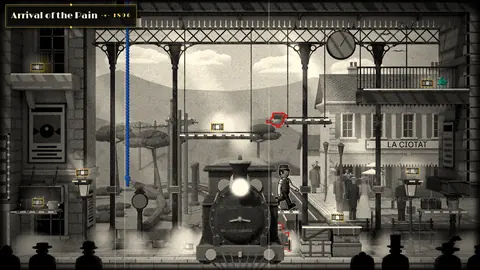 1896
Arrival of a Train at La Ciotat
Our room: Arrival of the Pain
-
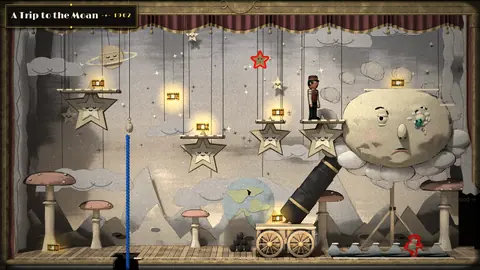 1902
A Trip to the Moon
Our room: A Trip to the Moan
-
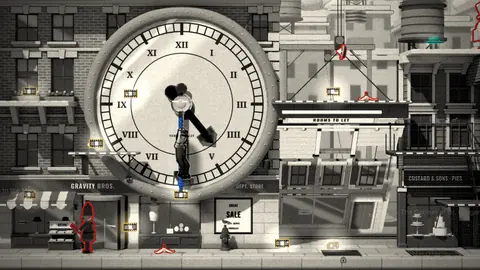 1923
Safety Last!
Our room: Safety Second
Free, in a desktop browser or as a download for Windows, Mac and Linux.
Quick answers
What is The Kid Brother about?
Harold Hickory, the weak youngest son of a sheriff, falls for a girl from a medicine show. When the money for the town's dam is stolen and he is blamed, he follows the thieves to an abandoned ship and wins back his father's respect.
Who directed The Kid Brother?
Ted Wilde is the credited director, with J. A. Howe also credited. Sources add that Lewis Milestone worked on the film without credit, and that Lloyd himself had a hand in the direction.
Who is the girl in The Kid Brother?
Jobyna Ralston plays Mary Powers. It was the last of her films with Lloyd, after five or six, depending on the count.
Was The Kid Brother Harold Lloyd's favourite of his own films?
Some modern writers say so, but the claim is not well documented. Others simply call it one of his best, and some call it his masterpiece.
Where was The Kid Brother filmed?
Mostly in the Los Angeles area, including the Lasky Ranch in Burbank. The wrecked ship was the Palmyra, an old lumber ship, filmed at Catalina Island.
Where can I watch The Kid Brother?
On this page: the player above plays the whole film, silent, from a public-domain copy on Wikimedia Commons. Restored editions with music are sold on disc.
How long is The Kid Brother?
Eight reels. That is about 82 to 84 minutes, depending on the source and the speed of projection.
Is The Kid Brother in the public domain?
In the United States, yes. Duke's Center for the Study of the Public Domain lists it among the works of 1927 that entered the public domain on 1 January 2023. It may still be protected in other countries.
Sources and further reading
- The Kid Brother, Wikipedia: plot, cast, credits, production, restorations
- The Kid Brother (1927), Silent Era, Progressive Silent Film List: credits, release date, length, rights
- Harold Lloyd's The Kid Brother Was Close to Home, John Bengtson, Silent Locations, 2019: locations, directors, restoration
- The Kid Brother, Film Forum: credits and the Variety review of 1927
- Harold Lloyd's The Kid Brother: More Than Just Slapstick, RVA Magazine: gags, reputation
- Ted Wilde: The Kid Brother, Mookse and Gripes, 2019: the gags and the Blu-ray
- The Kid Brother (1927), Obscure Hollywood: scene-by-scene account of the gags
- Ted Wilde, Wikipedia: the director's career and death
- Public Domain Day 2023, Duke Center for the Study of the Public Domain
- Harold Lloyd, Harold Lloyd Entertainment, official site: trade mark notice