
Palace Picture House · Programme note
A Free Soul 1931
An MGM melodrama about a lawyer, his daughter and a gangster won Lionel Barrymore an Oscar and turned Clark Gable from a supporting player into a star.
By HertzyPertzy · Updated · 5 minute read
In short
A Free Soul is an American drama of 1931, directed by Clarence Brown for MGM, from a novel by Adela Rogers St. Johns. Norma Shearer plays a lawyer's daughter who takes up with a gangster, played by Clark Gable. Lionel Barrymore, as her drunken father, won the Academy Award for Best Actor for his courtroom speech. Frank about sex and drink, it is a pre-Code film, and Gable's part is the one most often credited with making him a leading man.
Watch the film
It is not played on this page: see where to watch it.
Find where to stream, rent or buy it, on JustWatch.
- Released
- Premiere in New York on 2 June 1931; general release in the United States on 20 June 1931
- Made by
- Metro-Goldwyn-Mayer. Director and producer Clarence Brown; photography William Daniels; editing Hugh Wynn
- Based on
- The novel A Free Soul (1927) by Adela Rogers St. Johns, and by most accounts Willard Mack's 1928 stage version of it
- Cast
- Norma Shearer (Jan Ashe), Leslie Howard (Dwight Winthrop), Lionel Barrymore (Stephen Ashe), Clark Gable (Ace Wilfong), James Gleason (Eddie)
- Awards
- Best Actor for Lionel Barrymore at the 4th Academy Awards, 10 November 1931; nominations for Norma Shearer (Best Actress) and Clarence Brown (Best Director)
- Length
- About 91 minutes; catalogues give 90 to 92
- Format
- Sound, black and white, English
- Copyright
- Due to enter the public domain in the United States on 1 January 2027, with the other works of 1931: the copyright record gives a term to 31 December 2026. Modern restorations and disc editions have rights of their own
The story
Stephen Ashe is a brilliant defence lawyer in San Francisco who drinks as other men breathe. He has brought up his daughter Jan to do as she likes, and she does. She is engaged to Dwight Winthrop, a polite young man of good family, and bored by him. Then she meets Ace Wilfong, a gambler and racketeer whom her father has just got off a murder charge.
Jan moves into an affair with Ace. He is rough with her, and possessive, and when she tries to leave him he will not hear of it. Dwight, who still loves her, goes to Ace's rooms and shoots him. He gives a gambling debt as his reason, to keep Jan's name out of it.
Stephen takes the defence. At the trial he puts Jan on the stand, and the truth comes out. In his last speech he blames himself, for the drink and for the freedom he gave his daughter, and he collapses and dies. Dwight is acquitted. The film ends with Jan and Dwight on their way to New York.
The book and the family behind it
The source is the novel A Free Soul (1927) by Adela Rogers St. Johns, which ran in a Hearst magazine from September 1926 to February 1927. A stage version by Willard Mack followed in 1928. The screen credits name only the book, though contemporary reviews name the play as well. The adaptation is credited to Becky Gardiner, with dialogue continuity by John Meehan.
Behind the story stands the author's own father. Earl Rogers (1869 to 1922) was a Los Angeles trial lawyer who, by one reckoning, defended 77 murder cases and lost three. He also drank heavily, and sobered up in Turkish baths to get back into court. His daughter worked for him as a girl and later wrote his life, Final Verdict (1962). The Ashes are generally said to be drawn from the two of them, though the film is fiction and the novel is not a biography.
Gable and the gangster
Clark Gable was not new to the screen. He had been playing minor parts, many of them villains, for some time. As Ace he is a bully with charm, and audiences noticed. The role is usually credited with moving him from supporting player to leading man. One fan-run history adds that his contract of $650 a week was torn up for one of $1,150, a figure worth treating with care.
The reviews of the day spent most of their words elsewhere. Critics went for Barrymore, and the notices that did mention Gable were short and approving. Later viewers are often startled to see the man of It Happened One Night and Gone With the Wind playing a thug.
The scenes between Gable and Norma Shearer are the film's most discussed. Shearer, the wife of MGM's production chief Irving Thalberg, had by then been a star for years.
A pre-Code melodrama
The film dates from the short season between the arrival of sound and the enforcement of the Production Code in 1934, and it is typical of it. Jan sleeps with a man she does not marry, and the film does not punish her. Her father drinks through Prohibition and is the hero. Ace is a criminal with a list of offences that includes drug dealing. The man who kills him walks free.
Modern critics are less comfortable with the moral. The father pays for his permissiveness with his life, while his daughter's conduct is quietly forgiven. The title idea itself, the girl as a free soul, sits oddly with a plot that has her bullied by Ace and rescued by two men. It is a film of 1931, and it shows.
The speech and the Oscars
The courtroom scene is what the picture is remembered for. Barrymore, as the drunken lawyer, delivers a long address to the jury, takes the blame for his daughter's fall, and then collapses. Even so, one reviewer calls it perhaps the first of Hollywood's climactic courtroom speeches.
At the 4th Academy Awards, held at the Biltmore Hotel in Los Angeles on 10 November 1931, Barrymore won Best Actor. His rivals were Jackie Cooper (Skippy), Richard Dix (Cimarron), Fredric March (The Royal Family of Broadway) and Adolphe Menjou (The Front Page). Shearer was nominated as Best Actress, but Marie Dressler won for Min and Bill. Brown was nominated for Best Director, and lost to Norman Taurog of Skippy.
The picture also paid. By MGM's own records, as later reported, it cost $529,000 and took about $1.4 million, a profit to the studio of some $244,000.
Why it matters
It made a star. Gable's turn as Ace is the part most often named as the start of his run as MGM's leading man.
It gave Hollywood a type of scene. The tired lawyer who stakes everything on one speech to a jury, and wins it, would be copied for decades.
It shows what the screen allowed. A woman's affair, a drunken hero and a gangster who is not made to look foolish all passed the censors of 1931. Within three years they would not have.
It is about to be free. By the copyright record the film's term ends on 31 December 2026, so it is due to enter the public domain in the United States on 1 January 2027, with the other works of 1931. A modern disc edition or restoration is another matter.
On the same programme
Some of these films are rooms you can play
These notes come from Reel Trouble, a comedy platformer through film history. Every room in it is a movie set, built from scratch as a parody of a real film, and a fall is never a death: it is a retake.
-
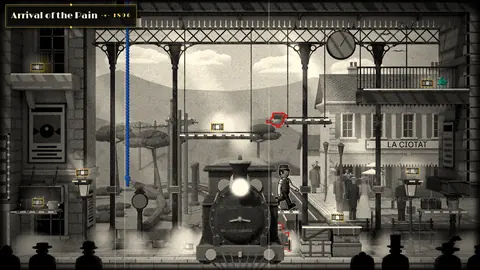 1896
Arrival of a Train at La Ciotat
Our room: Arrival of the Pain
-
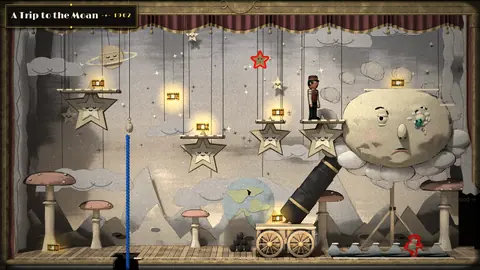 1902
A Trip to the Moon
Our room: A Trip to the Moan
-
 1923
Safety Last!
Our room: Safety Second
Free, in a desktop browser or as a download for Windows, Mac and Linux.
Quick answers
What is A Free Soul (1931) about?
Jan Ashe, the daughter of a brilliant, drunken San Francisco defence lawyer, leaves her respectable fiancé for a gangster. When her fiancé shoots the gangster, her father defends him in court and makes a speech that costs him his life.
Who is in A Free Soul?
Norma Shearer plays Jan, Lionel Barrymore her father Stephen, Leslie Howard her fiancé Dwight Winthrop and Clark Gable the gangster Ace Wilfong. James Gleason plays Eddie. Clarence Brown directed.
Did Lionel Barrymore win an Oscar for A Free Soul?
Yes. He won Best Actor at the 4th Academy Awards, held on 10 November 1931. The other nominees were Jackie Cooper, Richard Dix, Fredric March and Adolphe Menjou.
Was A Free Soul Clark Gable's first film?
No. Gable had played smaller parts for some time. This is the role usually credited with moving him from supporting player to leading man.
Is A Free Soul based on a true story?
It is based on a novel. Its author, Adela Rogers St. Johns, was the daughter of the Los Angeles trial lawyer Earl Rogers, who drank heavily, and the father and daughter in the story are generally said to draw on them.
Is A Free Soul a pre-Code film?
Yes. It was made before the Production Code was enforced, and it shows a young woman's affair, a gangster's bullying and an alcoholic hero without moral apology.
Was A Free Soul remade?
Yes. MGM made it again in 1953 as The Girl Who Had Everything, with Elizabeth Taylor and William Powell.
Is A Free Soul in the public domain?
Not yet in the United States, by the copyright record. It is due to enter the public domain there on 1 January 2027, with the other works of 1931. Rules in other countries differ.
Sources and further reading
- A Free Soul, Wikipedia: credits, dates, source novel and play, awards, box office, Gable's breakthrough
- Films entering the US public domain on 1 January 2027, Public Reel: the copyright record for the film and the rule for 1931
- 4th Academy Awards, Wikipedia: the ceremony, the nominees and winners
- Earl Rogers, Wikipedia: the lawyer, his drinking, his daughter and her 1927 novel
- Lionel Barrymore, Wikipedia: his Oscar and his health in 1931
- A Free Soul (1931) review, Pre-Code.com: the film's frankness, its crimes, its ending, Gable's part
- Pre-Code Retrospective: A Free Soul (1931), The Movie Waffler, 2012: the story, Gable's casting and the courtroom climax
- A Free Soul (1931), Dear Mr. Gable: the role, the fan letters and the reviews