
Palace Picture House · Programme note
The Blue Angel 1930
A respectable professor follows his pupils into a cabaret, and a stage actress called Marlene Dietrich walks out of it into Hollywood.
By HertzyPertzy · Updated · 5 minute read
In short
Der blaue Engel (The Blue Angel) is a German talkie of 1930, directed by Josef von Sternberg for UFA, with Emil Jannings as a schoolteacher destroyed by his passion for the cabaret singer Lola Lola, played by Marlene Dietrich. It is loosely based on Heinrich Mann's novel Professor Unrat. Shot in German and English at the same time, it made Dietrich an international star and took her and Sternberg to Hollywood. The Nazis despised it, and it entered the US public domain on 1 January 2026.
Watch the film
It is not played on this page: see where to watch it.
Find where to stream, rent or buy it, on JustWatch.
- Original title
- Der blaue Engel ("The Blue Angel")
- Released
- Berlin premiere at the Gloria-Palast on 1 April 1930 by most accounts (one source gives 31 March)
- Made by
- UFA, Berlin. Director Josef von Sternberg; producer Erich Pommer; music Friedrich Hollaender
- Written by
- Carl Zuckmayer, Karl Vollmoeller and Robert Liebmann, from Heinrich Mann's novel Professor Unrat (1905)
- Cast
- Emil Jannings (Professor Rath), Marlene Dietrich (Lola Lola), Kurt Gerron (the magician Kiepert)
- Filmed
- 4 November 1929 to 22 January 1930, at the UFA studios in Neubabelsberg near Berlin; a German and an English version made side by side
- Length
- About 108 minutes; sources give anything from 107 to 124 minutes depending on the print
- Copyright
- Public domain in the United States since 1 January 2026, as the 1930 works were listed. In Germany and the EU the term runs 70 years after the last of the director, writers and composer died, so it is far from over. Restorations and recorded scores have rights of their own
The story
Immanuel Rath is a professor at a high school in a German town, a man of rules and routine whose pupils do not like him. When he learns that some of them spend their evenings at a cabaret called The Blue Angel, he goes there to catch them. He finds instead the headliner, Lola Lola, and her troupe.
He returns, and keeps returning. He marries her. The school dismisses him, and the respectable man who once taught others how to behave becomes a dependant on a travelling show. Lola's troupe puts him to work, first as a hand, then as a clown. When the troupe plays his own home town, he is made to appear on stage in front of people who know him. By the end he has seen Lola with the strongman Mazeppa, goes mad, and dies at his old desk at the school.
Reviewers have often noticed how cruel the film is. It has few jokes, and the fall is shown in detail, step by step.
Who made it
The producer was Erich Pommer of UFA, who brought the American director Josef von Sternberg to Berlin. By one account Sternberg turned down a project about Rasputin and proposed Heinrich Mann's novel Professor Unrat of 1905, a satire of middle-class hypocrisy in the German provinces instead. The script is credited to Carl Zuckmayer, Karl Vollmoeller and Robert Liebmann. The film drops the second half of the book and gives the professor an ending of its own: the descent into jealousy and madness is, by most accounts, Sternberg's.
The lead was Emil Jannings, the first winner of an Academy Award for acting, lately returned from Hollywood and the star Sternberg had directed in The Last Command. Kurt Gerron, a cabaret veteran, plays the magician. The music is by Friedrich Hollaender, and Liebmann wrote the lyrics. Hollaender wrote the songs to suit Dietrich's limited range.
Shooting ran from 4 November 1929 to 22 January 1930 at UFA's studios at Neubabelsberg. Sound was new to German film, and the company made two versions at once, one in German and one in English, with the same actors speaking their lines twice. The camerawork credit for the English version alone goes to Hans Schneeberger, according to the German reference works. The English version was long considered lost and has since been restored.
Finding Lola
Several actresses were considered for Lola Lola, among them Trude Hesterberg, Brigitte Helm and Lucie Mannheim, and one, Käthe Haack, had been signed already. Sternberg met Marlene Dietrich through Karl Vollmoeller. She was a stage actress with a handful of small film parts, and he wanted her.
The songs were the hits. The best known is "Ich bin von Kopf bis Fuß auf Liebe eingestellt", later known in English as "Falling in Love Again". Others sung by Lola include "Nimm dich in Acht vor blonden Frau'n" and "Kinder, heut' abend, da such' ich mir was aus". Dietrich, in her own later career, was a concert singer.
On set, Jannings is said to have resented the attention paid to his co-star, and to have thrown tantrums, even, as the story goes, threatening to strangle her. It is a story told often and sourced thinly, so take it as the gossip it may be.
The premiere and the departure
The film opened at the Gloria-Palast on the Kurfürstendamm in Berlin. Most sources give 1 April 1930; one gives 31 March. UFA's owner, Alfred Hugenberg, a right-wing press baron, is said to have objected to the involvement of the socialist Heinrich Mann and held up the release, before relenting for money's sake. Mann himself was, by one account, angry at how much the film made of Dietrich's body.
The audience was enthusiastic. Critics were divided: Carl von Ossietzky found the film sentimental and dull, while Herbert Ihering admired Dietrich's cool, detached playing. Dietrich left Germany on the evening of the premiere. Sternberg and she sailed for New York and she signed with Paramount, where she made Morocco and a string of other films with him. She refused to come back to Germany for the rest of the Nazi years, though by one account Hitler's government tried to lure her.
Under the Nazis
The Nazi press was hostile from the first. The party paper, the Völkischer Beobachter, attacked it as an alien, "Jewish" attack on German values and schools. After 1933 the film was banned. Its makers fared very differently. Hollaender, who was Jewish, left Germany in 1933 for Paris and then America, and wrote music for more than a hundred films there. Gerron left for Paris and Amsterdam, was arrested, and was murdered at Auschwitz. Jannings stayed, worked for UFA under the Nazis, and was forbidden to act after 1945. By one account, Hitler kept a private copy of the film that he screened often.
Why it matters
It made Marlene Dietrich. Her Lola, bored, cool and cruel, became the image of the star, and led to the Hollywood partnership with Sternberg.
It was an early German talkie that used sound as a stage. The cabaret songs are not decoration: they are how the film speaks about desire and humiliation.
It is a downfall story told without comfort. Critics such as Andrew Sarris see in it a tragedy of lost authority. It has been remade, in 1959, and echoed in Fassbinder's Lola (1981).
Its rights are still a patchwork. The film is free in the United States since 1 January 2026. In Germany and the EU the term of protection is counted from the deaths of its makers, the latest of whom, Zuckmayer, died in 1977, so it runs on for decades yet.
On the same programme
Some of these films are rooms you can play
These notes come from Reel Trouble, a comedy platformer through film history. Every room in it is a movie set, built from scratch as a parody of a real film, and a fall is never a death: it is a retake.
-
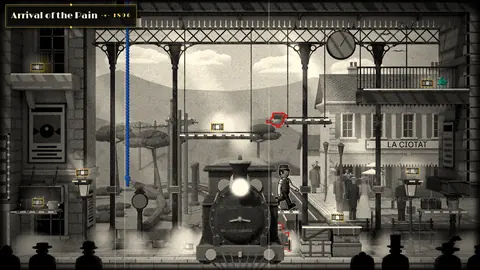 1896
Arrival of a Train at La Ciotat
Our room: Arrival of the Pain
-
 1902
A Trip to the Moon
Our room: A Trip to the Moan
-
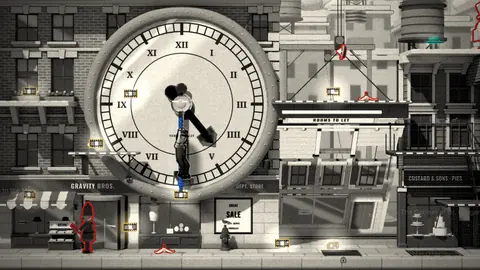 1923
Safety Last!
Our room: Safety Second
Free, in a desktop browser or as a download for Windows, Mac and Linux.
Quick answers
What is The Blue Angel about?
Professor Rath, a strict schoolmaster, goes to a cabaret to catch his pupils and falls for its singer, Lola Lola. He marries her, loses his post and ends as a clown in her troupe, where he is humiliated and goes mad.
Who plays Lola Lola in The Blue Angel?
Marlene Dietrich, then a stage and minor film actress in Berlin. The part made her an international star, and she left for Hollywood with Josef von Sternberg.
Is The Blue Angel based on a book?
Yes, on Heinrich Mann's 1905 novel Professor Unrat. The film keeps only part of it and gives the professor a tragic end of its own.
Was The Blue Angel made in English as well as German?
Yes. German and English versions were shot at the same time with the same principal actors. The English version was long thought lost and has since been restored.
What songs does Marlene Dietrich sing in The Blue Angel?
Friedrich Hollaender wrote them. They include "Ich bin von Kopf bis Fuß auf Liebe eingestellt", known in English as "Falling in Love Again", and "Nimm dich in Acht vor blonden Frau'n".
Did the Nazis ban The Blue Angel?
Yes. They condemned it on release and banned it after taking power in 1933, partly because of its Jewish makers. Hitler is said to have kept a copy of his own.
Is The Blue Angel in the public domain?
In the United States, yes: 1930 works entered the public domain on 1 January 2026. In Germany and the EU its makers' deaths, up to 1977, put the end of protection decades away.
Sources and further reading
- The Blue Angel, Wikipedia: credits, plot, production and release as reported
- Der blaue Engel, German Wikipedia: shooting dates, songs, premiere, versions
- The Blue Angel, Turner Classic Movies, article on the production, writers, casting and Jannings
- Vor 90 Jahren: Marlene Dietrich und "Der blaue Engel", Berliner Zeitung, on the premiere and its reception
- Radical Object: The Blue Angel (1930), History Workshop, on the film under the Nazis
- Emil Jannings, PBS, Cinema's Exiles
- Friedrich Hollaender, Wikipedia: his songs, exile and death
- Betty Boop, Blondie and Nancy Drew enter the public domain in 2026, PBS NewsHour, on the 1930 works