
Palace Picture House · Programme note
Pandora's Box 1929
Germany scorned the American actress, censors cut the film to pieces, and decades later it made Louise Brooks a legend.
By HertzyPertzy · Updated · 6 minute read
In short
Die Büchse der Pandora (Pandora's Box) is a German silent film of 1929, directed by G. W. Pabst from two plays by Frank Wedekind. Louise Brooks, an American, plays Lulu, a young woman whose charm ruins the men around her and, in the end, herself. The Berlin critics disliked it, and censors in many countries cut it or changed its ending. It was rediscovered from the 1950s, and is now counted a classic of Weimar cinema and Brooks's finest work.
Watch the film
It is not played on this page: see where to watch it.
Find where to stream, rent or buy it, on JustWatch.
- Original title
- Die Büchse der Pandora ("The Box of Pandora")
- Released
- Passed by the Berlin censor on 30 January 1929; premiere at the Gloria-Palast, Berlin, on 9 February 1929
- Made by
- Nero-Film, Berlin. Director G. W. Pabst; script by Pabst and Ladislaus Vajda; producer Seymour Nebenzal; camera Günther Krampf
- Cast
- Louise Brooks (Lulu), Fritz Kortner (Dr. Schön), Francis Lederer (Alwa), Alice Roberts (Countess Geschwitz), Gustav Diessl (Jack the Ripper)
- Based on
- Frank Wedekind's plays Erdgeist (1895) and Die Büchse der Pandora (1904)
- Length
- About 131 to 133 minutes in the full German version; American and French releases ran much shorter
- Format
- Silent, black and white, 35 mm, German intertitles
- Copyright
- In the public domain in the United States since 1 January 2025. In Germany and the EU it stays protected to the end of 2037, seventy years after Pabst's death in 1967
The story
Lulu is young, beautiful and has no idea of the harm she does. In Berlin she is the lover of Dr. Ludwig Schön, a newspaper publisher, who means to marry someone respectable. Lulu is not content to be set aside. Schön's son Alwa, a composer, falls for her too, and so does the Countess Geschwitz, who adores her from the start.
On the night of her wedding to Schön, a shot is fired and he dies. Lulu is tried for murder. Her friends help her escape, and she flees abroad, first to a gambling ship, then to London with Alwa and the old Schigolch, who may be her father or her protector. Poor and desperate, she takes to the streets on Christmas Eve. The man she brings home is Jack the Ripper, and he kills her. The film shows it plainly and does not dwell on it.
Wedekind's Lulu
The film comes from two plays by Frank Wedekind: Erdgeist (1895) and Die Büchse der Pandora (1904), the Lulu plays. They were notorious in their day for their attack on the manners of imperial Germany. Wedekind himself is quoted as calling Lulu the personification of primitive sexuality, and on the stage she was a man-eater, a femme fatale and a male fantasy. The plays had been filmed four times before Pabst took them on, and the composer Alban Berg later made his opera Lulu from them.
G. W. Pabst, an Austrian working in Berlin, and his co-writer Ladislaus Vajda compressed both plays into one film. They also changed Lulu. In their hands she is less a destroyer than an innocent whose nature happens to destroy, a "New Woman" of the 1920s. Many Berlin critics thought this a travesty of Wedekind. Others have since argued that it is a better film for it.
An American as Lulu
Pabst looked for his Lulu for a long time, by his own account and that of most writers, and found her on the screen in Howard Hawks's A Girl in Every Port (1928). Louise Brooks, then about 22, was under contract to Paramount. She had just quit the studio in a dispute over a promised rise, and so she was free to go to Berlin.
A famous story says Marlene Dietrich was sitting in Pabst's office ready to sign when Brooks became available. Brooks herself told it, and sources differ in the details. What is agreed is that Dietrich was his other choice and that he thought her too old and too obvious for the part. He wanted, as he later wrote, innocence together with the power to project sexuality.
German audiences and critics did not forgive him for choosing an American. Brooks was called a non-actress. By one account Pabst warned her during the shoot that her life was exactly like Lulu's and that she would end the same way. Treat that as a story she told, not a proven remark.
The Countess
Countess Geschwitz is Lulu's devoted admirer, a woman in a man's evening clothes. She is played by Alice Roberts, who is described as a Belgian actress. Pabst is said to have coached her in the manner the part required, and she was reported to be uneasy about it. On Lulu's wedding night the two dance cheek to cheek, the scene most often cited.
Careful sources call Geschwitz one of the first openly lesbian characters in film, and the dance one of the first such scenes. Some writers go further and call her the first, but earlier films hinted at such love, and what counts as open is itself disputed. This was also the part that censors cut first.
Berlin, and the censors
The censor passed the film in Berlin on 30 January 1929. The premiere followed at the Gloria-Palast on 9 February. Brooks had already gone back to America and was not there. The reception was lukewarm, and critics mocked the American lead.
Abroad it was cut to ribbons. The French version, also shown in Britain, removed the Countess, acquitted Lulu and left out the Ripper. The shortened American versions ended with Lulu joining the Salvation Army. Finland, Norway and Sweden banned the film. In the United States, The Film Daily complained that the censors had cut it to pieces, and the New York Times called it a disconnected melodramatic effusion, though filmed better than its story deserved. It was later banned in Germany from 1933 to 1945.
Brooks, forgotten and found
Brooks made one more film for Pabst, Diary of a Lost Girl (1929), then returned to America. Hollywood had little for her. She is said to have been unwelcome after leaving Paramount, and a story that her voice was unfit for sound is disputed; Brooks said another actress had dubbed her. Her last film came in 1938. She was later a dancer, a radio actress, a shop assistant and a writer, and for some years, by her own account, she was close to ruin.
In the mid-1950s French film historians, among them Henri Langlois of the Cinémathèque française, rediscovered her work. Langlois is reported to have said:
There is no Garbo! There is no Dietrich! There is only Louise Brooks!
Henri Langlois, as quoted in Senses of Cinema
James Card, a curator at the George Eastman House, brought her to Rochester, New York, in 1956, where she became a respected writer on film. Her essays, among them "Pabst and Lulu" (1965), are collected in Lulu in Hollywood (1982). Many of them are about this film. She died in Rochester in 1985.
Why it matters
It is the part Brooks is remembered for. Roger Ebert wrote that she regards us from the screen as if the screen were not there, and put the film in his Great Movies list.
It put a lesbian character on the screen, openly for its time. Careful sources say "one of the first", and stop there. Censors in many countries took her out.
It shows what censorship does to a film. The cuts removed the Countess, acquitted Lulu and gave her a happy ending, and the film's first audiences abroad saw a different one.
Its rights are split. In the United States it has been in the public domain since 1 January 2025. In Germany and the EU it remains protected until the end of 2037, because Pabst died in 1967. Modern restorations and recorded scores have rights of their own.
On the same programme
Some of these films are rooms you can play
These notes come from Reel Trouble, a comedy platformer through film history. Every room in it is a movie set, built from scratch as a parody of a real film, and a fall is never a death: it is a retake.
-
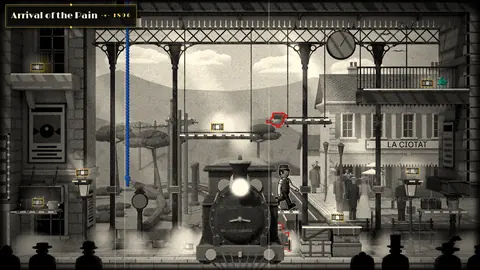 1896
Arrival of a Train at La Ciotat
Our room: Arrival of the Pain
-
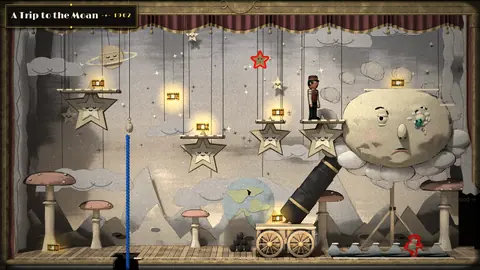 1902
A Trip to the Moon
Our room: A Trip to the Moan
-
 1923
Safety Last!
Our room: Safety Second
Free, in a desktop browser or as a download for Windows, Mac and Linux.
Quick answers
What is Pandora's Box (1929) about?
Lulu, a beautiful and carefree young woman, ruins the men who desire her, and some who love her. A murder trial, flight abroad and a gambling ship lead her to poverty in London, where she is killed on Christmas Eve.
Is Pandora's Box based on a book?
It is based on two plays by Frank Wedekind, Erdgeist (1895) and Die Büchse der Pandora (1904), known together as the Lulu plays. Pabst folded them into one film and softened Lulu, critics have long said.
Why did Pabst cast Louise Brooks as Lulu?
By his own account he searched for a long time and found her in A Girl in Every Port (1928). Sources say he thought Marlene Dietrich, his other candidate, too old and too knowing, and that he wanted innocence with sexuality.
Who plays Countess Geschwitz in Pandora's Box?
Alice Roberts, an actress described as Belgian. Her Countess loves Lulu, and the film is often called one of the first to draw a lesbian character openly, though careful writers say "one of the first".
Who is the killer in Pandora's Box?
Jack the Ripper, played by Gustav Diessl. Lulu meets him on a foggy Christmas Eve in London, and he kills her.
Why was Pandora's Box censored?
Censors objected to its frank treatment of sex, prostitution and the lesbian Countess. The French version, which was also shown in Britain, dropped the Countess, acquitted Lulu and cut the Ripper. Finland, Norway and Sweden banned it.
How did Pandora's Box end in America?
In the cut versions shown in America in 1929, Lulu joins the Salvation Army in a happy ending. The murder was not in them.
Is Pandora's Box in the public domain?
In the United States, yes: the Duke Center for the Study of the Public Domain lists it among the 1929 works that entered it on 1 January 2025. In Germany and the EU it is protected to the end of 2037.
Sources and further reading
- Pandora's Box (1929 film), Wikipedia, with the Criterion booklet essays and the 1929 reviews it cites: the cast, the cuts, the reception
- Pandora's Box, San Francisco Silent Film Festival, on the plays, the casting and the premiere
- Pandora's Box, Turner Classic Movies, on Brooks, Geschwitz and Alice Roberts
- Pandora's Box, Senses of Cinema, 2004, on the London ending and Henri Langlois
- Pandora's Box Opens, EBSCO Research Starters, on Wedekind, Geschwitz and the cuts
- Louise Brooks, Wikipedia, on her career, her return and her writings
- G. W. Pabst, Wikipedia, for the dates of his life
- Public Domain Day 2025, Duke Center for the Study of the Public Domain