
Palace Picture House · Programme note
It 1927
A department-store comedy took a novelist's word for charm, handed it to a shopgirl on screen, and left the language with the It girl.
By HertzyPertzy · Updated · 5 minute read
In short
It is an American silent comedy of 1927, directed by Clarence Badger, in which Clara Bow plays Betty Lou Spence, a shopgirl who sets her heart on the owner's son. It is built on a word, not a book: the novelist Elinor Glyn had defined "it" as a magnetic quality, Paramount paid her for the idea and cast her as herself. The film made Bow the biggest name of her day and gave English the "It girl". It was long thought lost; a print is said to have turned up in Prague in the 1960s, and it joined the National Film Registry in 2001.
Watch the film
The whole film: 75 minutes, silent, with no music. A copy of unstated source.
Played from Wikimedia Commons, which hosts this copy as a public-domain work. Nothing is fetched from there until you press play. If it will not play here, it will on their page.
- Released
- Los Angeles premiere on 14 January 1927; New York showing on 5 February 1927; general release on 19 February 1927, by one account
- Made by
- Famous Players-Lasky, for Paramount Pictures
- Director
- Clarence G. Badger; Josef von Sternberg is said to have worked on it without credit
- Written by
- Elinor Glyn (story and adaptation), Hope Loring and Louis D. Lighton (screenplay), George Marion Jr. (titles)
- Cast
- Clara Bow (Betty Lou Spence), Antonio Moreno (Cyrus Waltham Jr.), William Austin (Monty), Elinor Glyn as herself; Gary Cooper, unbilled, as a newspaper reporter
- Length
- About 72 minutes; the BFI lists 76
- Format
- Silent, black and white, English intertitles
- Copyright
- Public domain in the United States since 1 January 2023, as sources state it; its copyright had been renewed in 1954. Modern restorations and scores have rights of their own
The story
Betty Lou Spence is a shopgirl in a big New York department store, and she has set her heart on its owner's son, Cyrus Waltham Jr. He is, as far as the gossip goes, spoken for by a socialite, Adela Van Norman. Betty Lou does not mind.
After an evening at Coney Island, Cyrus tries to kiss her and she slaps him. Her roommate Molly is a single mother, and when welfare workers call to take the baby away, Betty Lou claims it as her own. Cyrus draws the wrong conclusion and offers her an arrangement that stops short of marriage. She refuses.
To get even, she joins a yachting party as the grand-sounding Miss Van Cortland. Cyrus proposes, and she turns him down again. Then he learns the truth about the baby. Monty, his friend, crashes the yacht, Betty Lou rescues Adela, and the couple make it up. Monty and Adela, by the look of it, will do likewise.
The word, and the novelist
The film is less an adaptation than an advertisement for a word. Elinor Glyn, born in Jersey in 1864, was a British novelist whose romances were thought scandalous in their day and look tame now. She had used "it" in print in 1914 for a quality that "draws all others with magnetic force", and she insisted it could be of the mind as well as the body. Reducing it to sex appeal, as people did at once, was a misreading.
Glyn came to Hollywood after the First World War and became one of the best-known women writing for the screen in the 1920s. Paramount paid her $50,000 for the idea, gave her the credit for story and adaptation, and cast her as herself: in the film she explains "it" to Mr Waltham. A serialised novella appeared in Cosmopolitan and in a book that year, but by most accounts the picture owes more to the idea than to the text. The poet Carl Sandburg wrote that her story was not at all like the film. In the story, moreover, the magnetic character was a man; Paramount made the part a woman, and a working-class one.
Clara Bow
Bow had been at Paramount since 1926, on a five-year deal that rose to $4,000 a week. It is usually called the peak of her career: the San Francisco Silent Film Festival counts it as her 37th film in five years. Her Betty Lou is quick, bold and funny, and she plays the slap, the yacht and the lie about the baby as if she were making them up. The same festival's essay says she was known for improvising, which frustrated some of the directors she worked with.
Antonio Moreno plays Cyrus, and William Austin is Monty. Gary Cooper appears, unbilled, as a newspaper reporter; the two stars had a brief romance, by the accounts. After the film Bow was billed as "The It Girl", and the label has outlived the career. Variety said she ran away with the film. She left the screen in 1933, married the actor Rex Bell in 1931 and had two sons, ran a ranch in Nevada, and died of a heart attack in 1965, aged 60.
Who directed it
The credited director is Clarence G. Badger. Josef von Sternberg, later famous for his films with Marlene Dietrich, is often named as a co-director, and Turner Classic Movies lists him as uncredited. The claim is disputed: Bow's biographer David Stenn writes that Sternberg is often incorrectly credited with directing at least one scene. Sources agree that he was somewhere near the production and differ on what he did.
Release and survival
By one account the film opened in Los Angeles on 14 January 1927, reached New York on 5 February and went into general release on 19 February. Variety reviewed it on 9 February. It was a hit: one source gives $1 million in rentals in the United States and Canada. Its stray scenes were reused in a 1931 Paramount compilation, The House That Shadows Built.
It was then considered lost for many years. By most accounts, though the story rests on thin sources, a nitrate copy was found in Prague in the 1960s. The film survives, with modern prints from the British Film Institute among those shown. In 2001 the Library of Congress selected it for the National Film Registry.
Its copyright was renewed in 1954, and sources say it entered the United States public domain on 1 January 2023, with the rest of the films of 1927.
Why it matters
It made a star and a phrase. "The It girl" was born with this film and has not left the language. Bow became, for a few years, the most talked-about film actress in America.
It sold an idea, not a plot. Paramount bought a word and built a picture round it. Glyn's own appearance as herself is part of the joke.
It shows the flapper comedy at its best. A working girl who outwits the rich boy with nerve is the shape of a hundred later comedies. Betty Lou refuses the offer of an affair and demands more.
It came back from the lost. A film that seemed gone for decades now has its place in the Registry, and by now it is out of copyright in the United States, so more people can see it.
On the same programme
Some of these films are rooms you can play
These notes come from Reel Trouble, a comedy platformer through film history. Every room in it is a movie set, built from scratch as a parody of a real film, and a fall is never a death: it is a retake.
-
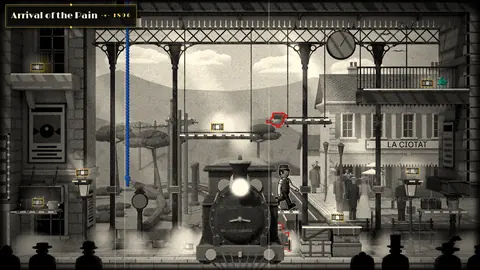 1896
Arrival of a Train at La Ciotat
Our room: Arrival of the Pain
-
 1902
A Trip to the Moon
Our room: A Trip to the Moan
-
 1923
Safety Last!
Our room: Safety Second
Free, in a desktop browser or as a download for Windows, Mac and Linux.
Quick answers
What does "It" mean in the 1927 film?
The film opens with a definition of "it" as a quality possessed by some people that draws all others with its magnetic force. The word comes from Elinor Glyn, who appears in the film to explain it. Glyn said it was not only physical.
Who was the original It girl?
Clara Bow. After this film she was known as "The It Girl", and the label has been used for glamorous young women ever since.
Who wrote It (1927)?
Elinor Glyn is credited with the story and adaptation, Hope Loring and Louis D. Lighton with the screenplay, and George Marion Jr. with the titles. The film follows Glyn's idea more than her novella.
Did Josef von Sternberg direct It?
He is often listed as co-director and is said to have worked on the film without credit. The credited director is Clarence Badger. A biographer of Clara Bow is quoted as calling the credit for Sternberg doubtful, so the extent of his work is disputed.
Was It (1927) a lost film?
It was long thought lost. By most accounts a nitrate copy was found in Prague in the 1960s, and the film survives today.
Is It (1927) in the National Film Registry?
Yes. The Library of Congress selected it for the National Film Registry in 2001.
Is It (1927) in the public domain?
In the United States, yes: the film entered the public domain on 1 January 2023, as works of 1927 did. Modern restorations and recorded scores can have rights of their own.
How long is It (1927)?
About 72 minutes by most listings. The BFI lists 76 minutes, and the time varies with the print and the projection speed.
Sources and further reading
- It (1927 film), Wikipedia: the cast and credits, the plot, the release dates, the Prague print, the Registry selection and the copyright, as reported
- It (1927), Turner Classic Movies, notes on the production and cast
- It, San Francisco Silent Film Festival, programme essay
- It (1927), British Film Institute, film record
- Elinor Glyn, Wikipedia, on Glyn's idea of "it" and her Hollywood career
- Clara Bow, Wikipedia, on her Paramount contract, her career and her later life
- It (1927), Public Domain Movies, on the print found in Prague and the copyright