
Palace Picture House · Programme note
The Phantom of the Opera 1925
Universal built a Paris opera house on a Hollywood stage, Lon Chaney made his own face, and the finished film was cut, reshot and reissued until no single version was left.
By HertzyPertzy · Updated · 6 minute read
In short
The Phantom of the Opera is an American silent horror film of 1925, made by Universal and credited to the director Rupert Julian, with Lon Chaney as the disfigured musician who haunts the Paris Opera and Mary Philbin as the singer he loves. It is based on Gaston Leroux's novel of 1910. Chaney designed his own make-up and the studio kept it secret until the premiere. The production was troubled, the film was recut after bad previews, and it was reissued with sound in 1929, so what survives comes in more than one version. Its unmasking scene, and the Phantom's face, became the image later versions had to answer to.
Watch the film
The whole film: 103 minutes, in the New York general release version of 1925 (the John Hampton print), silent, with no music.
Played from Wikimedia Commons, which hosts this copy as a public-domain work. Nothing is fetched from there until you press play. If it will not play here, it will on their page.
- Released
- Previews in Los Angeles (January 1925) and San Francisco (April 1925); New York premiere at the Astor Theatre in September 1925, dated 6th by most sources and 26th by one; general release 15 November 1925; sound reissue 15 December 1929
- Made by
- Universal Pictures (Carl Laemmle). Director credited: Rupert Julian, with further scenes by Edward Sedgwick and others; camera Charles Van Enger
- Cast
- Lon Chaney (the Phantom), Mary Philbin (Christine Daaé), Norman Kerry (Raoul), Arthur Edmund Carewe (Ledoux), Gibson Gowland (Simon), Snitz Edwards (Florine Papillon)
- Based on
- Gaston Leroux's novel Le Fantôme de l'Opéra (1910)
- Filmed
- Universal's lot in California, from October 1924, the Opera built on Stage 28; further scenes shot in 1925, and again in 1929 for the sound reissue
- Length
- 107 minutes in the original release by most sources. The 1929 reissue is given as 94 minutes. Surviving prints run from about 76 to 92 minutes, depending on the version and the projection speed
- Format
- Silent, 35 mm, 1.33:1; black and white with tinting and, for the masked ball and some stage scenes, two-colour Technicolor; the Phantom's cape coloured by the Handschiegl process; English intertitles
- Copyright
- Public domain in the United States, as sources report: Universal did not renew the copyright. Restorations, tinting and recorded scores are separate work with rights of their own
The story
Gaston Leroux published Le Fantôme de l'Opéra in 1910. In Universal's film, set in the Paris of the 1890s, Christine Daaé is taught to sing by a voice she takes for an angel's. It belongs to a disfigured man who lives beneath the Opera House, kills to advance her career, and carries her down to his lair. When she pulls off his mask she sees his face, and the film shows it to us at the same moment. He lets her go on condition that she stops seeing her sweetheart Raoul. A police inspector, Ledoux, helps Raoul rescue her, and the Phantom dies at the hands of a mob.
The film is regarded as one of the more faithful adaptations of the book, with changes: the managers differ, Ledoux is new, and the film gives the Phantom no Persian past. Carl Laemmle, Universal's chief, is said to have read the novel after Leroux gave him a copy in 1922, and bought it as a vehicle for Lon Chaney.
Chaney's face
Chaney designed the make-up himself, and by most accounts the studio kept it secret until the premiere. Descriptions of it come mostly from the cameraman Charles Van Enger and the film historian Scott MacQueen, as quoted in American Cinematographer: wadding to raise the cheeks, an exaggerated skullcap, blackened eye sockets, false teeth held on prongs, and wires in the nostrils that are said to have made his nose bleed. Van Enger recalled that shooting went on regardless. Chaney's own line was that the horror came from paint and lighting, not from a mask.
The unmasking is the film's famous moment, and the stories round it are mostly legend. It is often said that audiences screamed or fainted. That is repeated everywhere and sourced almost nowhere. It is safer to say that the reveal was built to be the high point of the film and sold as such.
The set and the shoot
Universal built the Opera on its Stage 28, at 360 by 145 feet one of the largest on the lot, with the scenery based, as one programme note has it, on the plans of the real Palais Garnier. Van Enger said it was still too small for the long shots. The set was so solid that Universal used it again, including for the 1943 remake with Claude Rains. When the stage was demolished in 2014, the Phantom set was taken down and put in storage. The budget is given as $632,357.
The shoot was unhappy. Shooting began in mid-October 1924 and ran about ten weeks, with some 350,000 feet of negative exposed. Van Enger said Chaney and the director Rupert Julian would not speak to each other, so he carried messages between them. The first cut ran nearly four hours, and the studio demanded no more than twelve reels.
Then came the previews. The first, in Los Angeles on 26 January 1925, went badly: audience cards are said to have complained of too much spook melodrama. A second version was previewed in San Francisco in April and was also poorly received. Reshoots followed, with new scenes and comic subplots directed by Edward Sedgwick, and the film was cut to nine reels. Sources differ on who did what. Julian is credited, Sedgwick, Ernst Laemmle and Chaney are named as uncredited contributors, and accounts differ on whether Julian left or was dismissed. The ending was also rewritten more than once: a death at the organ was filmed and used at a preview, but not in the general release, which has the mob and the river.
Colour
The film was not all black and white. By Universal's plan the masked ball, the "Bal Masqué", was to be in the natural-colour process Prizma, but Technicolor replaced it, and the two-colour Technicolor cameras shot the ball and some stage scenes. Sources disagree on how much colour there was: a trade review of the time gave seventeen minutes, while the Technicolor records are said to show 497 feet.
The Phantom's red cape on the rooftop was coloured by the Handschiegl process, a stencil method that laid colour on a black-and-white print. The restoration made by Kevin Brownlow's Photoplay Productions in 1996 recreated it with computer colouring, which is a modern addition, not the original.
Premieres and versions
Sources differ on the New York premiere. Most give the Astor Theatre on 6 September 1925, one programme gives 26 September, and the general release followed on 15 November. The music was a compiled score, and accounts differ on whether the composed cues were ready for the premiere.
In 1929 Universal had a sound reissue, which opened on 15 December, with a synchronised score and effects, and new dialogue scenes: nearly half the film was reshot, by Ernst Laemmle and Frank McCormack. The picture was shorter, 94 minutes against 107. That sound version is considered lost, though its disc soundtrack survives.
Today's copies descend from several sources. The best-quality print was made by Universal in 1950 for the George Eastman House and includes the Technicolor ball. Its exact origin is unknown: it may be an edit of the 1929 or a foreign-market version made from second-camera material. Restorations are built on it, and the San Francisco Silent Film Festival says the 1929 recut is the basis of the version it shows. The 1925 cut survives mainly in 16 mm home-market prints, which are poor in quality, and sources differ on how complete they are. Running times therefore vary from about 76 to 92 minutes, depending on version and speed.
Why it matters
It fixed the Phantom's face. The skull-like head, the mask, the cape and the organ are the image most people carry, and Chaney's own make-up is the source. Later versions, the Universal remake of 1943 among them, had to deal with it.
It was an early star's showpiece. Chaney was already known for self-made disfigurement. Here the reveal was the sales pitch, and the film earned about $2 million on its first release, though the contemporary reviews were mixed: the New York Times was divided, Time found it only pretty good.
It points ahead to Universal's horror cycle. It is generally seen as a forerunner of the studio's horror films, beginning with Dracula and Frankenstein in 1931.
It is recognised, and in the United States it is free. It was selected for the National Film Registry in 1998. In the United States it is in the public domain, because Universal did not renew the copyright. The 1929 recut, restorations and scores are separate work.
On the same programme
Some of these films are rooms you can play
These notes come from Reel Trouble, a comedy platformer through film history. Every room in it is a movie set, built from scratch as a parody of a real film, and a fall is never a death: it is a retake.
-
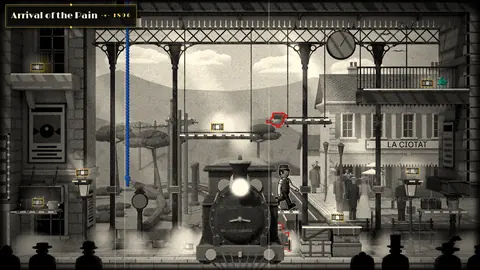 1896
Arrival of a Train at La Ciotat
Our room: Arrival of the Pain
-
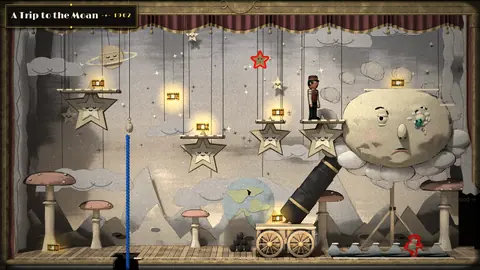 1902
A Trip to the Moon
Our room: A Trip to the Moan
-
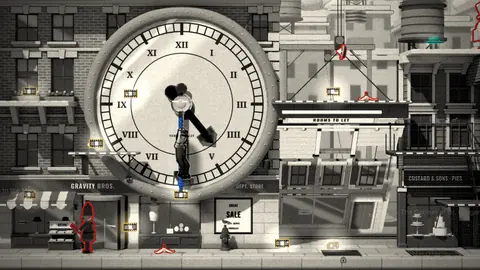 1923
Safety Last!
Our room: Safety Second
Free, in a desktop browser or as a download for Windows, Mac and Linux.
Quick answers
Who played the Phantom in the 1925 film?
Lon Chaney, who designed his own make-up. The studio kept it secret until the film opened.
Who directed the 1925 Phantom of the Opera?
Rupert Julian is the credited director. After bad previews the film was reworked, and Edward Sedgwick directed new scenes. Sources differ on whether Julian left or was dismissed.
Is the 1925 Phantom of the Opera in colour?
Mostly not. Two-colour Technicolor was used for the masked ball and some stage scenes, and the Phantom's cape was coloured by the Handschiegl process. The rest was black and white, often tinted.
Is the 1925 Phantom of the Opera in the public domain?
In the United States, yes: sources report that Universal did not renew the copyright. Restored prints, tinting and new scores are separate work, so a particular release can still have rights attached.
How long is the 1925 Phantom of the Opera?
The original release is given as 107 minutes by most sources. The 1929 sound reissue is given as 94 minutes, and surviving prints run from about 76 to 92 minutes.
Which version of The Phantom of the Opera survives?
Several. The 1929 reissue is the basis of most copies seen today, though its sound version is lost. The 1925 cut survives mainly in 16 mm home prints of poor quality.
Did people really faint at the unmasking?
It is often said that audiences screamed or fainted. The claim is repeated without a firm source, so treat it as publicity legend.
Is the film on the National Film Registry?
Yes. It was selected for the Library of Congress's National Film Registry in 1998.
Sources and further reading
- The Phantom of the Opera (1925 film), Wikipedia: dates, versions, running times, colour, copyright and the Registry, as reported
- Phantom of the Opera, American Cinematographer, on the shoot, the set and the Technicolor scenes, drawing on Van Enger and Scott MacQueen
- The Phantom of the Opera, San Francisco Silent Film Festival, programme page
- The Phantom of the Opera, American Musical Productions, programme notes on the surviving prints and the 1950 Eastman House print
- The Phantom of the Opera: Home Video, Silent Era, listing the editions and the versions on each
- The Phantom of the Opera (1925), Film Studies Center, University of Chicago, print record of a 16 mm release print
- The Phantom of the opera (1925), ACMI, Australian Centre for the Moving Image, collection record
- The Phantom of the Opera (1925), Timeline of Historical Film Colors, on the Technicolor No. II material