
Palace Picture House · Programme note
The Lost World 1925
Willis O'Brien's rubber dinosaurs went to London on screen in 1925, and the film was then cut down so far that it was long thought lost.
By HertzyPertzy · Updated · 5 minute read
In short
The Lost World is an American silent adventure film of 1925, directed by Harry O. Hoyt for First National from Arthur Conan Doyle's 1912 novel. Explorers find living dinosaurs on a South American plateau and bring one home to London. The creatures are rubber-skinned models about 18 inches tall, animated a frame at a time by Willis O'Brien. The film was a hit, was later cut to little more than an hour, and was pieced back together from archive prints. It is the first big step on the road to King Kong.
Watch the film
It is not played on this page: see where to watch it.
Find where to stream, rent or buy it, on JustWatch.
- Opening
- New York, at the Astor Theatre, on 8 February 1925, as usually given
- Made by
- First National Pictures. Directed by Harry O. Hoyt; screenplay by Marion Fairfax, from the 1912 novel by Arthur Conan Doyle
- Effects
- Willis O'Brien, credited as technical director; the creature models were built by Marcel Delgado
- Cast
- Wallace Beery (Professor Challenger), Bessie Love (Paula White), Lewis Stone (Sir John Roxton), Lloyd Hughes (Edward Malone), Arthur Hoyt (Professor Summerlee)
- Models
- About 18 inches tall, by one account; another counts 49 model dinosaurs. Metal armatures under rubber skins
- Length
- 106 minutes on one account; the restoration made from eleven sources is listed at 100 minutes. For decades, worn copies ran little more than an hour
- Format
- Silent, black and white, English intertitles
- Copyright
- Public domain in the United States. Duke's Center for the Study of the Public Domain notes that its copyright was not renewed after the first 28-year term. Restorations and new scores can carry rights of their own
The story
A journal left by the explorer Maple White sends the combative Professor Challenger to a plateau in South America, where, he claims, dinosaurs still live. A party goes with him: a sceptical rival professor, a big-game hunter, a young reporter and, in the film, Paula White. On the plateau they meet dinosaurs and an ape-man, and they are stranded for a time. Wallace Beery plays Challenger, Lewis Stone the hunter Sir John Roxton, Lloyd Hughes the reporter Edward Malone and Bessie Love Paula White. The ape-man is an actor in a hairy suit, not a model.
The film ends in London. Challenger brings back a Brontosaurus, it breaks loose, damages Tower Bridge and swims off down the Thames. That is the film's own invention. In Doyle's novel, serialised in the Strand Magazine in 1912, the animal brought home is a young pterodactyl, and it simply flies away.
Models, a frame at a time
Willis O'Brien had made animated dinosaur shorts since the 1910s, in clay on wooden frames. For this film he hired an art student, Marcel Delgado, to build the creatures. By then they had metal skeletons and rubber skins, and the Library of Congress describes them as built over complex, articulated metal armatures.
The dinosaurs were small. JSTOR Daily gives their height as 18 inches, and Turner Classic Movies counts 49 of them. To make one move, O'Brien shifted it a hair's breadth and photographed it, then did it again. By one account O'Brien did all the animation himself and was lucky to get about 30 seconds of footage from a ten-hour day. Split-screen and other effects put the models in the same shot as the actors.
Doyle, the magicians and the premiere
The best-known story comes from 1922. Conan Doyle, the author of the novel, showed some of O'Brien's test footage to the Society of American Magicians, whose president was Harry Houdini. By most accounts he did not tell them it was a film or how it was made. The newspapers were impressed, and one report is said to have concluded that if the creatures were fakes, they were masterpieces. How far Doyle deliberately played the joke is told differently by different sources, so treat the neat version of the tale with care.
The film opened in New York, at the Astor Theatre, on 8 February 1925, as the date is usually given. First National released it. It was a success: the Chicago Tribune called it a box-office phenomenon, and some audience members are said to have believed the film-makers had found the real thing.
Zambo
The film has a character that modern viewers find hard to watch. Zambo, the expedition's servant, is played by a white actor, Jules Cowles, in blackface. In Doyle's novel Zambo is a strong and loyal figure. In the film he becomes a comic stereotype, and film writers today say plainly that this change has aged badly.
Cut down, and found again
The film did not last in full. A 1929 agreement is reported to have withdrawn the original 1925 prints from circulation, and for decades audiences saw only worn 16 mm copies reduced to little more than an hour. The full-length version was thought to have gone.
It had not quite. From the 1990s, missing footage began to surface, above all a near-complete print in the Czech national film archive. A restoration made with the George Eastman Museum in the late 1990s used it, but gaps remained. Later versions added more: a Blu-ray from Flicker Alley, produced by Serge Bromberg of Lobster Films, carries a new 2K restoration with a score by Robert Israel. Sources date the latest restoration to 2016 or 2017, and one counts eleven sources behind it. The Library of Congress holds two rolls of nitrate, including slated outtakes, and says the search for missing material goes on.
Why it matters
It is an early feature built on stop-motion. The Library of Congress calls it one of the first full-length features to combine stop-motion animation with live actors. Some writers go further and call it the first, but that rests on how "feature" and "first" are defined.
It leads to King Kong. JSTOR Daily says that after this film O'Brien began work on an 18-inch model meant to climb the Empire State Building, and that this led to King Kong eight years later. The Library of Congress notes that Kong's ending reprises a primitive monster loose in a modern city, the film's one big change from the novel.
It is on the National Film Registry. The Library of Congress added it in 1998 as culturally, historically and aesthetically significant.
It shows how films get lost. A hit was trimmed, withdrawn and worn out, then rebuilt from archives in several countries. Because its copyright was not renewed, the film itself is in the public domain in the United States, though restorations and new scores can have rights of their own.
On the same programme
Some of these films are rooms you can play
These notes come from Reel Trouble, a comedy platformer through film history. Every room in it is a movie set, built from scratch as a parody of a real film, and a fall is never a death: it is a retake.
-
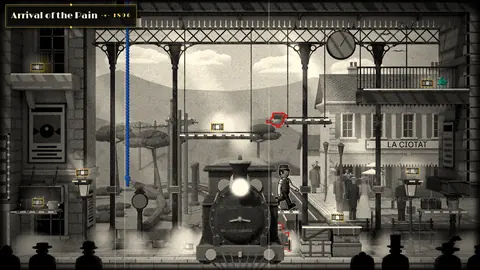 1896
Arrival of a Train at La Ciotat
Our room: Arrival of the Pain
-
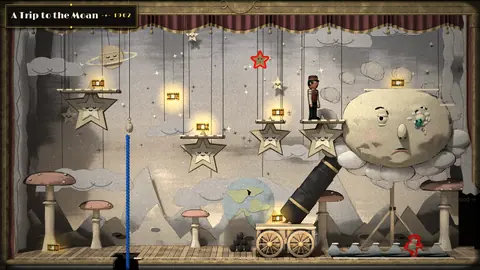 1902
A Trip to the Moon
Our room: A Trip to the Moan
-
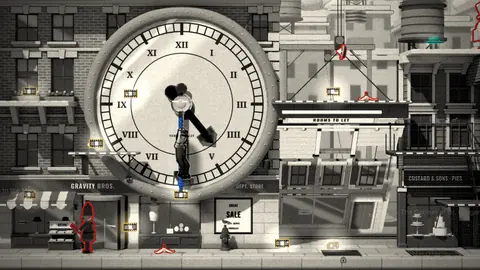 1923
Safety Last!
Our room: Safety Second
Free, in a desktop browser or as a download for Windows, Mac and Linux.
Quick answers
What is The Lost World (1925) about?
A journal leads the irascible Professor Challenger and a party of explorers to a plateau in South America where dinosaurs survive. Challenger brings a Brontosaurus back to London, where it escapes and damages Tower Bridge.
How were the dinosaurs in The Lost World (1925) made?
They were models, about 18 inches tall, built with metal armatures under rubber. Willis O'Brien moved them slightly and photographed each pose, then combined the footage with the live actors by split-screen and other tricks.
Is The Lost World (1925) based on a book?
Yes, on Arthur Conan Doyle's novel The Lost World, serialised in the Strand Magazine in 1912 and published as a book the same year.
Did Arthur Conan Doyle really fool Houdini's magicians with dinosaurs?
In 1922 Doyle showed test footage to the Society of American Magicians, which Harry Houdini headed, without saying how it was made. Press reports of the day were impressed. Accounts differ on how much he claimed.
Was The Lost World (1925) lost?
Not entirely, but for decades only worn copies of about an hour survived. A near-complete print later turned up in the Czech national archive, and restorations have used it with other material.
Did The Lost World influence King Kong?
Yes. Willis O'Brien went from this film to King Kong (1933), and the Library of Congress notes that both set a prehistoric monster loose in a modern city.
Is The Lost World (1925) in the National Film Registry?
Yes. The Library of Congress added it in 1998.
Is The Lost World (1925) in the public domain?
In the United States, yes: Duke's Center for the Study of the Public Domain says its copyright was not renewed. Modern restorations and recorded scores can have rights of their own.
Sources and further reading
- The Lost World (1925 film), Wikipedia, for the cast, the New York opening and the restorations as reported
- The Lost World (Doyle novel), Wikipedia, for the novel's publication and plot
- The Lost World Is 100 Years Old and Still Roaring, Library of Congress, Now See Hear! blog, 2025
- The 1925 Dinosaur Movie That Paved the Way for King Kong, JSTOR Daily
- The Lost World, San Francisco Silent Film Festival
- The Lost World (1925), Turner Classic Movies
- Public Domain Day 2021, Center for the Study of the Public Domain, Duke University