
Palace Picture House · Programme note
Blackmail 1929
Hitchcock began a silent thriller, was told to add sound, and ended up with two films: a talkie that made history and a silent that made more money.
By HertzyPertzy · Updated · 6 minute read
In short
Blackmail is a British thriller of 1929, directed by Alfred Hitchcock for British International Pictures, with Anny Ondra as a young woman who kills a man in self-defence and then falls into the hands of a blackmailer. It began as a silent film and was turned into a talkie part way through, so a silent version and a sound version were both released. The sound version is often called the first British talkie, though careful sources add that it was not quite alone. It also holds the first of Hitchcock's famous London chases, which ends on the dome of the British Museum.
Watch the film
It is not played on this page: see where to watch it.
Find where to stream, rent or buy it, on JustWatch.
- Original title
- Blackmail
- Released
- Trade show on 21 June 1929 at the Regal, Marble Arch, London; London premiere at the Capitol Cinema on 28 July 1929, as one account has it
- Made by
- British International Pictures. Director Alfred Hitchcock; producer John Maxwell; camera Jack E. Cox; editor Emile de Ruelle; from the play by Charles Bennett
- Cast
- Anny Ondra (Alice White, her voice Joan Barry), John Longden (Frank Webber), Donald Calthrop (Tracy), Cyril Ritchard (Crewe), Sara Allgood (Mrs White)
- Filmed
- At British and Dominions Imperial Studios, Elstree, and on London locations including the Underground and the British Museum
- Length
- Sound version 7,136 feet, about 85 minutes; silent version 6,740 feet, about 76 minutes as restored in 2012. Other lists give different running times
- Format
- Black and white, 35 mm. Sound version on RCA Photophone sound-on-film; the silent version in the standard silent frame
- Copyright
- Public domain in the United States since the start of 2025, as a 1929 film. In the UK and EU a film is protected for 70 years after the last of its director, screenwriters, dialogue writers and composer dies: Hitchcock died in 1980 and Bennett, whose play it adapts, in 1995. A restoration or a recorded score has rights of its own
The story
Alice White, a London shopkeeper's daughter, is going out with Frank Webber, a Scotland Yard detective. They quarrel, and she leaves a restaurant with an artist, Crewe, who takes her up to his studio. He tries to rape her. She seizes a bread knife from the table and kills him.
She creeps home and says nothing. Next morning Frank, of all people, is sent to the artist's rooms, where he finds her glove. He keeps it from his colleagues. Then a small-time crook, Tracy, who has seen her leave, turns up at the shop, glove in hand, and begins to squeeze the couple for money. Frank takes charge and the police go after Tracy, who runs through London and ends on the roof of the British Museum. Alice, meanwhile, is left with her conscience.
A silent that grew a voice
The film is based on a play by Charles Bennett, staged in 1928 with Tallulah Bankhead in the lead. It was made at Elstree for British International Pictures, and the producer was John Maxwell. It began as a silent. By most accounts, the success of The Jazz Singer in 1927 led Maxwell to ask for sound, and Hitchcock, who had shot a silent, ended by remaking most of it as a talkie, with his cameras in soundproof boxes. One source says that the producers first meant to add sound only to the last reel, for the chase, and that Hitchcock objected and was allowed to reshoot more. Sources do not fully agree on how much of the sound version was filmed again.
The result was two versions. The sound version runs to about 85 minutes, the silent to about 76. They share their opening reel, and sound begins about six and a half minutes in. The sound version still has silent passages with music and effects, and the final chase uses silent footage with a few stray voices. Which came out first is disputed: the Film Foundation says the talkie reached cinemas two months before the silent, another account says the silent followed shortly after, and a Turner Classic Movies article has both opening together in 1929. What is agreed is the reason for the silent version. Few cinemas could show sound, and it played to the rest. It earned more, and it is said to have won a public poll for the best British film of 1929.
The trade show was on 21 June 1929 at the Regal, Marble Arch. One account gives the London premiere as 28 July 1929, at the Capitol. Both versions survive. The original nitrate negative decayed, but the British Film Institute holds prints of each, and both were restored there in 2012 with the Film Foundation.
The first British talkie?
The British Film Institute calls the sound version Britain's first talkie, and that is how most people say it. A careful reading is more modest. A few part-sound British films appeared at about the same time, among them The Clue of the New Pin. One account calls Blackmail the first artistically significant sound film made in Britain, and not necessarily the first. Another points out that it was not a silent film with talking scenes tacked on, which is how the earlier part-talkies were put together. It was shot for sound, and it uses it.
The best-known sound effect is in the knife scene. The morning after the killing, a gossiping neighbour at the shop chatters about the murder, and the dialogue blurs into noise, except for the word "knife", which keeps jumping out. Alice hears only that. It is one of the earliest uses of sound to put a character's state of mind on the soundtrack, not just her speech.
Alice and her voice
Anny Ondra, the star, was brought up in Prague, and her accent was judged wrong for an English shopgirl. The BFI calls her Polish; her heavy accent is not in dispute. Her voice could not be dubbed afterwards, so the actress Joan Barry spoke Alice's lines off camera, into a microphone, while Ondra mouthed them in front of the camera. Barry went on to star in Hitchcock's Rich and Strange (1931). Some critics find the effect slightly awkward, which would only be natural.
The Underground and the museum
Hitchcock appears about ten minutes in, a passenger on the Underground trying to read a book while a small boy pesters him. It is probably the longest of his cameos. The film is full of London: Whitehall, a Lyons tea house at Piccadilly Circus, and then the climax, in and on the British Museum.
The chase runs through the museum and out over the dome of the Reading Room, where Tracy slips and falls through the glass. Much of it is done with the Schüfftan process, in which a mirror, with part of the silver scraped away, is set at an angle to the camera so that live action and a painted or model background appear in a single shot. The process is best known from Fritz Lang's Metropolis (1927). By one account Hitchcock used it partly because the museum's interiors were too dark to shoot in the normal way, and did so without telling the producers.
Why it matters
It is Hitchcock's first sound film, and his last silent. One of the two versions you see is the end of one era, the other the start of the next, and the director made both from the same material.
It is a landmark of British sound. It is often called the first British talkie. A few part-sound British films came out around the same time, so the careful claim is that it was the first British sound feature of real weight.
It has the first of the famous landmark finales. Hitchcock was to stage chases on the Statue of Liberty and Mount Rushmore, and the British Museum comes first. The BFI also notes that he returned to the knife murder in The 39 Steps and Psycho.
It used sound to tell us what a character feels. The word "knife" in the neighbour's chatter is the best-known moment in the film, and it was made in the year sound came to Britain.
On the same programme
Some of these films are rooms you can play
These notes come from Reel Trouble, a comedy platformer through film history. Every room in it is a movie set, built from scratch as a parody of a real film, and a fall is never a death: it is a retake.
-
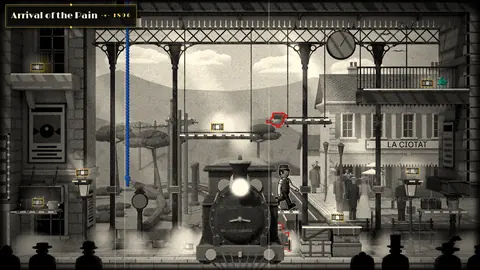 1896
Arrival of a Train at La Ciotat
Our room: Arrival of the Pain
-
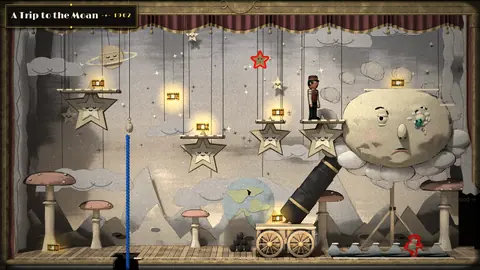 1902
A Trip to the Moon
Our room: A Trip to the Moan
-
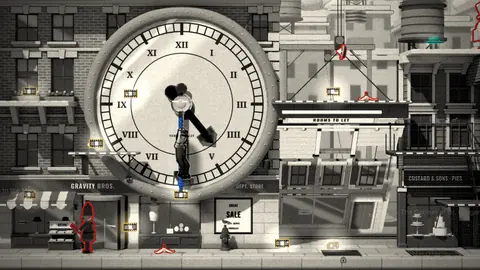 1923
Safety Last!
Our room: Safety Second
Free, in a desktop browser or as a download for Windows, Mac and Linux.
Quick answers
Was Blackmail the first British talkie?
It is often called that, and the British Film Institute describes the sound version as Britain's first talkie. A few part-sound British films came out around the same time, so the claim needs a little care: it was the first British sound feature that mattered.
Is Blackmail a silent film or a talkie?
Both. It was started as a silent, and the producers had sound added, so a silent version and a sound version were released. Even the sound version keeps some silent stretches, and its first reel is shared with the silent one.
Who is the voice of Alice in Blackmail?
The actress Joan Barry. Anny Ondra, who plays Alice, had an accent judged unsuitable for the part, so Barry spoke the lines off camera while Ondra mouthed them.
Where is the Hitchcock cameo in Blackmail?
About ten minutes in, on the London Underground. He is a passenger reading a book while a small boy pesters him.
How was the British Museum chase filmed?
With the Schüfftan process, a mirror trick that combines live action with a painted or model background. By one account the museum's rooms were too dark to film in the normal way.
Is Blackmail based on a play?
Yes, on Charles Bennett's play of 1928, which starred Tallulah Bankhead.
Is Blackmail in the public domain?
In the United States, yes: 1929 films entered the public domain at the start of 2025. In the UK and EU it is still protected, because the term runs from the death of the last of the film's authors, Hitchcock among them (died 1980). Restorations and scores have rights of their own.
Sources and further reading
- Blackmail (1929 film), Wikipedia: the credits, running times, release dates and the Schüfftan work, as reported
- Blackmail (1929), British Film Institute, film record
- Out of the Vaults: Blackmail, 1929, The Film Foundation, on the restoration of both versions
- Blackmail (1929), sound version, Turner Classic Movies, article
- Blackmail (1929), silent version, Turner Classic Movies, article
- Blackmail (1929), Silent Era, lengths, trade show and the surviving prints
- Charles Bennett (screenwriter), Wikipedia, on the play and its author's death