
Palace Picture House · Programme note
Ben-Hur 1925
A novel, a lawsuit, two shoots on two continents and a chariot race made the costliest silent film of its day, and a pile of stories that need sorting.
By HertzyPertzy · Updated · 6 minute read
In short
Ben-Hur: A Tale of the Christ is a 1925 American silent epic directed by Fred Niblo, with Ramon Novarro as a Jewish prince sold into slavery by his Roman friend. Begun by Goldwyn in Italy and finished by the newly merged MGM in California, it is usually called the most expensive silent film ever made, and it did not make its money back at first. Its chariot race is the part everyone remembers. So is the question of who and what died while it was filmed.
Watch the film
The whole film: 141 minutes, silent, with its tints and no music.
Played from Wikimedia Commons, which hosts this copy as a public-domain work. Nothing is fetched from there until you press play. If it will not play here, it will on their page.
- Premiere
- 30 December 1925, New York
- Made by
- Directed by Fred Niblo. Charles Brabin began the shoot in Italy and was replaced; B. Reeves Eason directed second-unit action, including the chariot race. From the novel by Lew Wallace (1880)
- Cast
- Ramon Novarro (Judah Ben-Hur), Francis X. Bushman (Messala), May McAvoy (Esther), Betty Bronson (Mary)
- Studio and cost
- Goldwyn Pictures, then Metro-Goldwyn-Mayer. Turner Classic Movies and others give about $3.9 million, the usual figure; some round it to $4 million
- Earnings
- Sources differ. Turner Classic Movies gives a gross of $9,386,000 and a shortfall for MGM of $850,000; another account gives a loss of $698,000. A 1931 reissue is said to have turned a profit
- Format
- Silent, tinted black and white, with sequences in two-strip Technicolor. Turner Classic Movies lists it at 144 minutes
- Honours
- Selected for the National Film Registry of the Library of Congress in 1997
- Copyright
- Public domain in the United States, as a work published in 1925: Duke's Center for the Study of the Public Domain says published works of 1925 entered it on 1 January 2021. Other countries have their own terms, so this page links to no free copy
The novel and the lawsuit
Lew Wallace, a Union general, published Ben-Hur: A Tale of the Christ in 1880. It became one of the best-selling American novels of its century, and its stage version, by most accounts, ran for 25 years.
The first film of it came in December 1907: a single reel of about fifteen minutes by the Kalem company, made without permission. The publisher, Harper & Brothers, sued, together with Wallace's son and the play's producers, Klaw and Erlanger. In November 1911 the US Supreme Court ruled unanimously against Kalem, in an opinion by Justice Holmes. Making a film of a dramatic work without leave could infringe its copyright. Kalem and its backers are reported to have paid $25,000, and the case is usually described as one that pushed the studios towards buying rights and hiring writers to adapt books. That account of its effect rests on a few sources, so take it as the usual story rather than settled history.
Two shoots, two continents
Goldwyn Pictures bought the film rights in 1922. Shooting began in Rome in late 1923 or early 1924, depending on the source, under Charles Brabin, with George Walsh as Judah. Weather, rising costs and creative differences halted the shoot, and the cast and crew were recalled. Goldwyn had meanwhile become part of the new Metro-Goldwyn-Mayer. Fred Niblo took over as director and Ramon Novarro replaced Walsh. Filming went on in Italy, off Livorno, and in North Africa, until Louis B. Mayer, the new studio's head, ordered the company home. By one account, roughly two years and $3 million had been spent.
Work resumed at the studio in Culver City, California, in spring 1925. B. Reeves Eason and others directed the second unit, and Erté is credited with costumes and sets. The film opened in New York on 30 December 1925.
The chariot race
The race was filmed on a replica of the Circus Maximus built at Culver City. Thousands of extras filled the stands, and William Wyler, then 23, was one of about sixty assistant directors, in charge of his own section of the crowd. Accounts give 42 cameras for the big crowd and master shots. The drivers, mostly horsemen and rodeo riders, are said to have been promised a $5,000 prize. One account gives about 200,000 feet of film shot for the race and 750 feet in the finished sequence. Turner Classic Movies says Irving Thalberg spent $300,000 on it.
A real pile-up is in the film. A wheel broke, and the chariots behind ran into it. Accounts agree that horses died in it, usually put at five.
Beyond that, the record thins. The death of a driver is widely repeated: Bushman is quoted as describing a man thrown some 30 feet who died of internal injuries, and Skeptoid says most film historians accept at least one stuntman was killed. No name or record is given, and the same page notes that records were poorly kept. Totals of a hundred horses or more are also repeated. One account traces that figure to Bushman, as quoted by the historian Kevin Brownlow, and attaches it to the abandoned Italian shoot as much as to the race. Nobody cites a document for it. Animal-welfare campaigners did criticise the wire tripping device used to bring horses down.
A separate legend should be set aside. The story that a stuntman died in the race of the 1959 remake, and that the death is in the film, is false by the studio's records and most of the people there, and dummies were used for the figures run over. The 1925 film is the likelier source of the confusion.
The sea battle and the colour
The pirate battle at sea was, by one account, reshot off Livorno. Popular accounts say a ship caught fire sooner than planned, that extras, many unable to swim, jumped overboard, and that three were missing afterwards. One telling says several were unaccounted for at the head count. Slashfilm notes that there is no official record of what became of them, and writers tell it with different details.
The film was released in black and white, tinted and toned, with some sequences in two-strip Technicolor, mainly those showing Jesus. Reviewers at the time praised the Bethlehem scenes. The colour sections were considered lost until the 1980s, when they turned up in the Czechoslovak film archive. A restoration supervised by Turner Entertainment, made in 1988, put them back. Another, funded by the Hollywood Foreign Press Association for the Film Foundation, followed in 2022.
Cost and afterlife
The cost, about $3.9 million, is called the highest of any silent film. Takings are reported differently: Turner Classic Movies gives $9,386,000 and an $850,000 shortfall for MGM after the Erlanger deal and distribution costs, another account a loss of $698,000. A reissue in 1931 is said to have earned a modest profit. The Library of Congress picked the film for the National Film Registry in 1997.
The 1959 remake, directed by Wyler, built an arena of eighteen acres, took a record eleven Oscars and grossed more than $76 million, by the Library of Congress's account.
Why it matters
It set the scale for the film epic. A purpose-built arena, thousands of extras and dozens of cameras were the price of a race, and Wyler's 1959 remake rebuilt the arena larger still.
It belongs to the story of who owns a story. The suit over the first film is generally cited as a case that showed adapting a book for the screen needs the owner's leave.
It shows what spectacle cost. Horses died for the race, and the totals are still argued over. A film can be thrilling and that fact can stand beside it.
On the same programme
Some of these films are rooms you can play
These notes come from Reel Trouble, a comedy platformer through film history. Every room in it is a movie set, built from scratch as a parody of a real film, and a fall is never a death: it is a retake.
-
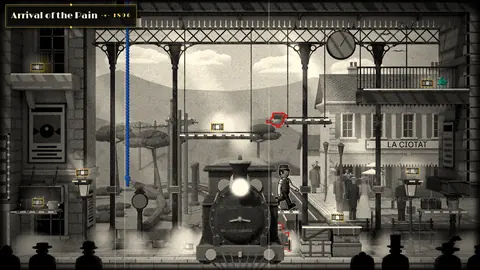 1896
Arrival of a Train at La Ciotat
Our room: Arrival of the Pain
-
 1902
A Trip to the Moon
Our room: A Trip to the Moan
-
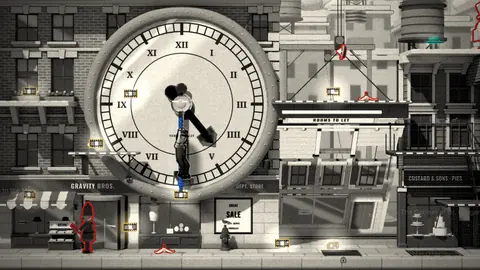 1923
Safety Last!
Our room: Safety Second
Free, in a desktop browser or as a download for Windows, Mac and Linux.
Quick answers
What is Ben-Hur (1925) about?
Judah Ben-Hur, a Jewish prince in Roman-ruled Judea, is betrayed by his boyhood friend Messala and sent to the galleys. He survives, is adopted by a Roman officer, and returns to settle the score in a chariot race. The story runs alongside the life of Jesus, who appears in sequences shot in colour.
Who played Ben-Hur in the 1925 film?
Ramon Novarro. George Walsh was first cast in the part and, by most accounts, was let go while the production was on location in Italy. Francis X. Bushman played his rival Messala.
Did anyone die in the 1925 chariot race?
It is not proven either way. Accounts agree that a crash killed horses, usually put at five. A stuntman's death is widely repeated and is attributed to the recollection of Bushman, but no record of it is cited. Records of the time were poorly kept.
How many horses were killed making Ben-Hur?
Five in the crash is the figure most accounts give. Totals of a hundred or more are also repeated, but they appear to trace back to Bushman's recollection, relayed by the historian Kevin Brownlow, and no document is cited for them.
How much did the 1925 Ben-Hur cost?
About $3.9 million is the usual figure, which sources call the most expensive silent film made. Roughly two years and some $3 million are said to have been wasted in Italy before the move to California.
Is Ben-Hur (1925) in colour?
Partly. It was released in tinted black and white, with some sequences, mostly those showing Jesus, in two-strip Technicolor. The colour sections were long thought lost and were found in the Czechoslovak film archive in the 1980s.
Is Ben-Hur (1925) in the public domain?
In the United States, yes: Duke's Center for the Study of the Public Domain says that published works of 1925 entered the public domain there on 1 January 2021. Rules elsewhere differ, and restorations and new scores may carry rights of their own.
What is the difference between the 1925 and 1959 Ben-Hur?
The 1959 remake was directed by William Wyler, who had worked on the 1925 race as one of its assistant directors. It is in colour with sound and won a record eleven Oscars. The 1925 film is silent and has a much shorter, rougher race.
Sources and further reading
- Ben-Hur: A Tale of the Christ (1925 film), Wikipedia, for the production, cost, earnings, premiere, Registry and Technicolor details given here
- Kalem Co. v. Harper Bros., Wikipedia, on the 1907 film and the suit
- Ben-Hur: A Tale of the Christ (1925), Turner Classic Movies
- Ben-Hur (silent film), EBSCO Research Starters
- The 1925 chariot race and the 1959 stuntman myth, Skeptoid, episode 237
- The Original Ben-Hur Action Sequences Were More Dangerous Than You Think, Slashfilm, on the cameras, the pile-up and the sea battle
- Silence and Silver 27: Ben-Hur: A Tale of the Christ (1925), Fear Her Wrath, Substack, citing Kevin Brownlow on Bushman's account
- Ben-Hur (1959), Gabriel Miller, Library of Congress National Film Registry essay, on Wyler and the 1925 race
- Public Domain Day 2021, Duke Center for the Study of the Public Domain