
Palace Picture House · Programme note
Cimarron 1931
RKO's biggest picture so far staged the 1889 Oklahoma land rush, won Best Picture, probably lost money, and has aged badly in places.
By HertzyPertzy · Updated · 6 minute read
In short
Cimarron is a 1931 American film directed by Wesley Ruggles for RKO Radio Pictures, from Edna Ferber's novel. Richard Dix and Irene Dunne play a newspaper editor and his wife, who settle in Oklahoma after the land rush of 1889 and stay for forty years. It opens with a land rush staged with some 5,000 extras, was RKO's costliest picture to that date, and is usually said to have lost money. It won Best Picture at the 4th Academy Awards, and its treatment of Native Americans and of a Black servant boy is a large part of how it is judged today.
Watch the film
The whole film: 124 minutes, from the Warner Archive's 4K restoration of a safety film print, with its sound.
Played from Wikimedia Commons, which hosts this copy as a public-domain work. Nothing is fetched from there until you press play. If it will not play here, it will on their page.
- Premiere
- New York, 26 January 1931, at the Globe Theatre, according to the report of that day in The New York Times; general release followed in February. Sources vary on the exact dates
- Made by
- Directed by Wesley Ruggles. Screenplay by Howard Estabrook, with Louis Sarecky. Produced by William LeBaron. Photographed by Edward Cronjager; art direction by Max Rée; music by Max Steiner
- Cast
- Richard Dix (Yancey Cravat), Irene Dunne (Sabra Cravat), Estelle Taylor (Dixie Lee), Edna May Oliver (Mrs Tracy Wyatt), Roscoe Ates (Jesse Rickey), Eugene Jackson (Isaiah)
- Studio and cost
- RKO Radio Pictures. Turner Classic Movies gives the cost as $1,433,000, the largest budget of any RKO picture up to then. Film historians' figures for the loss are given in the text
- Source
- Edna Ferber's novel Cimarron, published by Doubleday, Doran in 1930 and the best-selling novel of that year
- Length and format
- About 124 minutes, black and white, sound, 35 mm
- Honours
- 4th Academy Awards, 10 November 1931: Outstanding Production (now called Best Picture), Writing (Adaptation) and Art Direction, from seven nominations
- Copyright
- Public domain in the United States since 1 January 2026, according to Duke's Center for the Study of the Public Domain, which lists it among the films registered for copyright in 1930 although it was released in 1931. Rights outside the United States may differ, so this page links to no copy
The book and the story
Cimarron began as a novel. Edna Ferber's book came out from Doubleday, Doran in 1930 and was the best-selling novel of that year. RKO is reported to have bought it for Richard Dix, an actor under contract to the studio.
Dix plays Yancey Cravat, a newspaper editor, lawyer and adventurer. In the film he joins the Oklahoma land rush of 22 April 1889, and his wife Sabra (Irene Dunne) follows him to the new town of Osage. He stakes his claim, founds a paper and takes up causes. Then he gets restless and leaves, again and again. Sabra stays, runs the paper, raises the children and ends up in Congress. The story runs to about 1929.
Dix insisted on Dunne as his co-star, TCM reports, and she won the part after a screen test. She later judged the film rather hammy. Later critics single out Dunne's performance, and one reference work calls Dix's almost self-parodying.
The land rush
The film opens with the rush, and it is the part everyone remembers. It was shot in the summer of 1930 at the Quinn Ranch, outside Los Angeles, with more than 5,000 costumed extras, wagons, buckboards and horses. TCM credits the action specialist B. Reeves Eason, who had worked on Ben-Hur (1925), with engineering it. Sources differ on the cameras: 28 cameramen in one account, 47 in another. RKO also built the boomtown of Osage in Encino, and its sets later became the core of the studio's movie ranch.
Even critics who like little else in the film praise the opening. It is also where the film's politics begin. By one critic's reading the picture treats the rush as a plain good for America, and rarely stops to consider that the land had belonged to Native peoples, by that writer's account Creek and Seminole land.
The money
RKO was a young studio, formed in 1928, and this was its most expensive picture to that date. TCM gives the cost as $1,433,000. The film historians Richard Jewell and Vernon Harbin, in The RKO Story (1982), say it lost $565,000 at first. A 1994 article by Jewell gives a box office of $1,383,000. Those figures do not subtract to $565,000, and the sources given here do not say why: studio accounts counted more than a film's cost against its takings. Some of the loss was recovered by a re-release in 1935.
Best Picture
The 4th Academy Awards were held on 10 November 1931 at the Biltmore Hotel in Los Angeles, for films released between 1 August 1930 and 31 July 1931. Cimarron had seven nominations and won three: Outstanding Production, which is now called Best Picture, Writing (Adaptation) for Howard Estabrook, and Art Direction for Max Rée. Ruggles, Dix, Dunne and the photographer Edward Cronjager were nominated and did not win.
It is usually called the first Western to win the top prize, and the only one until Dances with Wolves won for 1990. Unforgiven (1992) and No Country for Old Men (2007) have won since. That is the usual count, and the /Film website says the same of the first win. Whether a family saga over forty years is a Western is arguable. Critics now often list it among the weaker winners. Tim Dirks of Filmsite counts it among the undeserving winners.
How it has aged
The film's depiction of two groups is the main reason it is hard to watch.
Isaiah, played by Eugene Jackson, is the Cravats' young Black servant. He is there mostly for comic relief, in speech and behaviour that critics today describe as an embarrassing racist caricature, one of the film's painful stereotypes. Critics do not defend the character: the reviews of recent decades call the portrayal racist.
The Native characters are handled differently, and critics disagree. Yancey writes editorials for Native citizenship and defends Native people, and the Nebraska Encyclopedia of the Great Plains reads him as a consistent voice for tolerance. Sabra begins hostile to Native people and changes. The other reading is that this is a settler's story, told from the settlers' side, in which the people who lost the land are scenery.
The Encyclopedia adds a plainer verdict: it looks slow and talky now.
The 1960 remake
MGM bought the remake rights in 1941 and filmed the story in colour in 1960. Anthony Mann directed, though Charles Walters finished it without credit. Glenn Ford and Maria Schell starred, and it ran 147 minutes. It cost $5,421,000 and, by MGM's own records, lost $3,618,000. Reviews were mixed: Bosley Crowther of The New York Times liked the land rush and found the rest stereotyped and sentimental. Ferber wrote to the newspaper in 1961 that she was not paid for it and objected to its anachronisms and casting.
Why it matters
It is the Western that won, once, then not for nearly sixty years. The gap between 1931 and 1990 is part of why the genre's relation to the Oscars is told as it is.
It shows what a big studio picture cost in 1930, and what it could lose. RKO spent more than ever on a film that won the top prize and, on the studio's own records, still lost money.
It is a clear case of an old hit that cannot be watched innocently. The land rush still works. The picture around it asks the viewer to notice who is, and who is not, treated as a person.
It is now in the public domain in the United States. Duke lists it among the films that entered the public domain on 1 January 2026, as a film copyrighted in 1930.
On the same programme
Some of these films are rooms you can play
These notes come from Reel Trouble, a comedy platformer through film history. Every room in it is a movie set, built from scratch as a parody of a real film, and a fall is never a death: it is a retake.
-
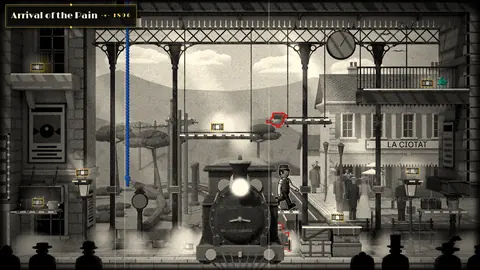 1896
Arrival of a Train at La Ciotat
Our room: Arrival of the Pain
-
 1902
A Trip to the Moon
Our room: A Trip to the Moan
-
 1923
Safety Last!
Our room: Safety Second
Free, in a desktop browser or as a download for Windows, Mac and Linux.
Quick answers
What is Cimarron (1931) about?
Yancey Cravat, a newspaper editor and adventurer, joins the Oklahoma land rush of 1889 and takes his wife Sabra and their child to the new town of Osage. The film follows them to about 1929, through his restlessness and her rise from a reluctant settler to a public figure.
Did Cimarron win Best Picture?
Yes. At the 4th Academy Awards, on 10 November 1931, it won Outstanding Production, the award now called Best Picture, as well as Writing (Adaptation) and Art Direction. It had seven nominations in all.
Was Cimarron the first Western to win Best Picture?
By the usual count, yes, and the only one until Dances with Wolves won for 1990. Unforgiven (1992) and No Country for Old Men (2007) have won since. Whether Cimarron is a Western at all is a question of definition: it is as much a family saga.
Did Cimarron lose money?
It is usually said to have. The film historians Richard Jewell and Vernon Harbin put the initial loss at $565,000, against a cost of $1,433,000 and a box office of $1,383,000, and say some of it was recovered by a re-release in 1935.
How was the land rush in Cimarron filmed?
On a ranch outside Los Angeles, with more than 5,000 costumed extras, wagons and horses, and many cameras. Sources differ on how many: 28 cameramen in one account, 47 in another. TCM credits the action director B. Reeves Eason with engineering it.
Is Cimarron (1931) in the public domain?
In the United States, yes, since 1 January 2026. Duke's Center for the Study of the Public Domain lists it among the films registered for copyright in 1930, although it was released in 1931. Its law is American law only; other countries may differ.
Is there a remake of Cimarron?
Yes. MGM made one in 1960, directed by Anthony Mann and starring Glenn Ford and Maria Schell. It lost a great deal of money and Ferber publicly objected to it.
Why is Cimarron criticised today?
Mainly for its Black servant boy Isaiah, whom critics call a racist caricature, and for treating the land rush as a triumph while barely considering the Native peoples whose land it was. Some writers add that it now looks slow and stagey.
Sources and further reading
- Public Domain Day 2026, Duke Center for the Study of the Public Domain
- Cimarron (1931 film), Wikipedia, for the figures it takes from Jewell and Harbin's The RKO Story and from Jewell's 1994 article, and for the cast and crew
- Cimarron (1930), Turner Classic Movies, on the cost, the staging of the rush, the casting and the film's stereotypes
- The 4th Academy Awards, 1932, Academy of Motion Picture Arts and Sciences
- Cimarron (novel), Wikipedia, on Ferber's book and its publication
- Cimarron (1960 film), Wikipedia, on the remake's cast, cost, reception and Ferber's objections
- Cimarron (film), Encyclopedia of the Great Plains, University of Nebraska-Lincoln
- The First Western To Win Best Picture At The Oscars, /Film
- Cimarron (1931), Filmsite.org, Tim Dirks