
Palace Picture House · Programme note
Dr. Jekyll and Mr. Hyde 1920
John Barrymore changed from saint to monster in front of the camera, in a film built on a stage play rather than on Stevenson's book.
By HertzyPertzy · Updated · 5 minute read
In short
Dr. Jekyll and Mr. Hyde is an American silent film of 1920, directed by John S. Robertson for Famous Players-Lasky and released through Paramount, with John Barrymore in both title roles. It follows Thomas Russell Sullivan's stage play of 1887 more closely than Robert Louis Stevenson's 1886 novella, and so brings in a fiancée, her father and a dancer the book never had. Barrymore's change into Hyde is the film's famous scene. A second, cheaper version appeared the same spring, and this is the one that lasted.
Watch the film
The whole film: 79 minutes, silent, tinted, with its intertitles and no music. An Internet Archive copy, source print unstated.
Played from Wikimedia Commons, which hosts this copy as a public-domain work. Nothing is fetched from there until you press play. If it will not play here, it will on their page.
- Original title
- Dr. Jekyll and Mr. Hyde
- Released
- New York premiere on 28 March 1920; some listings give 18 March, which is the date of the studio's copyright claim
- Made by
- Famous Players-Lasky (producers Adolph Zukor and Jesse L. Lasky), released by Paramount. Director John S. Robertson; screenplay Clara Beranger; camera Roy F. Overbaugh
- Cast
- John Barrymore (Jekyll and Hyde), Martha Mansfield (Millicent Carew), Nita Naldi (Gina), Brandon Hurst (Sir George Carew), Charles Willis Lane (Lanyon)
- Based on
- Thomas Russell Sullivan's stage play (1887), itself drawn from Robert Louis Stevenson's novella (1886)
- Length
- About 79 minutes in the usual listing; one source gives 69. Sources differ, and so do the frame speeds of prints
- Format
- Silent, black and white, with English intertitles
- Copyright
- Public domain in the United States, as sources list it. A film published in 1920 is generally put in the public domain from 1 January 2016; modern restorations and scores have rights of their own
The story
Dr. Henry Jekyll is a London physician, handsome, charitable and engaged to Millicent Carew. Her father, Sir George Carew, is a worldly clubman who teases Jekyll for being too good and says a man should taste a little of every pleasure. Jekyll takes the thought into his laboratory. He believes the soul can be split, and he drinks a drug that lets his lower self out.
That self is Hyde, small, hunched and spidery, with long fingers. Hyde goes slumming, sets up with a music-hall dancer called Gina. Each deed leaves its mark: the film shows him growing uglier as he sins. Jekyll finds that he changes without the drug, in his sleep and in the street, and the cure stops working. Cornered, he kills himself, and Hyde's body turns back into Jekyll's as it dies. The book does not end like that: there Jekyll dies as Hyde.
Stevenson, and the stage between
Robert Louis Stevenson published his novella in 1886. A year later the American actor Richard Mansfield, who wanted a part with a dual role, commissioned Thomas Russell Sullivan to make a play of it. It opened in Boston in May 1887 and reached Broadway that September. Sullivan told the story in a straight line and dropped the book's scientific explanations, since a stage could show the change instead. His Hyde is plainly wicked, his Jekyll a sociable, healthy man with kind motives. The book has almost no women, and he added several, among them Jekyll's fiancée. In the play she is called Agnes, in the film Millicent.
The film follows that play, not the book. The fiancée and her father come from the stage, and so does Hyde's affair with a dance-hall girl, which gives the film a sexual edge Stevenson never wrote. The screenplay is by Clara Beranger. One historian, Troy Howarth, likens the elder Carew to Lord Henry Wotton in Oscar Wilde's The Picture of Dorian Gray, and the film is also said to borrow from that novel.
Barrymore's change
John Barrymore, then a famous stage actor who was playing Shakespeare's Richard III in the evenings while the film was made, played both men. The scene everyone remembers is the first transformation. By most accounts the start of it needs no make-up and no trick photography: Barrymore turns away, covers his face with his hands, and turns back with his face and body twisted into another man. One account says the whole change runs in a single unbroken take of about 1,000 feet of film.
It would be wrong to say the film uses no make-up. The later changes are done with it, and Hyde has a pointed head, elongated fingers and fangs. One reviewer of the restored film calls the no-make-up legend apocryphal, pointing to the visible work on Hyde's hands and skull. Even the prosthetics slip once: on the first change back, one of Hyde's false fingers flies off in Barrymore's convulsions. In a dream sequence Barrymore is also credited as a giant spider.
Gina and the cast
Nita Naldi plays Gina, an Italian dancer and singer, a naughty cabaret performer in one description, whose costumes were thought daring even for 1920. According to her obituary in the New York Times, Barrymore got her the part after he saw her dance at the Winter Garden Theatre. Martha Mansfield is Millicent, Brandon Hurst plays Sir George, and Charles Willis Lane is Dr. Lanyon. The director was John S. Robertson, the cameraman Roy F. Overbaugh, and the producers Adolph Zukor and Jesse L. Lasky.
Two films in one year
There was a second Dr. Jekyll and Mr. Hyde in 1920. J. Charles Haydon directed it and Sheldon Lewis played the double role. It began shooting before the Paramount film, reached cinemas about a month later, in April, and was poorly received. Its producer, Louis Meyer, was worried about copyright and moved the story to modern New York with an altered plot, perhaps for reasons of budget too. This Meyer is not the studio head Louis B. Mayer, whose name sometimes gets attached to it. Haydon is said to have had his own name taken off the credits.
The release date of the Paramount picture is given two ways. The New York premiere was on 28 March 1920, and a crowd is reported to have broken a door and two windows at the first showing. Some listings say 18 March, which matches the date of the studio's copyright claim. The film was a hit: one account puts it seventh among the year's releases, with takings above a million dollars. Today it exists in a good to very good copy from a preserved negative, with some decay, and a few gaps patched from a 16 mm print.
Why it matters
It is one of the first horror films from a Hollywood studio. One recent account calls it likely the first full-length horror film made by a Hollywood studio. Take "first" with care, since early Jekyll and Hyde films go back to 1908, but a big studio and a star did put the story in front of a wide audience.
It fixed the version people know. Most screen Jekylls follow the stage play, not the book. The 1931 sound film, for which Fredric March won an Academy Award, follows the Sullivan plot too, and the 1941 version with Spencer Tracy remade that one. The article on the film's many adaptations counts well over a hundred.
It shows an actor's craft before the make-up. The best-known scene turns on a performer's body and face, which is why writers still discuss it a century later.
It is free to use. As sources list it, the film is in the public domain in the United States, so it can be shown and reworked without asking anyone.
On the same programme
Some of these films are rooms you can play
These notes come from Reel Trouble, a comedy platformer through film history. Every room in it is a movie set, built from scratch as a parody of a real film, and a fall is never a death: it is a retake.
-
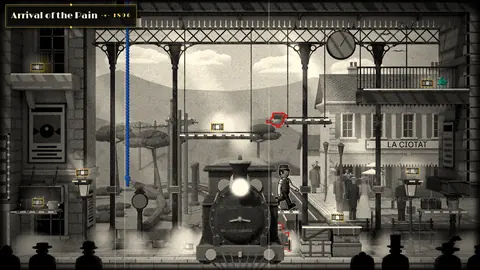 1896
Arrival of a Train at La Ciotat
Our room: Arrival of the Pain
-
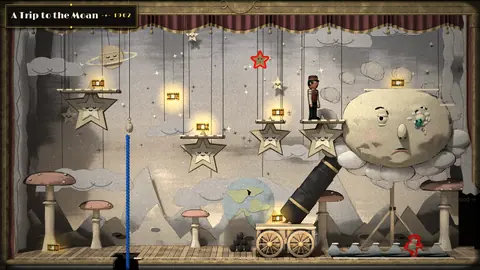 1902
A Trip to the Moon
Our room: A Trip to the Moan
-
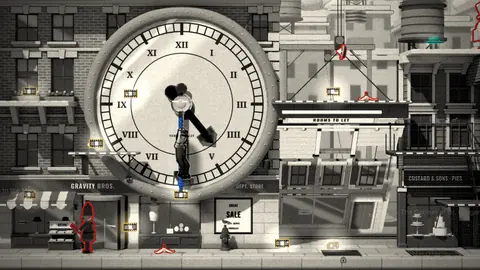 1923
Safety Last!
Our room: Safety Second
Free, in a desktop browser or as a download for Windows, Mac and Linux.
Quick answers
Who played Dr. Jekyll and Mr. Hyde in 1920?
John Barrymore played both roles in the Paramount film directed by John S. Robertson. The other 1920 version starred Sheldon Lewis.
Is the 1920 Dr. Jekyll and Mr. Hyde based on the book?
Only at one remove. The script follows Thomas Russell Sullivan's stage play of 1887, which was drawn from Stevenson's 1886 novella and added characters the book does not have, such as Jekyll's fiancée.
Did John Barrymore change into Hyde without make-up?
By most accounts the start of the first transformation was done with no make-up, by twisting his face and body. Prosthetics such as long fingers and a pointed head come later, so the claim that he used none at all is wrong.
Who is Nita Naldi in Dr. Jekyll and Mr. Hyde?
She plays Gina, a dancer in a music hall who catches Hyde's eye. Her obituary in the New York Times is said to record that Barrymore got her the part after seeing her dance in New York.
Were there two Jekyll and Hyde films in 1920?
Yes. J. Charles Haydon's version with Sheldon Lewis, set in modern New York, appeared in April 1920, a month after Barrymore's, and was poorly received. Its producer was Louis Meyer, not Louis B. Mayer.
When was Dr. Jekyll and Mr. Hyde (1920) released?
It premiered in New York on 28 March 1920. Some listings give 18 March, the date of the copyright claim.
Is Dr. Jekyll and Mr. Hyde (1920) in the public domain?
In the United States, yes, as sources list it. Other countries count copyright differently, and restorations and recorded scores can have rights of their own.
Sources and further reading
- Dr. Jekyll and Mr. Hyde (1920 Paramount film), Wikipedia: credits, departures from the novella, transformation, reception, public domain
- Dr. Jekyll and Mr. Hyde (1920 Haydon film), Wikipedia: the rival version, Sheldon Lewis and its producer
- Dr. Jekyll and Mr. Hyde (1887 play), Wikipedia: Thomas Russell Sullivan, Richard Mansfield and what the play changed
- Adaptations of Strange Case of Dr Jekyll and Mr Hyde, Wikipedia: the many film versions
- Dr. Jekyll and Mr. Hyde (1920), Turner Classic Movies, article on the film: the transformation sequence, Nita Naldi
- Dr. Jekyll and Mr. Hyde, John Barrymore, 105 years on, Inverse, 2025: premiere date, grosses, Barrymore's method
- Dr. Jekyll and Mr. Hyde (1920), Blu-ray review, Silent Era: the make-up, the surviving negative