
Palace Picture House · Programme note
Noah's Ark 1928
Warner Bros. told the Flood and the First World War side by side, then drowned its extras in a real torrent, and the cost of that scene is still argued over.
By HertzyPertzy · Updated · 6 minute read
In short
Noah's Ark is an American part-talkie of 1928, directed by Michael Curtiz for Warner Bros. from a story by Darryl F. Zanuck. It tells the biblical Flood and a modern love story set in the First World War, with Dolores Costello and George O'Brien playing both sets of lovers. Its climax, a flood released on a vast set full of extras, injured many people and is said to have killed some, though the deaths have never been firmly confirmed. The original roadshow cut is lost, and the film is in the US public domain.
Watch the film
The whole film: 107 minutes, a roadshow print with its overture and the film's own Vitaphone sound (music, effects and the few spoken scenes). The uploader does not say which print it is.
Played from Wikimedia Commons, which hosts this copy as a public-domain work. Nothing is fetched from there until you press play. If it will not play here, it will on their page.
- Original title
- Noah's Ark
- Released
- Premiere at Grauman's Chinese Theatre, Hollywood, on 1 November 1928, at about 135 minutes; wider US re-release on 15 June 1929
- Made by
- Warner Bros. Director Michael Curtiz; story by Darryl F. Zanuck; adaptation by Anthony Coldeway; music by Louis Silvers and Alois Reiser
- Cast
- Dolores Costello, George O'Brien, Noah Beery, Louise Fazenda, Guinn "Big Boy" Williams, Paul McAllister, Myrna Loy
- Filmed
- Hollywood studio sets and Californian locations, among them the Iverson Movie Ranch at Chatsworth
- Length
- About 135 minutes in the first roadshow cut, now lost; surviving restorations run about 100 to 108 minutes, depending on the source
- Format
- Part-talkie: mostly silent, with a synchronised Vitaphone score and effects, and some spoken scenes; black and white; English intertitles
- Copyright
- Public domain in the United States since 1 January 2024, as a 1928 film. Outside the US, protection depends on the lifetimes of its makers; modern restorations and recorded scores have rights of their own
The story
The film runs two stories side by side. The modern one opens in 1914 aboard the Orient Express, which is derailed by a washed-out bridge. An American playboy, Travis, and his friend Al rescue Marie, a German member of a small theatrical troupe, and a Russian officer, Nickoloff, tries to force his way into her room at a nearby lodge. A fight breaks out, and French soldiers arrive to announce the outbreak of war. In Paris Travis and Marie fall in love. Al enlists and so does Travis, though he is married, and Al is killed in an attack. Later Nickoloff threatens to have Marie arrested as a spy, and she is sentenced to a firing squad in which Travis finds himself standing.
The couple and others end up trapped under a collapsed building, where a minister compares the war's bloodshed to the biblical flood, and the film turns into his Bible story. The same actors take new parts. Dolores Costello is Miriam, a handmaiden of Noah, and George O'Brien is Japheth, Noah's son. Noah Beery plays the wicked King Nephilim, who has turned his people to a false god. Noah builds the ark, Miriam is chosen for sacrifice, Japheth is blinded in trying to save her, and the flood arrives just as she is about to die. In the modern frame the trapped group is freed and the armistice is signed.
The double structure was not new: UCLA's notes set it beside Intolerance, which had cut between several ages a dozen years before. Here there are only two, and the war and the Flood are meant to rhyme.
Who made it
The director was Michael Curtiz, born in Budapest in 1886. He had made dozens of films in Europe before Warner Bros. brought him to Hollywood in 1926, and he is best known today for Casablanca (1942). The story was by Darryl F. Zanuck, then a rising Warner executive, and the adaptation by Anthony Coldeway. By one account Curtiz's spoken scenes were in fact directed by Roy Del Ruth. Two cinematographers are credited, Barney McGill and Hal Mohr, who also shot The Jazz Singer.
The cast was led by Dolores Costello and George O'Brien. Louise Fazenda, Guinn Williams, Paul McAllister and the young Myrna Loy filled out the parts.
Curtiz's biography calls it Warner Bros.' first epic. It cost about $1,005,000, more than any earlier Warner film. Worldwide rentals of about $2.3 million meant it earned back its cost.
Part-talkie
The film came out a year after The Jazz Singer, when Warner Bros. was still feeling its way with sound. Noah's Ark is a part-talkie. Most of it is silent, with English intertitles and a synchronised score and sound effects on Vitaphone, the studio's sound-on-disc system. A few scenes have spoken dialogue.
It opened at Grauman's Chinese Theatre in Hollywood on 1 November 1928, at about 135 minutes. Soon afterwards Warner Bros. withdrew it and cut around half an hour, among it, by one account, all the talking scenes of Paul McAllister, who played both the minister and Noah. It then played in reserved-seat engagements, followed by popular-price runs, and was reissued in June 1929. Critics were mixed.
The flood
The flood is the reason the film is remembered. The climax drowns the Temple of Moloch, and the studio did it with real water. By one count some 600,000 US gallons were let loose; another account speaks of about 15,000 tons released from reservoirs through chutes hidden in the columns of a set built inside a concrete tank. Several thousand extras were in it. Counts differ widely, from about 3,500 to about 7,500, and one biography of Curtiz says over 10,000.
What happened to them is disputed. The accounts that circulate say three extras drowned, one lost a leg, and others suffered broken bones and worse. The injuries are reported more widely than the deaths. One writer calls the drownings alleged, notes that no firm report of a death has been found in the studio's files, and says it is unclear whether eyewitnesses exaggerated or the studio buried the truth. A film archive's notes call the drownings a legend. Dolores Costello is said to have caught severe pneumonia from the soaking; her own account, as retold, is that Curtiz knew which parts of the set would break away and placed people accordingly.
The cinematographer Hal Mohr is said to have warned the producers about the danger to the extras, been told that they would have to take their chances, and walked off the picture. That story rests on his own telling and on later books. It is also reported that Zanuck and his colleagues tried to keep the matter out of the papers, and that stunt safety rules followed the year after. Treat the figures as claims, not records.
John Wayne, it is said, was among the extras in the water. There is no record of him discussing it, and he cannot be seen in the sequence.
What survives
The 135-minute roadshow version is believed lost. What can be seen are shorter versions. The UCLA Film and Television Archive restored the general release version in 2006, with money from Turner Entertainment and AT&T, and gives its length as 100 minutes; another listing gives 108, with overture and exit music. In 1957 Robert Youngson produced a shorter silent version of about 75 minutes with narration added, which circulated for years in place of the film. A copy of a 1950s television version is held by the Library of Congress.
The film is in the United States public domain, since 1 January 2024, as a 1928 work. Duke's Center for the Study of the Public Domain, which lists that year's films, warns that newly added material, such as a musical accompaniment, may still be protected.
Why it matters
It is Warner Bros.' first epic. A studio that had made its name with small films and sound spent its biggest budget so far on a Bible spectacle with a modern twin.
It shows a studio in the middle of the sound change. A silent film with a recorded score, a few talking scenes and some cuts made after opening is a snapshot of 1928, not of a settled medium.
It is part of the argument about safety on film sets. The flood is cited again and again in the story of how stunt and extras' safety came to be regulated. The details are hard to pin down, which is itself a lesson.
On the same programme
Some of these films are rooms you can play
These notes come from Reel Trouble, a comedy platformer through film history. Every room in it is a movie set, built from scratch as a parody of a real film, and a fall is never a death: it is a retake.
-
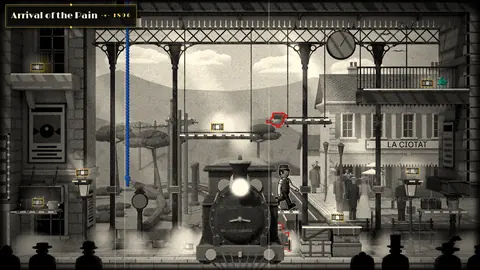 1896
Arrival of a Train at La Ciotat
Our room: Arrival of the Pain
-
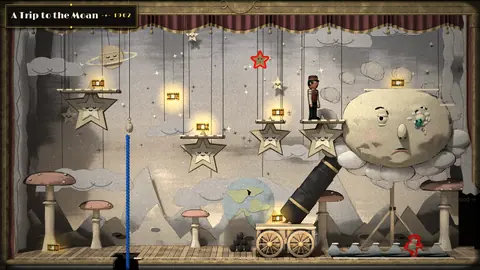 1902
A Trip to the Moon
Our room: A Trip to the Moan
-
 1923
Safety Last!
Our room: Safety Second
Free, in a desktop browser or as a download for Windows, Mac and Linux.
Quick answers
Is Noah's Ark (1928) a talkie?
Partly. Most of it is silent with a synchronised Vitaphone score and sound effects, and some scenes have spoken dialogue. After the premiere the studio is reported to have cut the talking scenes of Paul McAllister.
Did people really die making Noah's Ark?
Injuries are widely reported, including a leg lost and broken bones. The three drownings that are often repeated have never been confirmed, and one account says studio files hold no firm report of a death.
Was John Wayne in Noah's Ark?
He is listed as one of the extras in the flood scene, and so are Andy Devine and Ward Bond. There is no record of Wayne himself speaking about it, and he is not visible on screen in the flood.
Who directed Noah's Ark (1928)?
Michael Curtiz, the Hungarian-born director who later made Casablanca. One account says its spoken scenes were directed by Roy Del Ruth.
How long is Noah's Ark (1928)?
The original roadshow version ran about 135 minutes and is lost. The restoration made by the UCLA Film and Television Archive in 2006 is given as 100 minutes by UCLA and 108 by other sources.
What was the 1957 version of Noah's Ark?
A shortened silent version of about 75 minutes, with narration added, produced by Robert Youngson and released in 1957. It is not the film as it was shown in 1928.
How much did Noah's Ark cost?
About $1,005,000, more than any earlier Warner Bros. film, by the usual figures. Worldwide rentals are given as about $2.3 million.
Is Noah's Ark (1928) in the public domain?
In the United States, yes, since 1 January 2024, as a film of 1928. Restorations and recorded scores are separate work with rights of their own, and the position outside the US depends on the makers' lifetimes.
Sources and further reading
- Noah's Ark (1928 film), Wikipedia: premiere, credits, cast, budget, casualty figures, the 1957 version, restoration and copyright
- Noah's Ark (1929), UCLA Film and Television Archive, screening notes on the 2006 restoration
- The Movie Stunt That Almost Killed John Wayne Before His Rise To Fame, SlashFilm, on the flood scene, its numbers and Hal Mohr
- Noah's Ark: the shocking movie incident that led three actors to drown, Far Out Magazine, on the alleged drownings and the accounts of Dolores Costello and Hal Mohr
- Michael Curtiz, Wikipedia: Curtiz's career and Warner Bros.' first epic
- Dolores Costello, Wikipedia: the star's career and the film's surviving versions
- Public Domain Day 2024, Center for the Study of the Public Domain, Duke University, on 1928 films