
Palace Picture House · Programme note
The Lodger 1927
Hitchcock's first thriller was called unshowable by his distributor, shelved, then recut by a young editor, and his own verdict was that it was his first real picture.
By HertzyPertzy · Updated · 6 minute read
In short
The Lodger: A Story of the London Fog is a British silent thriller of 1926-27, directed by Alfred Hitchcock for Gainsborough Pictures and starring the matinee idol Ivor Novello. It is based on a novel inspired by the Jack the Ripper murders, about a boarding-house family who suspect their new lodger is a killer. It was Hitchcock's third film and his first thriller, and by his own later account the first one that was really his. Its distributor wanted to shelve it, and a re-edit turned it into a hit.
Watch the film
It is not played on this page: see where to watch it.
Find where to stream, rent or buy it, on JustWatch.
- Release
- Early 1927 in Britain: trade and press shows in 1926, public screenings in London from January 1927, and a general release in February 1927. Sources differ on the exact dates. US release 10 June 1928, as The Case of Jonathan Drew
- Made by
- Directed by Alfred Hitchcock. Screenplay by Eliot Stannard, from the novel by Marie Belloc Lowndes. Photographed by Gaetano di Ventimiglia. Editing and titles by Ivor Montagu
- Cast
- Ivor Novello (the lodger), Marie Ault, Arthur Chesney, June Tripp, Malcolm Keen. Alma Reville and Reginald Gardiner appear uncredited, by one account
- Studio
- Gainsborough Pictures, London. Produced by Michael Balcon and Carlyle Blackwell, with C. M. Woolf credited as well on one account. Distributed by Woolf & Freedman Film Service
- Shoot
- Began in February 1926. A budget of about £12,000 is given by one account
- Length
- About 90 minutes in the BFI's 2012 restoration. Listings of restored versions run from 86 to 99 minutes, and the archive version is shorter
- Format
- 35 mm, black and white, silent. The 2012 restoration is tinted and has a new score by Nitin Sawhney, played by the London Symphony Orchestra
- Copyright
- In the United States it has been in the public domain since 1 January 2023, as Duke's Center for the Study of the Public Domain lists it. In the UK and elsewhere it is reported to be protected until at least 2050, seventy years after Hitchcock's death in 1980. Restored, tinted and newly scored versions are reported to have rights of their own
A killer in the fog
Someone is murdering young women in London. A stranger arrives at a boarding house and asks for a room. He is pale, he goes out at night, and he paces the floor above the family's heads. The people downstairs begin to wonder.
The story comes from Marie Belloc Lowndes's novel The Lodger, published in 1913, which grew out of a short story of 1911 and was inspired by the Jack the Ripper murders. Hitchcock is also said to have drawn on a stage version of 1915, Who Is He?, which had already made the lodger an innocent gentleman. The screenplay was by Eliot Stannard, the producer was Michael Balcon of Gainsborough Pictures, and the lodger was played by Ivor Novello, then one of the biggest matinee idols in Britain.
The third film, and the first thriller
It was Hitchcock's third feature as director. The Pleasure Garden and The Mountain Eagle, made in Germany in 1925 and 1926, came first, and the second is now lost. The Lodger began shooting in February 1926 and, by one account, wrapped within about six weeks. It is generally called his first thriller.
It looks German, and that is no accident. Hitchcock had been at the Babelsberg studios near Berlin, where he watched part of F. W. Murnau's The Last Laugh being made, and he admired Murnau. The film's odd angles and uncanny lighting are usually credited to the expressionist cinema he had seen there. The BFI quotes the critic Geoffrey Macnab calling it a moody expressionist film in a specifically English context.
Hitchcock later gave it a special place. Asked by François Truffaut about it, he called it the first true Hitchcock movie, and said you might almost say it was his first picture. That is his own phrase, from conversations held decades later, and some Hitchcock scholars think it overstated.
Shelved, then saved
The finished film did not please the men who had to sell it. The distributor, C. M. Woolf, is said to have called it so dreadful that it should be put on the shelf and forgotten, and Balcon is reported to have been furious. Hitchcock's career at Gainsborough was, on some accounts, in the balance.
Balcon's answer was the young Ivor Montagu, who re-edited the film. By one account he cut the number of title cards by about three quarters, and he is also said to have tightened the cutting and called for some reshot scenes. The designs for the new titles came from the artist Edward McKnight Kauffer, whose stylised lettering gave the film a look of its own. Montagu later claimed that he had dealt with hundreds of intertitles, up to 500, a figure the biographer Donald Spoto thought likely to be an exaggeration. Hitchcock, for his part, never gave Montagu much credit in later interviews, though Montagu is billed for editing and titling.
A trade screening of the new version is said to have changed Woolf's mind. The trade paper The Bioscope, in a review of 16 September 1926, wrote that it was possible this was the finest British production ever made.
The ending, the glass and the cameo
The ending. The lodger is innocent in the film. Hitchcock told Truffaut that he had wanted the audience never to know for sure, but that Novello was a matinee idol and a star cannot be a villain, so the film had to spell out that he was innocent. That is Hitchcock's account, told long afterwards. It sits oddly with the 1915 play, which had already given the lodger a happy ending, and some writers doubt that he was ever meant to be guilty.
The glass floor. The film's best-known trick shows the lodger pacing his room as the family looks up at the ceiling. Hitchcock had a thick sheet of toughened glass laid as the floor, so that the camera could see the man from below. The BFI describes it as a glass floor, and some writers describe it as a transparent ceiling, since it is a view from the kitchen.
The cameo. Hitchcock is usually said to have made his first cameo here: a man seen from behind, at a desk in a newsroom, early in the film. He later said that he took the part because there was a shortage of extras. Some writers dismiss that, since the scene has plenty of extras, and Montagu is said to have told another story. A second cameo, in a crowd late on, is also claimed, and it is disputed.
When did it come out?
Sources do not agree, which is why the film is dated both 1926 and 1927. It was shown to the trade and press in the second half of 1926, with preview shows in September, including one in Nottingham. The public could see it in London from January 1927, and it reached the rest of the country in February 1927. Some sources, following the biographer Donald Spoto, give 14 February 1927 as the release date. The safest description is early 1927. It opened in New York on 10 June 1928, as The Case of Jonathan Drew.
The original negative no longer exists. The BFI National Archive restored the film in 2012 from nitrate prints it has held since the 1940s, with a new score by Nitin Sawhney. It was shown first at the Barbican in London that July and released in cinemas that August.
Why it matters
It began Hitchcock's thrillers. A wrongly suspected man, a handsome star, a London that feels like a trap: Hitchcock would come back to all of it for fifty years.
It shows a studio nearly throwing away a classic. The film was judged unshowable by the man who had to sell it, and it was saved by an editor and a graphic artist working on the title cards.
It was praised as soon as it was seen. The trade press hailed the recut version in 1926, and it has been restored and shown again, with new scores, ever since.
On the same programme
Some of these films are rooms you can play
These notes come from Reel Trouble, a comedy platformer through film history. Every room in it is a movie set, built from scratch as a parody of a real film, and a fall is never a death: it is a retake.
-
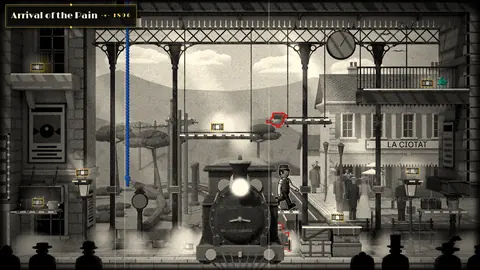 1896
Arrival of a Train at La Ciotat
Our room: Arrival of the Pain
-
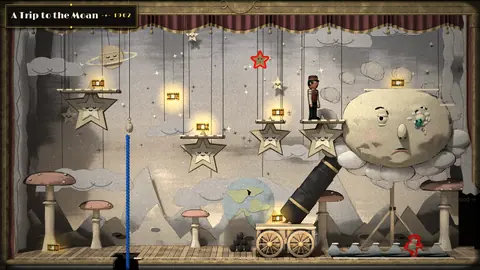 1902
A Trip to the Moon
Our room: A Trip to the Moan
-
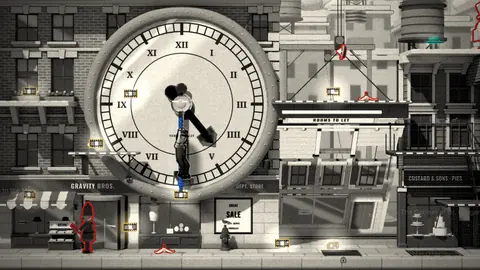 1923
Safety Last!
Our room: Safety Second
Free, in a desktop browser or as a download for Windows, Mac and Linux.
Quick answers
What is The Lodger (1927) about?
A killer is murdering young women in foggy London, and a mysterious man takes a room in a boarding house. The family who own it start to wonder whether he is the murderer. The story comes from a 1913 novel inspired by the Jack the Ripper case.
Was The Lodger Hitchcock's first film?
No, it was his third as director, after The Pleasure Garden and The Mountain Eagle, made in Germany in 1925 and 1926, the second now lost. It is his first thriller. He told François Truffaut that it was the first true Hitchcock movie, and in the same conversation that you might almost say it was his first picture.
Is The Lodger based on a true story?
Not directly. It is based on Marie Belloc Lowndes's 1913 novel The Lodger, which was inspired by the Jack the Ripper murders of 1888. The film invents its own killer and its own London.
When was The Lodger released?
Accounts differ, which is why it is dated both 1926 and 1927. It was shown to the trade and press in 1926, played to the public in London from January 1927 and reached cinemas more widely in February 1927. Some sources give 14 February 1927 as the release date.
Why did Hitchcock change the ending of The Lodger?
By his own account, because the star was Ivor Novello, a matinee idol. Hitchcock told Truffaut that a star cannot be a villain, so the film had to make clear that the lodger is innocent. The stage play it also drew on had already given him a happy ending.
Where is Hitchcock's cameo in The Lodger?
It is usually said to be his first. He sits with his back to the camera at a desk in a newsroom, early in the film. Hitchcock later said he stood in because there was a shortage of extras, a story some writers doubt.
Is The Lodger in the public domain?
In the United States, yes, since 1 January 2023. In the UK it is reported to be protected until at least 2050, seventy years after Hitchcock's death. The BFI's restoration and its score have rights of their own.
Who saved The Lodger from being shelved?
Michael Balcon of Gainsborough brought in the young Ivor Montagu, who cut the film's title cards by about three quarters and had the artist E. McKnight Kauffer design new ones. A trade screening of the new version then won over the distributor C. M. Woolf.
Sources and further reading
- The Lodger: A Story of the London Fog, Wikipedia, for the credits, the novel and play, the shoot and the release dates
- The Lodger (SFSFF programme note), San Francisco Silent Film Festival, on Woolf, Balcon, Montagu, Kauffer and the restoration
- Alfred Hitchcock Collectors' Guide: The Lodger: A Story of the London Fog (1926), part 1, Brenton Film, on the novel, the re-edit, the release dates and the cameo
- Alfred Hitchcock Collectors' Guide: The Lodger, part 2, Brenton Film, on Kauffer and the cameo
- Alfred Hitchcock Collectors' Guide: The Lodger, part 3: restorations and home video releases, Brenton Film, on the 2012 restoration, the lengths and the copyright
- Then and now: The Lodger reviewed, British Film Institute, 2012, quoting the Bioscope's review of 16 September 1926
- The Lodger: A Story of the London Fog, British Film Institute, film page, on the glass floor, Novello and the expressionist style
- Alfred Hitchcock's first true Hitchcock movie faced a studio problem he'd see again, SlashFilm, quoting Hitchcock's conversations with François Truffaut
- Alfred Hitchcock, Wikipedia, on Babelsberg, Murnau, his first films and his dates
- Public Domain Day 2023, Jennifer Jenkins, Duke Center for the Study of the Public Domain