
Palace Picture House · Programme note
Tabu 1931
Murnau and Flaherty set out to film the South Seas together, fell out, and Murnau finished it alone, then died in a car crash a week before it opened.
By HertzyPertzy · Updated · 6 minute read
In short
Tabu: A Story of the South Seas is an American film of 1931, directed by F. W. Murnau and written with the documentary maker Robert Flaherty. It was shot on Tahiti and Bora Bora with Polynesian islanders in the cast, and tells of two lovers whom an old custom pulls apart. Murnau died in a car crash on 11 March 1931, a week before it opened in New York. Floyd Crosby's photography won an Academy Award, and critics still argue over what the film says about the colonial world it shows.
Watch the film
It is not played on this page: see where to watch it.
Find where to stream, rent or buy it, on JustWatch.
- Original title
- Tabu: A Story of the South Seas
- Released
- New York premiere on 18 March 1931, a week after Murnau's death
- Made by
- Murnau-Flaherty Productions; distributed by Paramount. Directed by F. W. Murnau; story and script by Murnau and Robert J. Flaherty; camera Floyd Crosby; music Hugo Riesenfeld
- Cast
- Matahi (the young man), Anne Chevalier (Reri), Hitu (the old warrior), with islanders and a few others
- Filmed
- From late 1929 to 1930 in Tahiti, on Bora Bora and on a small island nearby; edited in Los Angeles
- Length
- Roughly 80 minutes in the common restorations; versions differ
- Format
- Black and white, 35 mm; a synchronised score and sound effects, no spoken dialogue, with intertitles
- Copyright
- Due to enter the public domain in the United States on 1 January 2027, with the other works of 1931. Free in the EU on the usual count: Murnau died in 1931, Flaherty in 1951. Modern restorations and scores are separate
The story
The film comes in two parts, "Paradise" and "Paradise Lost". In the first, on the island of Bora Bora, an old warrior named Hitu arrives with news from the elders: Reri, a young woman, has been chosen as a sacred maiden. From that moment she is forbidden to any man. Matahi, the young man who loves her, takes her away by outrigger canoe.
In the second part the lovers reach a French colony, where Matahi becomes a successful pearl diver. He does not understand money, and falls into debt. Hitu follows, and says he will kill Matahi unless Reri gives herself up. She agrees, and leaves a farewell note. Matahi dives for a pearl in a forbidden stretch of water, swims after Hitu's boat and is cut off from the rope that could save him. He drowns.
The title comes from the Polynesian word tapu, which gave English "taboo". The film has no spoken dialogue, but a synchronised score and sound effects. An opening title says that only native-born islanders appear, with a few people of mixed descent and some Chinese.
Two directors, one film
The idea began as a partnership. F. W. Murnau, the German director of Nosferatu and Sunrise, and Robert Flaherty, who had made Nanook of the North, wrote a story called Turia, drawn partly from a legend Flaherty had heard on an earlier South Seas job, and founded a company. The money was to come from Colorart, a colour-film firm. By one account it paid only a small part of what it had promised, and by late 1929 Murnau was paying for the film himself.
Murnau visited Tahiti in May 1929, and Flaherty came a month later to look at Bora Bora. Filming ran from late 1929 into the autumn of 1930. The crew was tiny. Murnau sent the Hollywood staff home, trained islanders for other jobs, and gave up the idea of colour. Flaherty's camera tore the film, and the young cameraman Floyd Crosby, called out to Tahiti, took over most of the photography.
By most accounts Flaherty thought Murnau's rewritten script too contrived and too Western, and was left with lab work. Crosby later recalled that the two disagreed on almost everything. In October 1930 Flaherty sold his share to Murnau for $25,000. Scholars still weigh how much of the film is his: one view is that Murnau is its true author. The credits give the telling of the story to both men and the direction to Murnau alone.
The cast, and the gaze
The leading players were not professionals. Matahi, who plays the young man, plays more or less himself. Anne Chevalier, who plays Reri, was found by the filmmakers in a cocktail bar in Tahiti. Hitu, the old warrior, is also an islander. They were directed by a European, and the way he looked is now the film's most argued point. The Polynesians are shown in a beautiful and doomed world, which money, the law and the colonial authorities ruin. One recent essay reads this as an earnest attempt to show the damage colonialism does to indigenous people, but one that lacks any self-criticism, carrying instead a kind of white guilt for a vanishing way of life. Other critics have discussed Murnau's own gaze, since he was a gay man making a film in which young men's bodies are lingered over, especially in the opening scenes of spearfishing. One scholar, Jeffrey Geiger, argues that these elements belong with the film's imperial outlook, not apart from it. The two chapter titles, with their echo of Milton, put a European frame over an island story. So does the music: Hugo Riesenfeld's score draws on Romantic composers such as Chopin and Smetana, and the only sung element is an islander song at Reri's ceremony.
The crash, and the release
Murnau edited the film in Los Angeles over the winter. In February 1931 he sold the worldwide distribution rights to Paramount, which let him pay Flaherty. Footage was cut before release, and the film met censorship in the United States for its bare-breasted Polynesian women.
On 10 March 1931 he was travelling up the California coast, from Los Angeles towards Santa Barbara, in a hired car. His driver swerved to avoid a truck, and the car overturned. Murnau suffered a head injury, and died the next day, 11 March, aged 42. The film opened in New York on 18 March, advertised as a Murnau-Flaherty production. His body was taken to Germany and buried near Berlin in April; Fritz Lang spoke, and Flaherty was there.
The film ran for twelve weeks in New York, but found little audience elsewhere in the United States, partly, one account suggests, because a silent picture looked old-fashioned in 1931. By one count it earned less than half a million dollars worldwide, and left Murnau's estate out of pocket. Floyd Crosby won the Academy Award for Best Cinematography. The original negative went to Germany and is said to have been destroyed in the Second World War.
Versions, and what survives
The film exists in several forms: Murnau's own cut from before Paramount's changes, the Paramount version, a heavily cut version of 1950 and a German one. A complete nitrate print of the 1931 release is reported to have been found in 1973, and a preservation negative was made from it. The Deutsche Kinemathek, with the Murnau Foundation and the Austrian Film Museum, has digitised many hours of outtakes and published the script and the shooting reports online.
Why it matters
It is the last picture of a great director. Murnau was 42. Tabu shows what he made once he was free of the studios, with almost no crew and the sea for a set.
It shows how films about other peoples were made. Real islanders, real locations, a European author: it records its own time as much as Polynesia.
It marks the end of the silent style. It was made as a silent picture and released with a recorded score as sound took over. One account says the silence was chosen for artistic, not money, reasons.
It is due to be free. Works of 1931 are due to enter the public domain in the United States on 1 January 2027, and in the EU the film is already free on the usual count, with Murnau dead since 1931 and Flaherty since 1951.
On the same programme
Some of these films are rooms you can play
These notes come from Reel Trouble, a comedy platformer through film history. Every room in it is a movie set, built from scratch as a parody of a real film, and a fall is never a death: it is a retake.
-
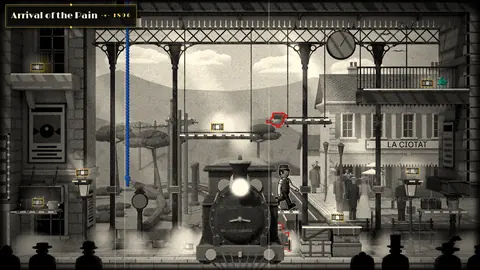 1896
Arrival of a Train at La Ciotat
Our room: Arrival of the Pain
-
 1902
A Trip to the Moon
Our room: A Trip to the Moan
-
 1923
Safety Last!
Our room: Safety Second
Free, in a desktop browser or as a download for Windows, Mac and Linux.
Quick answers
What is the film Tabu (1931) about?
Two young Polynesians, Matahi and Reri, love each other, but Reri is chosen as a sacred maiden and becomes forbidden. They flee to a French colony, and the old custom follows them there, with tragic results.
Who directed Tabu?
F. W. Murnau directed it. Robert Flaherty helped to devise the story and shot part of the opening, but by most accounts left the project after quarrels, and sold his share to Murnau.
Why did Murnau and Flaherty fall out?
By most accounts they disagreed on the script, which Flaherty thought too contrived and too Western, and on who was in charge. Floyd Crosby, the cameraman, recalled that they disagreed on nearly everything.
How did F. W. Murnau die?
He was injured when the car he was travelling in left a coast road near Santa Barbara, California, on 10 March 1931, after the driver swerved to avoid a truck. He died the next day.
Did Tabu win an Oscar?
Yes. Floyd Crosby won the Academy Award for Best Cinematography, at the awards for films of 1930 to 1931.
Is Tabu a silent film?
Mostly. It has no spoken dialogue and uses intertitles, but it was released with a synchronised orchestral score by Hugo Riesenfeld, sound effects and one island song.
Where was Tabu filmed?
In French Polynesia: on Tahiti, on Bora Bora and on a small island close by. Murnau edited the picture afterwards in Los Angeles.
Is Tabu in the public domain?
In the United States it is due to enter the public domain on 1 January 2027, with the other works of 1931. In the EU it is free on the usual count, since both its writers died long ago (Murnau in 1931, Flaherty in 1951). Modern restorations and scores can have rights of their own.
Sources and further reading
- Tabu: A Story of the South Seas, Wikipedia: plot, cast, production, premiere, rights and the film's afterlife as reported
- Tabu: A Story of the South Seas, Scott Eyman, San Francisco Silent Film Festival: the rift, Crosby, the crash and the reception
- Lost Paradise: F.W. Murnau's Tabu: A Story of the South Seas (1931), Andréas Giannopoulos, Senses of Cinema, issue 103, November 2022
- Tabu, Deutsche Kinemathek, on the versions, the shoot and the digital edition of the outtakes
- F. W. Murnau, Wikipedia: his death, funerals and burial
- Robert J. Flaherty, Wikipedia: his death in 1951 and his part in Tabu
- Tabu: a story of the south sea, Australian Centre for the Moving Image, collection record