
Palace Picture House · Programme note
Cabiria 1914
A Turin producer spent a fortune on Hannibal, a Carthaginian god and a strongman, and borrowed a poet's name to sell it.
By HertzyPertzy · Updated · 6 minute read
In short
Cabiria is an Italian silent epic of 1914, produced and directed by Giovanni Pastrone for Itala Film of Turin. Set in the Second Punic War, it sends a kidnapped girl through Sicily, Carthage and the Alps, past Hannibal and the temple of Moloch. The poet Gabriele D'Annunzio lent his name and wrote its intertitles. It introduced the strongman Maciste, who went on to a long career of his own, and it is often named as a model for the film epics that followed, including D. W. Griffith's Intolerance.
Watch the film
It is not played on this page: see where to watch it.
Find where to stream, rent or buy it, on JustWatch.
- Original title
- Cabiria, with the subtitle "visione storica del terzo secolo a.C." (a historical vision of the third century BC)
- Released
- 18 April 1914, Teatro Vittorio Emanuele, Turin
- Made by
- Itala Film, Turin. Producer and director Giovanni Pastrone, credited as Piero Fosco; intertitles and character names by Gabriele D'Annunzio
- Cast
- Lidia Quaranta (Cabiria), Umberto Mozzato (Fulvio Axilla), Bartolomeo Pagano (Maciste), Dante Testa (Karthalo)
- Filmed
- 1913, on large sets built in Turin, with exteriors in Tunisia, Sicily and the Alps, by one account
- Length
- Sources give 200 to 210 minutes for the first version, about 190 for the 2006 restoration, and 148 or 126 for the cut copies that survive
- Format
- Silent, black and white (with tinting and toning in the prints of the day), Italian intertitles
- Copyright
- Public domain in the United States. In Italy and the rest of the EU a film is protected until 70 years after the last of its director, writers and composer died: Pastrone died in 1959, so at least to the end of 2029. Restorations and recorded scores have rights of their own
The story
The setting is the Second Punic War, in the third century BC. Cabiria, a small girl in Sicily, is separated from her family when Mount Etna erupts. She is seized by pirates and sold in Carthage, where the priests of Moloch mark her for sacrifice. A Roman officer, Fulvio Axilla, and his servant Maciste, a slave of enormous strength, set out to save her.
Around this small plot the film hangs the large events of the war. Hannibal brings his army and his elephants over the Alps. The Carthaginian court and the city of Cirta appear in vast painted and built sets. Archimedes, by the film's account, burns the Roman fleet at Syracuse. Sources describe the story as loosely drawing on Flaubert's novel Salammbô.
The picture was shot in 1913. By one account the sets went up in Turin, and the outdoor scenes were filmed in Tunisia, Sicily and the Alps. Six camera operators are credited.
Who made it
Giovanni Pastrone (1883 to 1959) was a co-owner of Itala Film, a Turin company. He produced Cabiria and directed it, though the credit reads Piero Fosco, a name said to have been given to him by D'Annunzio. The cast was led by Lidia Quaranta as Cabiria and Umberto Mozzato as Fulvio, with Dante Testa as the high priest Karthalo.
The cost was, for its day, enormous. Sources give about a million lire, one says 1,250,000, against an ordinary feature costing perhaps 50,000. The first version ran to something like three and a half hours, and the figure 210 minutes is given for it, though other sources say 200. Such numbers drifted from version to version, and no copy of the 1914 original is known to survive.
The poet's name
Gabriele D'Annunzio was Italy's best-known living poet and a famous showman. His name is on the screenplay, and the intertitles, the names of the characters and the title itself are his. How much else he wrote is doubtful. One standard reference says his actual contribution to the script was very small, if it existed at all, and that he was well paid for lending his name. Another says he gave little beyond a few florid title cards. The titles, in any case, are in a lofty, poetic style that suits the pictures.
One clear and lasting gift is the strongman. In Pastrone's first outline the hero was called Ercole, Hercules. D'Annunzio is said to have changed it to Maciste, taking the word to be a learned synonym for Hercules.
The moving camera
The film is famous for its camera. Pastrone had patented a mobile platform, a dolly, two years earlier, and he used it to glide slowly through the huge sets, so that the audience seemed to walk among the pillars. Segundo de Chomón, a Spanish-born pioneer who worked mostly in France, is one of the credited cameramen and also worked on the special effects. Some accounts say he built the dolly, others credit the device to Pastrone, so who made it is told differently.
Moving cameras did not begin here, and careful writers say so. Their point is that Cabiria made the move famous and popular, and for years such shots were called Cabiria movements. The effects, such as the eruption and the burning fleet, owe much to multiple exposure, by one account.
Maciste
Bartolomeo Pagano, born in Genoa in 1878, is said to have worked as a stevedore in the port before he was cast. His Maciste is a slave in the story, a strongman at the side of the hero, and he became the part audiences remembered. He went on to play the part in two dozen or more silent films, counts differing, and later in life, it is said, he took the name legally. In the 1960s the character was revived in dozens of Italian sword-and-sandal films, none with Pagano.
The music
The Turin premiere, on 18 April 1914, had an orchestra of eighty and a chorus of seventy. The score is a matter of argument. Ildebrando Pizzetti, a composer of the day, wrote the Sinfonia del fuoco, about ten minutes long, and it is generally tied to the temple of Moloch. A 2017 study argues that Pizzetti never wrote it for that scene, and that the accompaniment in 1914 was a compiled score by Manlio Mazza, a score the same study says helped prepare the orchestral music Joseph Carl Breil wrote for Griffith's The Birth of a Nation. The Sinfonia itself was played once in 1914, revived in Rome in 1988 and recorded in 1997.
Pastrone, who had left the film business, supervised a musical arrangement in 1931, the year of the sound reissue. A restored version was shown at Cannes in May 2006, with an introduction by Martin Scorsese.
Why it matters
It showed what an epic could cost and earn. The film came with a large orchestra and a chorus at its premiere, and one account gives its takings as a million lire. It is said to have been shown on the White House lawn in June 1914.
It taught directors to move the camera. Scorsese gives Pastrone credit for ideas often handed to Griffith and Cecil B. DeMille. Critics such as Roger Ebert, as reported, answer that Griffith moved his camera with greater freedom and cut between scenes in ways Pastrone did not approach.
It likely left a mark on Griffith. Writers commonly say Cabiria influenced Intolerance (1916), and its temple of Moloch and Carthaginian palaces are named as likely models for the Babylon scenes.
It gave cinema a strongman. Maciste outlived the film, its director and its star, and became a stock figure of Italian popular cinema.
On the same programme
Some of these films are rooms you can play
These notes come from Reel Trouble, a comedy platformer through film history. Every room in it is a movie set, built from scratch as a parody of a real film, and a fall is never a death: it is a retake.
-
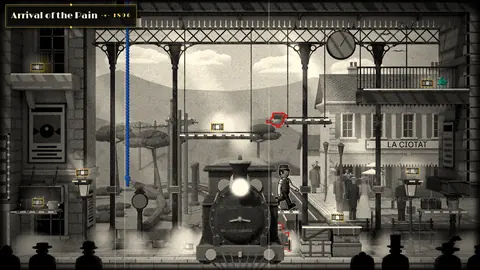 1896
Arrival of a Train at La Ciotat
Our room: Arrival of the Pain
-
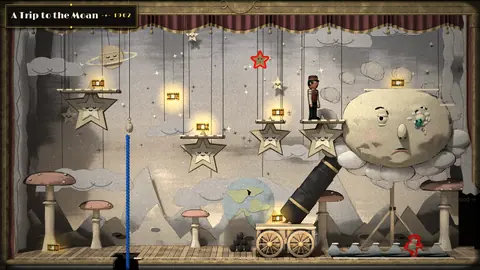 1902
A Trip to the Moon
Our room: A Trip to the Moan
-
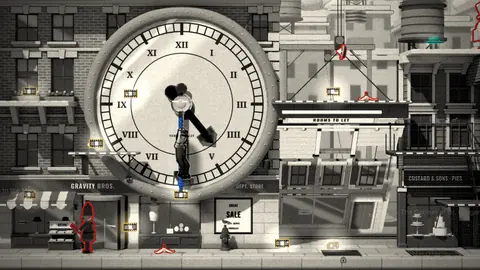 1923
Safety Last!
Our room: Safety Second
Free, in a desktop browser or as a download for Windows, Mac and Linux.
Quick answers
What is Cabiria (1914) about?
It is set during the Second Punic War. A Sicilian girl, Cabiria, is carried off, taken to Carthage and marked for sacrifice to the god Moloch, while a Roman officer and his strongman servant Maciste try to save her. Hannibal's crossing of the Alps and Archimedes' burning of the Roman fleet at Syracuse form part of the background.
Did Gabriele D'Annunzio write Cabiria?
Not in the way the credit suggests. He is billed on the screenplay and is the author of the intertitles and character names, but accounts of his share in the script itself say it was very small, if it existed at all. His name was worth a great deal as publicity.
Who was Maciste?
A muscular slave who helps rescue Cabiria. Bartolomeo Pagano, said to have worked as a dockworker in Genoa, played him, and the character returned in a long run of later films. D'Annunzio is said to have renamed the hero Maciste from Pastrone's first choice, Ercole (Hercules).
Did Cabiria invent the tracking shot?
No, careful accounts say the tracking shot was nothing new. Pastrone used a camera dolly he had patented to glide through his huge sets, and the film made the move famous, so such shots were later called Cabiria movements.
How long is Cabiria?
It depends on the version. The first cut is given as 200 to 210 minutes, the 2006 restoration runs about 190, and surviving cut copies run about 148 or 126 minutes.
What is the Sinfonia del fuoco?
A ten-minute orchestral piece by Ildebrando Pizzetti, written in connection with the film. It is usually tied to the sacrifice scene in the temple of Moloch, but one scholar argues Pizzetti did not write it for that scene, and that the 1914 accompaniment was a compiled score by Manlio Mazza.
Did Cabiria influence D. W. Griffith?
Many writers say so, pointing to the Babylon sets of Intolerance (1916). Others note that Griffith's cutting between scenes went well beyond anything in Pastrone's film.
Is Cabiria in the public domain?
In the United States, yes: a 1914 film. In Italy and the rest of the EU the term runs from the deaths of the film's authors, and sources do not settle which of them count. Modern restorations and recorded scores can have rights of their own.
Sources and further reading
- Cabiria, Wikipedia: credits, dates, versions, music, the White House screening and the points given here as reported
- Cabiria, Encyclopedia.com, International Dictionary of Films and Filmmakers: production, D'Annunzio's part, locations
- Cabiria, Turner Classic Movies: the score at the premiere, the budget, the dolly
- Giovanni Pastrone, Wikipedia: his life, the pseudonym, the patented platform, the 1931 arrangement
- Segundo de Chomón, Wikipedia: his work on the film
- Maciste, Wikipedia: the character's origin and name
- Bartolomeo Pagano, Wikipedia: his life and casting
- Dalla 'compilazione d'autore' al 'poema lirico-sinfonico', Emilio Sala, Archivio D'Annunzio, 2017 (abstract), on Pizzetti's Sinfonia del fuoco and Mazza's compiled score
- Ildebrando Pizzetti, Wikipedia: his dates and the Sinfonia del fuoco